Sunday, November 21, 2010

Update from the Boatyard

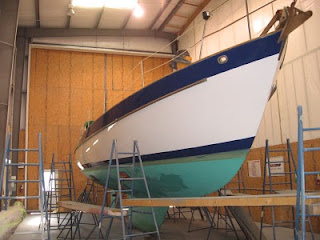
The deck of Whispering Jesse, my 1980 Valiant 40, masked and ready to be paintedDon from the Spring Cove Marina boatyard called me on Thursday to ask what color I wanted for the anti-skid deck paint for Whispering Jesse. I asked what the options were and he explained that sailors used to go with a contrasting color like beige to avoid excessive glare but that the current trend is to go with the same color as the deck. The deck is being painted in Awlgrip's "snow white," so I agreed to go with that same color. It will be awfully bright but hopefully also cooler than beige, which is already going to be the color of the new dodger and bimini--I don't want to overdo it.

After the deck is painted, Don said they would be covering the boat and moving it out of the paint shed for a few weeks while they work on a different boat. The next logical step in the refit process is to replace the engine, and that would involve moving the boat back indoors. It will be January, after all. I would like to be there in person when the engine is removed to get an idea of what is involved and to see the transmission and stuffing box. Don said he would be away the first week of the new year, so I told him I would look at heading out there the following week for a few days.

Steve from Creative Canvas Designs was on-site later that same day to take measurements for the new dodger and bimini, and was nice enough to send me the photo above, showing the deck masked and ready for painting. I noticed that the manual windlass and the cable TV/phone hookup box that is located directly to starboard of the cockpit bulkhead's port were still in place. The windlass will be replaced by an electric one and the hookup box is obsolete, so I had asked Don to remove them before the deck is painted. I emailed him a reminder. Another thing I noticed is that the new chainplates are in place now, so that completes the rerigging work, except for restepping the mast, of course, which will take place next spring.

Monday, November 8, 2010

Circumnavigation Routes, Part 7

During our sailing trip this past spring from Bocas del Toro, Panama to Isla Mujeres, Mexico, the subject of circumnavigating came up, as it always does when Nan and I sail with John Kretschmer. Being in the Caribbean at that moment, we spent most of our time talking about the best ways to sail that particular sea.

Several books are devoted to advice about sailing the "Thorny Path" from the east coast of the United States to the Virgin Islands by way of the Bahamas, which is, as the name implies, a relentless bashing to windward. Most recommend avoiding it by staying to the north and sailing as far to the east as possible using the variable winds of those latitudes before turning south into the easterly trade winds and aiming directly for the Virgin Islands. For those with the patience to pick and choose their wind opportunities, there are books that prescribe the path itself, like Bruce Van Sant's Gentleman's Guide to Passages South: The Thornless Path to Windward, which was recommended to me by my friend Paul Caouette but which Amazon tells me is out of print.

John Kretschmer is a proponent for sailing the Caribbean islands from south to north, or more accurately, from southeast to northwest, using the trade winds to natural advantage instead of fighting them. He has crossed the Atlantic several times, and this south-to-north route is part of his normal return trip, but what about those wanting to sail directly from the United States? John says the best way is to circumnavigate the Caribbean in a counter-clockwise direction. When he first mentioned this idea, during our sailing trip last year in the Spanish Virgin Islands, I imagined that he meant sailing from Florida to Mexico, following the Central American coast to the south and then the north coast of South America to the east, arriving in Trinidad and then island-hopping back to Florida.

During this year's discussions, I discovered how wrong I was. John said that sailing east along the north coast of South America is even more of a thrashing than the Thorny Path. Instead, he recommended sailing east from Mexico's Yucatan peninsula to Cuba's southern coast to stay in the lee of the trade winds and then using the evening land breezes to make progress to the east past Hispaniola and Puerto Rico. One would still need to island-hop to windward from the Virgin Islands down to Trinidad, but then one would be in position to reverse course and enjoy the downwind sail back through the islands, hitting any points of interest missed on the way down. Hang a right at Puerto Rico, and negotiate the Turks and Caicos and the Bahamas to arrive back at the original starting point.

This is the route I hope to take beginning next spring, when Whispering Jesse is set to sail. Depending on what we find along the way, it may take a year or more to return home. Then what? As John has suggested, why not get Europe out of the way sooner rather than later?

Sunday, October 31, 2010

The Bogeymen

     When John and his brother Stuart were very young, their father and mother gave them classic stories on vinyl records to encourage the development of their imaginations. The brothers played the stories over and over again on an old record player. Their favorites were The Knights of the Round Table and Robinson Crusoe, which they loved for their heroic characters, even though the Robinson Crusoe record skipped in the same place every time they played it: "… and knocked down one of his pursuers."
     Imaginations are impressionable, and the brothers listened to two of the stories only rarely, when they could work up the nerve: The Telltale Heart by Edgar Allan Poe and The Legend of Sleepy Hollow by Washington Irving. The Poe story was so frightening, with its rhythmic narration matching the imagined beat of the heart beneath the floorboards, that they could listen to it only during daylight hours or it would cause terrible dreams. By comparison, the Irving story was all-consuming. The image of a headless horseman charging his red-eyed stallion down upon the helpless Ichabod Crane and hurling his flaming jack-o-lantern caused frequent nightmares. John would awaken in a cold sweat, imagining himself knocked off his horse by the vengeful horseman. As he lay awake, waiting for his own telltale heart to stop beating in his chest, he would listen to the silence. On summer nights, when the windows were open, he imagined he could hear the headless horseman breathing outside the ground-floor window of the bedroom he shared with his brother. On particularly bad nights, he imagined he could hear the headless horseman scratching at the window screen.
     One rainy Saturday afternoon, when John and Stuart were racing their slot cars around the track in their bedroom, their friends from up the street, Gary and Dean, who were also brothers, knocked at the door. John and Stuart’s father answered the door and invited the brothers in out of the rain. Dean was holding a small white jewelry box in his hand. He announced that he had found the mummy’s finger and lifted off the lid. Inside was a ghostly pale finger surrounded by cotton batting. As everyone leaned in to get a closer look, the finger wiggled, eliciting shrieks of fright from everyone but the jokers, Dean and Gary, who laughed uncontrollably. Dean had powdered his finger and put it through a hole in the bottom of the box. He said that he and Gary played jokes all the time, like wandering the sleeping neighborhood and making noises outside windows. John’s gut tightened. He suddenly had an explanation for the sounds he heard at night.
     The next time John had the headless horseman nightmare and awoke in the middle of the night, he listened more intently than ever. He was so sure he could hear the breathing and scratching that he said as quietly as he could, “Dean?” The imagined sounds ceased immediately, replaced by the noise of crickets and the hum of distant cars on the highway. Then there was a new sound, a whispering. John strained to hear, not believing his ears. The silence that followed made him doubt he had heard the whispering at all. But then there was an answering whisper. Now there was no doubt. “Gary?” John pleaded in a soft, hoarse voice. There was no response. Blood pounded in John’s ears. He lay on his back, frozen in fear, until he lost consciousness.
     A few weeks later, John and Stuart’s family drove the brothers a couple of hours away, to their grandmother’s house, to spend a week with her, just the three of them. Grandma’s house had only two bedrooms, so John and Stuart shared a double bed in the front bedroom. It was hot enough that the ground-floor bedroom window was wide open every night. John slept peacefully, with the confidence that the headless horseman could not possibly have followed him to Grandma’s house.
     On the last night of their stay, Grandma made some popcorn, and they stayed up late to watch an old movie. It was after ten o’clock when the movie ended and they went to bed, more than an hour past John and Stuart’s regular bedtime. Stuart fell immediately into a deep sleep, but John lay awake, playing the movie over in his mind. As he lost control of his thoughts and drifted into sleep, the movie scenes melded into his recurrent nightmare of the headless horseman. At the moment when he expected to be struck by the flaming jack-o-lantern, he snapped awake. Nightglow flooded the room through the open window. There should have been cricket noise, but the room was quiet. He could hear Stuart’s soft breathing next to him, and beyond that, from the window, a second set of quiet breaths. His explanation that Dean and Gary were outside the window was suddenly so implausible that it was like a trapdoor dropping out from under him. He held his own breath and strained his ears, expecting to hear scratching at the screen. Instead, he heard a muffled tearing sound, like someone slowly cutting the screen, thin wire by thin wire, with a sharp pocketknife. He wanted to scream, but he couldn’t release his breath. He wanted to flee, but he couldn’t move. He lay trembling, tears squeezing out of the corners of his tightly closed eyes.
     The cutting noise stopped. John expected to hear the sound of someone crawling through the window, but there was only silence. Then he heard the sound of breathing, and it was coming from right next to the bed. He could almost feel the breath on his face. There was a strange smell. As he tried to make sense of it, the rhythm of the breathing changed, and he realized that there was a second breather. The one closer to his face started whispering. It was the same voice from home! They couldn’t have followed him to Grandma’s house. They must have found him somehow. The other one responded, and John realized that he could not understand a word but that they understood each other clearly. He recoiled as he felt hands lightly touch his chest and legs. His body lifted slowly off the bed, floated through the slit in the screen, and drifted up into the night sky.

Sunday, October 24, 2010

Another Trip to the Boatyard

Me, Pete and Curt in our matching Packer caps at the Packers-Redskins gameTwo weeks ago, I made another trip out east to check on the progress being made on Little Walk's refit at Spring Cove Marina in Solomons, Maryland. It was also an opportunity to attend the Annapolis Boat Show and to spend some more time with my friend Curt and his family in Falls Church. I arrived at Curt's on Friday evening and tried to muster some interest in the boat show, but there were no takers.

I went to the boat show by myself but met up with my friend Kevin Harrison, who helped me sail Little Walk from Baltimore to Solomons, and his girlfriend Beth. The three of us walked around together on some impressive new sailboats late in the afternoon. Before that, I attended a seminar on marine electrical systems and gathered information on some of the items I need to buy for the boat, like an inflatable dinghy and outboard. I also met with Scott from Handcraft Mattress Company to firm up an order for a new mattress for the aft berth, and talked with Collin from Chesapeake Rigging about his progress on rerigging the boat.
Whispering Jesse showing off her new Awlgrip hull paintOn the way back to Curt's, I called and found out that the family was at his son Pete's flag football game, so I joined them there. I learned that the rules have changed dramatically since we played it in gym class growing up, when the only difference between flag football and regular football was that you grabbed a flag instead of tackling. On Sunday, Curt, Pete and I attended the real deal, the Green Bay Packers versus the Washington Redskins game at Fedex Field. Like true Packer fans, we tailgated before the game, grilling brats, drinking beer and tossing the football around. Our seats in the end zone were better than expected, and we cheered as the Packers ran up an early lead, only to watch it evaporate in the second half, when a last-minute field goal attempt that would have won the game instead "doinked" off the upright right next to where we were sitting. The Packers lost to the Redskins in overtime.

The current state of Whispering Jesse's deckI drove down to Spring Cove Marina the next morning. Alan, one of the boatyard's managers, saw me in the parking lot and directed me to the paint shed, where Little Walk was waiting. Her new hull paint was dazzling, snow white with royal blue stripes. It made the rest of the boat look old and tired by comparison. I climbed up the ladder and noticed that the deck's traveler structure had been removed for the installation of new Harken traveler equipment by Chesapeake Rigging. I went below and saw that all the chainplates had been removed and that the water-damaged chainplate knee on the port side had been repaired. I went back down the ladder and saw that the boom had been painted but was covered with masking paper and resting on supports next to the boat. The mast was out back, having just been painted. It looked good, the same snow white as the hull, but the new sleeving that will reinforce its base had not been installed yet. I took a look at the masthead, which was missing its windvane and anemometer, and tried to figure out how to place a Windex as an analog backup to the electronic wind instruments.

Whispering Jesse's newly repaired chainplate kneeJohn Kretschmer, our frequent sailing companion, was conducting a celestial navigation seminar in the marina's lounge, so I walked over there to say hello. Jan, from our Bocas del Toro to Isla Mujeres trip this past spring, was there as well. We agreed to meet later, after the seminar was over, to look at Little Walk together. I left to go check in to the same hotel I stayed at the last time and try to catch up on some real-world work. When I returned late in the afternoon, Jan was gone but I found John talking with one of his seminar students, John Simonton, who is originally from Denver but is now living aboard his 37-foot sailboat in the marina. The three of us walked over to the boatyard for another look at Little Walk.

Whispering Jesse's mastheadAt this point in the refit process, the Little Walk name has been removed from the hull, so I feel it is appropriate to start referring to the boat by its new name, Whispering Jesse, even though it will be a few more months before the new name is affixed to the hull.

After the boat walkaround, John K. left to meet his sister Liz and brother-in-law Trevor, who are partners in Spring Cove Marina. John S. and I walked out to look at his boat and stood chatting on the dock next to it, agreeing to meet for dinner the following evening.

The next morning, I met with Don, the boatyard manager, to discuss the work on Whispering Jesse, what had been done and how to proceed. I mentioned that I had talked with the Beta Marine people at the boat show about a new engine and he proposed the idea of a remanufactured Perkins instead. It would greatly simplify the repowering process since it would be a like-for-like swap, and it would be less expensive since it would negate the need for new stringers and engine mounts. John Kretschmer and John Simonton examine Whispering Jesse's freshly painted mastHe called the dealer and they quoted him a price over the phone, which he added to his list of work items. We walked over to the paint shed together to look at the work in progress and figure out the best plan for future work. With the boat out of the weather in the paint shed, it would make sense to address the deck work, which will involve sanding down and applying Cetol to all the teak, and repairing, refinishing and repainting the deck fiberglass. This would also be the time to remove any attached equipment that will be replaced, like the manual windlass, dodger and bimini, or eliminated, like the wooden dinghy chocks and cable TV/phone hookup. I asked about bottom repair and painting, and Don recommended that we save that until just before the boat goes back into the water next spring.

Sunbrella fabric samples in heather beige, beige and toast, and clear plastic dodger windshield materialAs we were leaving the paint shed, I mentioned to Don that I wanted to meet with his recommended canvas people. He pulled out his phone to set up a meeting with Steve from Creative Canvas Designs. Steve and I met at the boat at nine o'clock the next morning and spent about an hour talking about a new dodger and bimini, a new sail cover, new hatch covers, and new interior cushions. We agreed to meet again the next day at his shop in Solomons to look at fabrics and foam. At that meeting, on a rainy Thursday morning, Steve showed me some Sunbrella samples in various shades of beige, which Don recommended for the exterior canvas because it reflects heat better and does not fade as quickly as darker colors. For the interior canvas, we're going to go with a bright royal blue to brighten the look of the dark wood paneling.

On my final day there, I met one last time with Don. He thought they would have the engine pulled within a week or two. They then would be able to paint the engine room, in anticipation of installing a new engine at the beginning of the new year. They would also continue work on the exterior wood and fiberglass. If it's at all possible, I would like to try to get out to see Whispering Jesse one more time before Christmas to check on progress. I'll keep you posted.


Wednesday, October 13, 2010

The importance of being handy

A few days ago, I received this complimentary blog comment from reader Steven:

Hi John. I started following your blog a few months ago and I am finally caught up :-) You've done such a great job here and I know I am not alone in being inspired and educated by what you have written. I am going to be scheduling sailing lessons for next Spring, it will give me time to raise the money. Anyway, I wanted to ask you a question and hoped you could help: Do you have to be handy to own a sailboat? I am useless with tools and I noticed you are having your boat repaired by the yard. Many of the sites I have read the owners always seem to be doing all repairs themselves. I know I am not capable of doing that without being bitten by some sort of radioactive spider. Are you a handy person by nature and plan on doing a lot yourself, John, or are you more like me? Thanks for your time and keep up the great work on the blog.

Here is my response, which I am posting as a blog entry so it doesn't get lost in a comments section:

Steven, the work I am having done on the boat involves skills and materials that I have no experience with, like machining metal parts and repairing fiberglass gelcoats. I am more of a home repair guy, able to do basic carpentry, plumbing, electricity and painting. I can also fix stuff that breaks, so in some regards, I would be considered fairly handy.

In answer to your question, I don't think it's absolutely critical to be handy to be a successful sailor and sailboat owner but it definitely helps. If you limit your sailing to coastal areas with well-equipped boatyards at every point of contact, then you may never need to worry about fixing anything on your boat by yourself. But if you sail far away from familiar shores, which can be a little scary all by itself, then having the confidence that you can fix most of the things on your boat that might break will help tremendously to reduce fear and stress.

Unfortunately, confidence can only be gained through experience, which means that you need to expect that things will go wrong. The trick is to control the things that can be controlled and to not worry obsessively about the rest. The best place to start is with preventive maintenance. Almost every piece of equipment on a boat comes with a maintenance manual. It is critical to read those manuals and follow their recommendations. Many times, this will involve buying suggested tools and spare parts. It will also involve a schedule, which means you are maintaining your equipment at routine intervals. If you can do this, you are eliminating most of what can go wrong through simple neglect and inattention, and you are building your confidence in your ability to use tools and fix things. You are becoming handy.

One more point: More than anything, being handy is an attitude more than it is an ability. It is a willingness to take on a problem instead of running away from it. When something breaks, if it's not an immediate emergency, then get the swearing out of the way, take a few deep breaths and start looking at what went wrong and why it might have happened. It doesn't pay to fix something if you don't first fix whatever it was that caused it to break. Take the time to figure out a lasting solution, using trial and error as needed. As you try different options, you will learn more about the particulars of the problem and be better able to apply your innate creativity. After several successful experiences with fixing things, you will know in your gut that you could jury rig just about anything it would take to keep your boat moving toward its destination.

An excellent book that touches on some of the points I have made here is Zen and the Art of Motorcycle Maintenance by Robert Pirsig. I have read it twice and expect that I will read it again someday.

Thank you for your readership and kind comments. Best of luck to you in your sailing future!

Saturday, October 2, 2010

Vote for my aha moment!

Hey, everybody! Want to see my smiling face on TV? Vote for my Mutual of Omaha "aha moment" and it might be in a future commercial!

http://www.ahamoment.com/pg/voting?id=17692

Thursday, September 30, 2010

Home from Isla Mujeres, Mexico

Juan, Paulina, Daniel, Paul, Chris and Manolo snorkeling at the wreck near El Ferito on Isla MujeresNan and I arrived home on Monday night from our vacation in Isla Mujeres, Mexico. We cut our two-week trip short by five days due to work concerns and lousy weather. The remnants of hurricane Karl were still causing rain when we arrived, transitioning seamlessly into hurricane Matthew's near miss, with its own downpours and high winds. When it wasn't raining, the heat, humidity and sand gnats drove me mostly indoors to sit in our air-conditioned Color de Verano penthouse apartment reading Jonathan Franzen's new novel, Freedom, a topical, enjoyable page turner. Nan toughed it out without me, getting as much "beach time" as possible.

Dark cloud and rain passing over the observation platform near El Ferito on Isla MujeresEvery time we go to Isla Mujeres, and we have been there eight times now, we spend time with the same friends, see the same sights and eat at the same restaurants, but we always make an effort to explore new areas and try new restaurants. This time, we even went on a "parade of homes" tour with a real estate broker named Rogelio and our Spanish instructor, Juan Torres. There are still oceanfront and lagoonfront lots for sale on the island, but they are ridiculously expensive for foreigners and would require an inordinate amount of work to build on, not to mention extensive communication in Spanish.

Rosi and Ariel on the boat as we pass 'the white house' at Sac Bajo on Isla MujeresWe tried three new restaurants: Chuuk Kay, a new Mayan-themed place located on the Laguna Macax channel and managed by our friend Ventura, whom we know from his days at Na Balam's Zazil-Ha bar and restaurant and from Brisas Grill; Rooster, a new, upscale place at the north end of Avenida Hidalgo that features wonderful creations by chef Sergio but unfortunately does not take credit cards; and Mango Cafe, an excellent breakfast and lunch place that is usually closed by the time we drive our rented golf cart past its location on the Caribbean side's main drag, but which we were lucky to find open one afternoon for jerked chicken tacos, grilled chicken empanadas and ginger lemonade.

Cervezas and pina coladas at Playa Tiburon on Isla Mujeres, with Manolo, Paula, Juan and Nan, while we wait for tic-n-xic barbecued grouperThe Sunday before we returned home on Monday was our best day, even though it had its share of rain. But we were out on our friend Ariel's panga for some snorkeling, so we expected to get wet. We had run into Ariel on our first night, working as a waiter at a new restaurant on Hidalgo, and agreed to do a boat trip with him. I asked if we could invite our good friend Juan Gomez's family to join us, and Ariel agreed enthusiastically. September ("septi-hambre") is always a very slow month for business, and Ariel told us he had not had a paying boat trip in more than a month. If you're down that way, please call (011-521-998-165-6332 from the US) or email (arielsantizo@yahoo.com.mx) him for a boat trip of your own.

Paula and Paulina at Playa Tiburon on Isla MujeresAriel, his wife Rosi and her son Chris met Nan and me with the panga on the beach across from our apartment. When Juan showed up with his wife Paula, kids Manolo and Paulina, and nephews Paul and Daniel, we all piled into the boat and headed over toward El Ferito, the little lighthouse that marks the entrance to Isla Mujeres's large bay. There is a partially submerged wreck there, a casualty of hurricane Wilma back in 2005, that is a natural haven for sealife. Juan and the kids put on lifevests and snorkel equipment before jumping overboard to see what they could see. A dark passing cloud soaked everybody left on board. Already wet, I jumped in too, but all I saw in the churned up water was a school of needle fish.

Group shot on the boat ride home from Playa Tiburon, with Manolo, Juan, Paula, Paul, Paulina, Nan, Daniel and meWhen everybody was back on board, we headed east for a slow circle around Laguna Macax, admiring the many yachts that are moored in its protective waters. Juan and his family could just see the top of their house in the Lol-Beh colonia over the mangrove treetops. The kids were intrigued by the inhabited "plastic bottle island" that floats on the opposite side of the lagoon. We departed through the channel and passed by Sac Bajo, where "the white house," another casualty of hurricane Wilma, sits abandoned except for its caretaker unit. From there, it was a short trip down the western coast to Playa Tiburon, where Ariel had arranged for "tic-n-xic" barbecued grouper, with rice, pasta, salad and tortillas supplied by Rosi and Chris. Delicious!

We plan to return to Isla Mujeres next June, when we will sail the new boat there from the United States. More on that later...

Monday, September 13, 2010

Dog Days 2010

Scout resting poolside at the 2010 Dog Days event in Grand JunctionI was walking back from dumping lawn clippings into the dumpster yesterday when my neighbors Rich, Diane and Mim pulled up in Rich's truck with Kola, Rich and Diane's schnauzer. They said they were on their way to Dog Days at the city swimming pool and that Scout and I should join them. If I paid more attention to our local news, I would have known about the event, which I have attended several times in the past with both Charlie and Scout.

Kola trying to get the ball from Scout at the 2010 Dog Days event in Grand JunctionI finished up the yardwork, put Scout in the car and drove over to Lincoln Park. Even though the event had been going on for two hours by that time, there were still plenty of wet dogs and damp owners in attendance. It took me a few minutes to locate my neighbors at the kiddie pool, encouraging Kola to swim after the tennis balls floating on the surface. I pointed at a ball for Scout to go after, but he just stood at the edge looking at it, so I gave him a nudge. After that, he belly-flopped off the edge after balls until he wore himself out. When they weren't swimming, Scout and Kola played keep-away with the other dogs, even though there were more than enough balls to go around.

Scout and Kola eating ice cream cones at the Dairy Queen after the 2010 Dog Days event in Grand JunctionAfter an hour, the dogs had had enough. Rich suggested that we go to Dairy Queen to get Blizzards for the adults and kiddie ice cream cones for the dogs. Scout had never had more than a taste of ice cream, so I thought, why not. Scout finished his cone in about two minutes, so quickly that I wondered if dogs get "ice cream headaches" the way people do. Apparently not, because when he was done, he wanted some of Kola's, too.

Wednesday, September 8, 2010

What's wrong with Colorado Springs?

Last week, I listened to a segment of "Colorado Matters" on Colorado Public Radio that featured the budget director from Colorado Springs. She said that tax revenues were so low that the city couldn't afford to maintain its parks or turn on its streetlights at night. This wasn't due to the current sad state of the economy; it was due to tax cuts approved by voters.

To keep things from going completely to hell, volunteers have been stepping in to cut the grass in the parks, and some neighborhoods have paid to have their streetlights turned back on. According to the budget director, this was a point of pride for many citizens, that they were actively engaged in keeping their community running.

My immediate reaction was, "Are you freakin' kidding me?! This is not a community! This is every man for himself!" The whole idea behind taxes is that we're all paying our fair share to support the services that benefit all of us, that make us a community instead of a bunch of selfish, small-minded individuals.

Extrapolating to the nation as a whole, this is what makes me so angry about the Tea Party, where Tea stands for "taxed enough already." I happen to think that income taxes are a reasonable price to pay for living in a free society, even though I take very little advantage of the services those taxes support. To think otherwise is to believe that you and your kind deserve some kind of special deal, maybe because you think you're working harder than the slackers who are milking the system. The truth is that, with few exceptions, people are doing the best they can. The sooner you understand this, the sooner you will realize that we are all in this life together. There are no winners, no losers. We all die in the end. Wouldn't you rather reach the end of your life knowing that you contributed what was needed to help your fellow man and support your community?

Saturday, September 4, 2010

Minifish

Not my AMF Alcort Minifish sailboat, just one I found on the Internet that looks exactly like mineI have owned an AMF Alcort Minifish sailboat since one was given to me as a present from my family for my eleventh birthday in 1969. My father and I taught ourselves to sail the little boat and enjoyed cruising it around the Chain of Lakes in Waupaca, Wisconsin over the next several summer vacations. When I was old enough to drive, I would take the boat out to the lakes west of Milwaukee, where I grew up, and sail it with friends. I even took it with me to college in Madison, sailing on Lake Mendota after classes. When I moved to Aspen, Colorado in 1986, there wasn't room in the U-Haul trailer for the boat, so I drove it out the following year. Nan and I would sail it every summer on Ruedi Reservoir, about an hour from home. Now we live in Grand Junction, and there really aren't any good places nearby to sail. There's Highline Lake to the north and Ridgway Reservoir to the south, but they're both so overrun with powerboats most of the time that we haven't even bothered. So the boat has been sitting unused in the garage for more than five years.

When I was back in Milwaukee visiting family in July, my sister Jane mentioned the boat. She and her family live in Seattle near Green Lake, and they also have a vacation home on Whidbey Island in Puget Sound. Her sons, Max and Ben, are developing an interest in sailing from lessons they have been taking on Green Lake, and she was wondering what I was doing with the old Minifish. I explained that we weren't really sailing it anymore and asked if she would like to have it for the boys to sail. She said yes, and we emailed back and forth about it again this past week, so next spring the Minifish is going to get shipped up to Seattle. I need to do a little work on it first: the plastic rings that attach the sail to the mast and boom are missing or cracked and need to be replaced; one of the mast's endcaps got dinged when the mast and boom fell off the trailer the last time we used the boat; and the current nylon halyard needs to be replaced with a better, non-stretching one. None of these repairs is too major, but I want to hand off the boat in good condition. Ideally, I would like to fly up there and introduce Max and Ben to the boat after it arrives to give them the benefit of my forty-one years of personal experience in rigging, launching and sailing it. I'll let you know how it goes.