Showing posts with label circumnavigation. Show all posts

Sunday, March 3, 2019

Rubbernecking the world in decline

Following the news these days, especially after a truly tragic week, is like witnessing a fatal car accident. You are horrified to see it happening but you are helpless to look away.

Watching Meet the Press this morning, I felt a fluttering in my chest that was more than too much coffee. It was an adrenal fight-or-flight response. Should I stop reading the newspapers and watching the news in order to preserve my mental health? Or should I get more involved in political activism and defending the common good?

When I started this blog in 2005, my dream was to sail around the world. Now that seems hopelessly naïve. There are too many countries along the way that would be seriously dangerous to visit. Much of the world is in turmoil, and it will only get worse as the population continues to grow and the effects of climate change become more prevalent.

What to do? Scale back the dream, first of all. Try to lessen my personal impact and contribute to causes that promote positive change. But understand that my efforts are, to use an expression I just heard, like a fart on a garbage ship—not that significant. As I recently read, individual efforts will not slow climate change. Only legislative action, in the form of stringent emission restrictions and alternative energy promotion, will accomplish anything. And that action will need to be worldwide.

Fat chance. The countries of the world are embroiled in their people’s everyday struggles—trying to secure a decent life for their families, or are enriching the few over the needs of the many. The big picture, what is happening to the world and what the future will bring, is a distant concern.

I am helpless to look away.

Monday, November 8, 2010

Circumnavigation Routes, Part 7

During our sailing trip this past spring from Bocas del Toro, Panama to Isla Mujeres, Mexico, the subject of circumnavigating came up, as it always does when Nan and I sail with John Kretschmer. Being in the Caribbean at that moment, we spent most of our time talking about the best ways to sail that particular sea.

Several books are devoted to advice about sailing the "Thorny Path" from the east coast of the United States to the Virgin Islands by way of the Bahamas, which is, as the name implies, a relentless bashing to windward. Most recommend avoiding it by staying to the north and sailing as far to the east as possible using the variable winds of those latitudes before turning south into the easterly trade winds and aiming directly for the Virgin Islands. For those with the patience to pick and choose their wind opportunities, there are books that prescribe the path itself, like Bruce Van Sant's Gentleman's Guide to Passages South: The Thornless Path to Windward, which was recommended to me by my friend Paul Caouette but which Amazon tells me is out of print.

John Kretschmer is a proponent for sailing the Caribbean islands from south to north, or more accurately, from southeast to northwest, using the trade winds to natural advantage instead of fighting them. He has crossed the Atlantic several times, and this south-to-north route is part of his normal return trip, but what about those wanting to sail directly from the United States? John says the best way is to circumnavigate the Caribbean in a counter-clockwise direction. When he first mentioned this idea, during our sailing trip last year in the Spanish Virgin Islands, I imagined that he meant sailing from Florida to Mexico, following the Central American coast to the south and then the north coast of South America to the east, arriving in Trinidad and then island-hopping back to Florida.

During this year's discussions, I discovered how wrong I was. John said that sailing east along the north coast of South America is even more of a thrashing than the Thorny Path. Instead, he recommended sailing east from Mexico's Yucatan peninsula to Cuba's southern coast to stay in the lee of the trade winds and then using the evening land breezes to make progress to the east past Hispaniola and Puerto Rico. One would still need to island-hop to windward from the Virgin Islands down to Trinidad, but then one would be in position to reverse course and enjoy the downwind sail back through the islands, hitting any points of interest missed on the way down. Hang a right at Puerto Rico, and negotiate the Turks and Caicos and the Bahamas to arrive back at the original starting point.

This is the route I hope to take beginning next spring, when Whispering Jesse is set to sail. Depending on what we find along the way, it may take a year or more to return home. Then what? As John has suggested, why not get Europe out of the way sooner rather than later?

Friday, August 27, 2010

My "aha moment" is live now

I just received an email message letting me know that my Mutual of Omaha "aha moment" is live now at http://www.ahamoment.com/pg/moments/view/17011.

The final film clip actually turned out better than expected. They managed to distill about ten minutes of my interview down to a single minute and still have it retain the points I was trying to make about how my dream of sailing around the world got started and what I am doing to fulfill it.

Nan liked their photo of me smiling so much that I have made it my blog's new profile image.

If you have a chance to watch the film clip, please leave a comment to let me know what you think. Thank you.

Monday, August 9, 2010

My aha moment

Clapboard for 'my aha moment' with Mutual of OmahaLate this afternoon, I drove over to the Mesa Mall parking lot, where Mutual of Omaha's Airstream mobile studio was parked. I had received an email invitation last week, as a result of a marketing person's discovery of my blog, inviting me to be filmed for their "aha moment" campaign. You have probably seen the commercials on TV featuring ordinary people talking about the moments that changed their lives. They couldn't guarantee that my spot would make it into a TV commercial, but it would definitely be posted to their website.

The invitation was specific that my aha moment should be about sailing and that I should plan to bring a prop to the filming. I didn't need to think too hard to come up with an idea: My aha moment happened in 1968, when I was ten years old. I read a National Geographic article about Robin Lee Graham, the first teen-ager to sail alone around the world. I knew right away that I wanted to do the same thing someday.

'My aha moment' prop: October 1968 National Geographic magazine with the article about Robin Lee Graham's solo circumnavigationThe studio people, Jessica and Dave, interviewed me for about ten minutes, starting with my dream and expanding on it to discuss my plans for actually sailing around the world. It was a nervous blur, but when it was over, Jessica said that it went really well, that my face was lit up with excitement. She told me that my aha moment would appear on the Mutual of Omaha website at http://www.mutualofomaha.com/aha within three weeks, and she handed me my clapboard as a souvenir. When it goes live, I'll be sure to post a direct link to it here.

Tuesday, July 28, 2009

Circumnavigation Routes, Part 6

While Nan and I were sailing with John Kretschmer in the Spanish Virgin Islands this past April, the subject of circumnavigation routes came up frequently. John and his wife, Tadji, are planning a circumnavigation that would begin after their kids are out of high school, seven or eight years from now. Nan and I are hoping to set sail much sooner, but there are still some major hurdles for us to overcome, like buying an appropriate boat. In the meantime, it's fun and educational to share ideas about where to go and what to see.

John and I agreed that a west-about route would be easiest, but then he threw out the idea of crossing the Atlantic to Europe early in the trip rather than waiting until after a transit of the Suez Canal. Since many of the places we hope to visit are in Europe, this made perfect sense.

What about the Caribbean, though? John had an idea for that as well: circumnavigate the Caribbean first in a counter-clockwise direction to take advantage of the easterly Trade Winds, which is much easier than trying to catch occasional northeasterly winds to go the other way around. The Caribbean loop could also serve as a shakedown cruise before the big leap across the Atlantic.

What about the return leg from Europe? John knew that I wanted to see the islands off the west coast of Chile--Robinson Crusoe Island, Easter Island, and Pitcairn Island--so he suggested skipping the Panama Canal in favor of sailing south along the east coast of South America, through the Straits of Magellan and then up the west coast to Valparaiso. At this point, the route would closely follow the one I laid out several years ago (Circumnavigation Route 2001) until we reached the Seychelles. With all the piracy off the coast of Somalia, it would be safer to go south instead of north at this point, round the Cape of Good Hope and then sail on to South America by way of St. Helena. A second tour of the Windward and Leeward Islands, the Bahamas and the Florida coast would put us back at our starting point in Savannah, Georgia.

The only dream places missing from this route are Cuba and the Galapagos Islands. The future possibility of legal travel to Cuba by sailboat from the United States is still uncertain. And who knows, if the "boat quest" boat is finally found on the west coast, then it might be possible to take a detour to the Galapagos Islands before transitting the Panama Canal and sailing north to Savannah.

I figured the 2001 route to be a little over 50,000 miles. This more ambitious 2009 route would be almost 65,000 miles. If you would like to see a Google Maps version of it, click here: Circumnavigation Route 2009.

Sunday, January 4, 2009

Circumnavigation Routes, Part 5

Google Maps is one of the most useful tools I have found on the Internet. I have been using it for about three years for everything from figuring out the shortest driving routes for road trips to looking at satellite views of the pyramids of Egypt. But most of the time, I just use it to fantasize about the places where I would like to go. Even if I never visit them all, at least I've improved my understanding of geography.

Until today I never bothered to check out the My Maps feature. It allows users to create their own custom maps with points of interest, routes, photos, videos and other content, and then to share their maps with others. Of course, as a sailing dreamer, the first thing I did was to lay out a circumnavigation route--not the one I have been dreaming about lately, which will appear in future "Circumnavigation Routes" posts, but the one I came up with in 2001. Here is a link to it: Circumnavigation Route 2001.

Back when I was working for the Aspen School District, I had a giant National Geographic map of the world on the wall in my office and I would spend odd moments staring at it and figuring out where I would sail if I ever had the chance. Since it was pure fantasy, I wanted to sail absolutely everywhere, with the idea that I would never see some of the places if I didn't include them in one incredibly ambitious circumnavigation. So remote places in the Pacific Ocean, like the Galapagos Islands, Robinson Crusoe Island, Easter Island, and Pitcairn Island from Mutiny on the Bounty fame were naturally on the list, as were most of the Mediterranean port cities of Europe. I had recently finished climbing all of Colorado's 14,000-foot peaks and was looking for new climbing challenges, so the four peaks of the Seven Summits (the highest peaks on each of the seven continents) that I would encounter along the way--Cerro Aconcagua, Mount Kosciuszko, Mount Kilimanjaro and Mount Elbrus--were also on the list. Since my parents own a vacation home near the ocean in Savannah, Georgia, that was my logical starting and ending location.

The circumference of the earth is about 25,000 miles but according to Google Maps, my "Around the World" route would be a little more than twice that distance. That's an awful lot of deviation from the shortest possible distance, and it doesn't even remotely take into account the prevailing winds or weather conditions, which I knew little about when I was planning it all out. I have studied other circumnavigators' routes, from Joshua Slocum's to Robin Lee Graham's, and they seem to average about 35,000 miles and take about five years. Applying the math, my route, if it was not impossible to complete, would take at least seven years. But most of those other voyages were continuous, with quick landfalls for reprovisioning. What if we decided to spend a year in France? That is why I think of this dream, as I have mentioned in previous "Circumnavigation Routes" posts, as a for-the-rest-of-my-life experience rather than as just another accomplishment to be checked off the "life list." As they say, the journey is the reward.

Sunday, November 9, 2008

Boat Quest, Part 12

Book of Boat Designs by Glen-L Marine DesignsIn Boat Quest, Part 2, I mentioned a catalog of boat plans that Phil LeBoutillier had shown me back in 1996. I thought it was Fifty Wooden Boats, published by WoodenBoat, but I was wrong. I found my copy of the catalog recently while going through a box of stuff in the garage. It was the Book of Boat Designs by Glen-L Marine Designs, and its front cover appears in the image above. (Click the images for full-size views.)

Dinky dinghy from Book of Boat Designs by Glen-L Marine DesignsI flipped through the catalog and quickly found the plans that Phil had ordered for building a plywood dinghy, "Dinky," for his trawler in the Bahamas. I flipped further and found my dream plans, for the "Amigo," a fiberglass or strip-planked wooden 28-foot sloop (22 feet without the bowsprit) that I thought I could build in a large garage.

Looking back on my thinking of that time, I have to ask, what was I thinking? Build a large, heavy sailboat in seriously landlocked Colorado? Even if I could complete the project, how would I get the thing to water? The plans call the Amigo "a trailerable offshore cruiser," which is an oxymoron if I ever heard one. The listed displacement is over 5000 pounds! Forgetting the trailering idea, it would probably cost more to transport the boat than it would to buy a modest fiberglass fixer-upper in a coastal area.

Amigo sloop from Book of Boat Designs by Glen-L Marine DesignsThat boat-building dream was even more fanciful than the circum-navigation one. No wonder it soon gave way to the obsession with the MacGregor 26 and the other boats that followed. But, you know, if I ever do get a boat, it's going to need a dinghy and nothing says that that dinghy needs to be an inflatable. Maybe I should put the catalog away in a safe place, just in case.

Friday, November 7, 2008

Circumnavigation Routes, Part 4

Chasing Sunsets: A Practicing Devout Coward's Circumnavigation by Lawrence PaneBefore we left for Mexico, I placed an Amazon.com order for the book recommended to me by "Melissa" in a comment to the first of these Circumnavigation Routes posts, Chasing Sunsets: A Practicing Devout Coward's Circumnavigation by Lawrence Pane. While I was at it, I also ordered Hal Roth's How to Sail Around the World: Advice and Ideas for Voyaging Under Sail, which I have wanted since browsing through it in a bookstore a few years ago.

Vacations are great opportunities for "power reading" and I had planned to spend many hours reading Chasing Sunsets. The book tells the story of the Pane family, Lawrence ("Laurie"), wife Carole and son Ryan, who set sail on their circumnavigation from Marina Del Ray, California in March, 1996 aboard their 1987 Mason 53 center cockpit cutter, Dolphin Spirit, and arrived back home in April, 2002. It sounds like a great premise, but I found myself starting to lose interest only sixty pages into it, for a number of reasons.

The book lists Carole and Ryan as co-authors, and the narrative is liberally sprinkled with their comments, as italicized asides in their own words. I found this format to be distracting, especially since many of the comments added little to the story aside from a slightly different perspective on what Laurie had just presented. Carole's comments tended to create a less than positive image of her personality. She was a reluctant participant in the adventure and lets the reader know this, repeatedly. I found myself thinking: you're doing something most people only dream of; you're doing it with your family, which includes a husband who is a safe, competent sailor; you're doing it on a large sailboat that features every conceivable convenience; and you're doing it while sparing no expense. What is the problem?

Another complaint I have is that the Pane family's voyage seemed unrealistically luxurious, way beyond the financial reach of most people and therefore difficult to relate to. The nine-year-old, fifty-three foot, totally tricked-out sailboat? Laurie mentions that it was paid for before the trip began. He politely doesn't mention the price, but a boat like that must have cost at least $500,000. Six years without substantial income? Laurie estimates that the trip cost about $40,000 a year in expenses, or $240,000 for the whole trip. It all adds up to a lot of money. I would rather read a story about people closer to my own means, people who are sailing their dream in a modestly sized boat while being as self-sufficient as possible, people like Hal Roth, whom I will get to shortly.

Even without the comments by Carole and Ryan, the narrative tends to read like a travelogue, with too much "we did this and then we did that" to provide a compelling storyline. After the first two chapters, I started flipping to the back of the book to check the appendices and the color photographs. There I found some good concise information: answers to frequently asked questions, covering everything from the threat of piracy to the best places visited; a complete equipment list, including spare parts; and a comprehensive bibliography listing all the pilot guides and other books referenced during the voyage.

As I read the appendices, I recalled that "Melissa" had referred to Chasing Sunsets as a great reference for planning a circumnavigation, and I can agree with that. When the time comes, I might check the book for information about such details as the best anchorages in Tahiti, but for now, I am setting it aside.

How to Sail Around the World: Advice and Ideas for Voyaging Under Sail by Hal RothHal Roth's book, despite its title, is not a step-by-step guide for sailing around the world. Instead it is a collection of twenty-nine short articles detailing the knowledge that Hal and his wife Margaret have gained over a lifetime of sailing. It begins with the dream of traveling the world and then outlines the advantages and economy of doing it in a sailboat. Hal makes it all seem so romantic and so possible. He favors providence over preparation, encouraging the reader to get out there and sail, not to sit at the dock fretting over endless equipment and to-do lists.

Simplicity naturally leads to thrift. For example, Hal sails without refrigeration and rarely uses his boat's diesel engine. But he doesn't skimp on safety, and there are several chapters on "storm management." I didn't read the book straight through but rather jumped from chapter to chapter as interest dictated. One of my personal cruising concerns is about how to handle the necessary paperwork for clearing in and out of foreign countries. Hal dedicates an entire chapter to the process, with plenty of real-life examples. He concludes with a chapter entitled "The Dream and the Reality," some final thoughts and advice on the sailing life, including the admonition to "have some fun every day."

While both books made me daydream about sailing away, only Hal Roth's book made it seem like a practical undertaking, an adventure that could begin right away instead of an expensive fantasy for some distant future. Excellent advice and an encouraging tone make How to Sail Around the World a book that every sailing dreamer should have on his shelf.

Saturday, September 20, 2008

Circumnavigation Routes, Part 3

In a comment to my first Circumnavigation Routes post from July 23, "Melissa" recommended the book Chasing Sunsets by Lawrence Pane to go along with the book I had written about, World Cruising Routes by Jimmy Cornell. She said, "We used Chasing Sunsets as a reference book for getting ready to cruise and found its real-life information to be invaluable." That was all the convincing I needed, so I filed away the title in the mental checklist I keep for future Amazon.com orders.

As coincidence would have it, this month's Latitudes & Attitudes features a new column entitled "Cruising Tips" by none other than Lawrence Pane. Melissa was right; Mr. Pane knows his stuff. His tips on the timing of a circumnavigation are the natural complement to planning the route itself (and I quote):
  • Because of the cyclone season, the South Pacific cannot be entered before March and has to be exited by November.
  • Again because of cyclones, the Queensland, Australia coast is not safe to sail between November and March.
  • The most favorable conditions to go up the Red Sea are found in February, March and April.
  • The winter months, November to March, are bad months to sail in the Mediterranean.
  • The best time to cross the Atlantic Ocean is November and December.
  • June to October (sometimes November) is the hurricane season in the Atlantic and Caribbean, so sailing in those months is dangerous.
This advice plays well into the idea of the discontinuous voyage that I presented in that first Circumnavigation Routes post. If you find yourself sailing in an area of the world that is about to enter an unfavorable weather pattern, you leave the boat and return later when it is safe to sail again. Of course, you would want to make sure the boat was safe from the weather, which could mean hauling it out and storing it "on the hard," but even that is not a foolproof strategy, as we will see in my next post.

Friday, August 22, 2008

Circumnavigation Routes, Part 2

One of the major considerations for us in planning a circumnavigation is what to do with our dog Scout. Do we leave him at home or do we take him with us? With our previous dog Charlie, we expected that he might be gone before we started the trip, maybe three or four years from now. But he died prematurely of cancer this past April at the age of ten, creating an overwhelming feeling of loss in our lives. Instead of waiting until after a circumnavigation to start thinking about a new puppy, we brought Scout into our lives in June to help ease the pain. But now what do we do?

When Nan and I attended Lin and Larry Pardey's cruising seminar in Denver back in 2004 ("Lin and Larry Pardey"), that was one of the big questions that came up: Is it possible to sail with your pets? Lin said that it definitely is, that people do it all the time, and that the only limitations are the restrictions some countries place on the importation of animals. Even that, she said, was becoming less of an issue though, as more countries adopted the Pet Travel Scheme (PETS). She referred us to The Basics of Boat Travel with Your Cat or Dog by Diana Jessie. According to Jessie, Great Britain instituted the PETS program to allow pets from specific countries to be exempted from the quarantine period--as long as six months for Australia and other desirable destinations--that prevented many people from traveling with their pets. To qualify, the pet must have proof of a current rabies vaccination, an implanted microchip for identification, and a blood test certified by a veterinarian. Papers must be filed in advance with the destination country, but then the pet is free to travel upon arrival.

Jessie's book carries a 2003 copyright, so it is possible that the situation has changed since it was published, hopefully for the better as far as pet owners are concerned. It would still be a good idea to check each destination country's restrictions before planning a trip, but it is encouraging to know that if we want to take Scout with us, we should be able to. If we find that he is not welcome in certain of the countries we wish to visit, we could use the concept of the discontinuous voyage ("Circumnavigation Routes, Part 1") to return Scout home for those particular legs of the trip. Of course, he would need to fly internationally and that's a serious concern all by itself.

Wednesday, July 23, 2008

Circumnavigation Routes, Part 1

The exchange I had with Ted Johnson a few weeks ago ("Sharing the Dream") has gotten me thinking about circumnavigation routes.

Like many active and armchair sailors, I have a well-thumbed copy of Jimmy Cornell's World Cruising Routes. If you're not familiar with it, this 600-plus page book contains detailed information about 1000 different sailing routes: concise but complete descriptions; the best times of the year to sail; in which months to expect tropical storms; what charts, pilot guides and cruising guides are necessary; and the critical navigation waypoints.

The book starts off in the first chapter with route planning, which stresses the importance of using all the information available--weather, navigation and official travel requirements--to assure a safe, comfortable passage.

The second chapter outlines what Cornell considers to be the six principal circumnavigation routes, five westabout and one eastabout, taking from two to three years to complete. Each route sticks mainly to the tropical latitudes, with accommodations for clearing the Cape of Good Hope as an option on the westabout routes and clearing Cape Horn on the eastabout route. This makes good sense since most sailors want to experience the soft winds and warm waters of the tropics, especially in the Caribbean and South Seas.

The only exception I take to Cornell's routes is that two to three years seems like way too short a time to experience all there would be to see in a trip around the world. Chances are that for most people this would be a one-time deal, with no "Aw, we'll catch that island on the next go-round." So why not take the time to see it all? On our Odyssey trip this past April and May, Nan's and my major complaint was "Too much boat time, not enough land time." We enjoyed our Aegean island-hopping between Athens and Kusadasi much more than the long, uninterrupted passages back the other way.

Applying this sentiment to a circumnavigation, we would want to hop from landfall to landfall as much as possible and minimize the long passages. For example, if our voyage should begin in the northeastern United States, we would want to hop down the coast, cross to the Bahamas, and then hop through all the Caribbean islands instead of taking a more direct route through Bermuda to the Virgin Islands and on to South America. The second option could be completed in a month or two, but the first might take a couple of years or more.

What makes this type of travel possible is the idea of a discontinuous voyage: leaving the boat for periods of time in order to return home and take care of real-world obligations before returning to the boat and sailing on, as mountaineer Jim Whittaker and his family were doing in their steel-hulled sailboat Impossible Dream when I met him in Aspen back in 2000.

Two to three years for a circumnavigation sounds reasonable if you're going to do it non-stop, but as I said to Ted in our exchange, I look at my sailing dream as more of an "until I die" proposition with no time limits, which ties right in with the discontinuous voyage idea.

Friday, May 30, 2008

Boat Quest, Part 10

Little Walk, a 1980 Valiant 40, in Callao, VirginiaLast week I was out in Washington, DC for the Web Maniacs Conference, a two-day event put on by Fig Leaf Software, Adobe and other technology sponsors to showcase advances in Internet development. It was held close enough to my friend Curt Haensel's house in Falls Church that I was able to stay with him and his family for the conference and the weekend before it started. We hadn't seen each other in twelve years, not since his and his wife Meg's kids were born, so it was good to spend time with them and to meet Ada and Peter.

The cockpit of Little Walk, a 1980 Valiant 40My flight out on the day after the conference ended wasn't until 5:00 PM, so I drove down to Callao, Virginia to check out a Valiant 40 sailboat that I had seen advertised on both YachtWorld.com and SailboatTraderOnline.com. Aside from Sea Hawk, the Valiant 40 I wrote about in previous Boat Quest posts, this was the only other Valiant 40 I had ever seen in person, and this time I was able to actually go onboard and take a close look. Little Walk was a little smaller than I expected, but the cockpit and cabin layouts were about perfect for two people, with occasional guests. Nothing I saw changed my mind about the Valiant 40 being the ideal sailboat for us to sail around the world.

The cabin of Little Walk, a 1980 Valiant 40If the salesperson had been available and there had been more time, I would have requested a quick sail and a demonstration of the boat's many systems, but that will have to wait for another time. When I got home, I emailed the salesperson a list of questions that came up as I examined the boat, including whether or not the slip it was in would transfer to the new owner and if a survey had already been done. I'll let you know what I hear back.

Saturday, February 2, 2008

Boat Quest, Part 7

Boat Quest, Part 7: Valiant 40 'Sea Hawk' in Fort LauderdaleAfter researching the Valiant 40 cutter-rigged sailboat and deciding that it was the best boat for what I had in mind, in terms of size, design, sail layout, equipment and price, I faithfully scanned the OffshoreYachts.com listings looking for an older one with a five-figure asking price. Due to the fiberglass blistering problem with some of the mid- to late-1970s Valiants, there were bound to be some bargains out there.

We took a few vacations during this time, around 2001 to 2007, to Florida, Mexico and the British Virgin Islands. Whenever we were near the coast or on an island, I would be on the look-out for Valiant 40s, but I never spotted one. This isn't too surprising since only 200 or so were ever manufactured.

It wasn't until I went on my Fort Lauderdale to Bahamas sailing trip with John Kretschmer that I was finally able to see a Valiant 40 sailboat in person. As the crew was getting acquainted on the first day, John asked each of us what kind of boat we owned. When he came to me, I explained that I had grown up sailing in Wisconsin and that I owned a vintage 1969 AMF Alcort Minifish but that I was hoping one day to buy a good, used Valiant 40. "What an interesting coincidence," he remarked. He knew of one for sale that was parked along New River in Fort Lauderdale, and he knew who the owner was. He passed it every time he moved his boat from its usual mooring spot farther up the river. We agreed to take a look at the end of the trip.

Five days later, after returning from our successful passage to the Bahamas, we tied up in front of the Downtowner Saloon on New River. The rest of the crew departed, but I stayed on John's boat Quetzal overnight to keep an eye on her. The next morning, John returned and the two of us piloted Quetzal up the river toward her mooring. At the wide spot where the river branches into its north and south forks, John pointed off to port and there she was, the first Valiant 40 I had ever seen. We motored over closer to get a better look. She looked worn and weathered, like she had been sailed hard for many years and then parked for many months. "Sea Hawk" was painted on her stern, and there was a badly faded for-sale sign taped to her wheel. John looped around a second time so I could try to write down the phone number from the sign. As we pulled away, I snapped the picture above. Sea Hawk is the boat with the rounded stern and blue trim between the two other boats in the center of the picture, which may be viewed in a larger size by clicking on it.

I wish I had also taken a picture of the for-sale sign because I didn't get the phone number written down correctly. When I got home, I tried calling it and found that it was not in service. I emailed John, and he said he would try to stop by and get the correct number for me, maybe call the owner himself to say hi and get reacquainted. Time went by, and John and I exchanged periodic email messages, but I never did get that number. After several months, I figured the boat had probably been sold to someone else and that I should just let it go.

Wednesday, January 16, 2008

Boat Quest, Part 6

Here is a short piece from "The O List" section of the October, 2001 issue of Outside magazine:

Aerodyne 47 sailboat
The Aerodyne 47 sailing off
Newport, Rhode Island
The Best Boat to Sail Around the World

A plucky Australian named Serge Testa once managed to get around the globe in a 12-footer, but if you prefer to go first class, the AERODYNE 47, a new passage-maker from innovative designer Rodger Martin, aspires to be the perfect ride. The 47-foot sloop thoroughly modernizes the art of cruising—it's strong enough to battle Cape Horn and light enough to reel off 250 miles on a good day. Oh, and it's easily handled by just two people. The secret is smart engineering (like a self-tacking jib) and maximum use of ultralight, ultrastrong composites such as Kevlar (the material of choice for bulletproof vests). And the performance pedigree does not come at the expense of serious cruising comfort. Any number of boats (like the venerable Valiant 40, which made its first circumnavigation in the 1970s) will take you around the world, but few will get you across the oceans as fast as the Aerodyne 47 while the off-watch does laundry, eats microwave popcorn, and freaks out to Dead Calm on the DVD. —Tim Zimmermann $430,000; 508-943-8776; http://www.aerodyneyachts.com/

I found this version in Outside's website archives. The original printed version included additional photos that showed a pilothouse, a washing machine, a flat-screen TV and even a workshop. I read it as a subscriber when it was published in 2001, while I was working for the Aspen School District and moonlighting as an Internet developer. The "Dot Bomb" stock market crash was already history but I believed I could still make it big with a vacation rentals website featuring "virtual walkthroughs." Big enough to throw $3000 a month at a sailboat for 25 years? Probably not. But dreaming about the Aerodyne 47 got me past my infatuation with the MacGregor 26.

After reading the piece many, many times, I finally looked seriously at the parenthetical, "(like the venerable Valiant 40, which made its first circumnavigation in the 1970s)." I had never heard of the Valiant 40, but if it was "venerable" and capable of making circumnavigations, then maybe it was worth checking out. I did a quick Google search, which returned thousands of results. Near the top was Offshore Atlantic Yachts, Inc. (http://www.offshoreyachts.com/), a yacht brokerage website run by a couple of the original founders of Valiant Yachts, Sylvia and Stanley Dabney. I read every page and then looked at all the associated YachtWorld.com sales listings. What I learned was that the Valiant was designed by naval architect Robert Perry in 1973 as the first high performance cruising sailboat with a fiberglass hull. It featured a cutter rig, fin keel, skeg-hung keel and tumble-home stern. Well-used Valiants from the late 1970s could be purchased for less than $100K, with some as low as $75K.

I made a habit of checking the OffshoreYachts.com listings a few times a week hoping that as our personal fortunes improved, I might find the right Valiant 40 at the right time in the right place. At one point, there was one available in not-too-far-away Mexico that I followed until the listing disappeared. I emailed Stan Dabney to ask what had happened and he responded that he had tried to close a sale, but the difficulty of doing business in Mexico had caused the deal to fall apart so he was no longer representing the boat. That got me thinking that there must be more to buying a brokered boat than I had thought, so I started paying greater attention to the terms of sale as I continued to study the listings.

Tuesday, December 4, 2007

Boat Quest, Part 3

Late in the summer of 1996, Phil LeBoutillier gave me a copy of September's Cruising World magazine. It contained a review of the Com-Pac 25, a compact--as the name implies--but comfortably set-up cruising sloop. I forgot about trying to build a boat from scratch as I read and reread that review, studying the pictures for every possible detail. The most intriguing thing to me was that the boat was trailerable. As a landlocked Coloradoan, that opened up all kinds of possibilities. Instead of traveling to the boat to sail it, I could trailer the boat to where I wanted to sail, whether it was some large reservoir or the Gulf of California.

At the end of the review, in the specifications table, I always came up against the hitch: a list price of $36,000. My computer business was having its best year ever, but there was just no way to afford it. That didn't dissuade me from emailing Gerry Hutchins at Com-Pac (www.com-pacyachts.com) and requesting the brochure and price list though. Or, when my parents invited me to join them at their new vacation home in Savannah that following spring, from emailing Gerry to see if I could arrange a side trip to tour the Com-Pac headquarters in Clearwater, Florida. He said I should contact him when I got there, but I never did. It was a 350-mile drive, I would have had to rent a car, and at some point I would have had to say, "Thanks for taking the time to show me around, but I can't really afford to buy one of your boats."

That fantasy pretty much died right there. Only to be replaced by a new one, of course. I can't remember now how I heard about it, but before long I was fascinated by the MacGregor 26 (www.macgregor26.com), another trailerable sailboat, but featuring a water ballast system instead of a keel, at the almost-affordable price of $15,000 (in 1997). The trade-off was that nobody was going to safely sail around the world in a water-ballasted boat. I read one account online of somebody crossing the Gulf Stream from Florida to Bimini in a MacGregor, and even though he did it using just the outboard motor and no sails to make it a fast trip, he still said it was the scariest thing he ever did. So maybe the MacGregor could be the coastal-cruising "trainer" on the way to something bigger and better someday?

Tuesday, November 20, 2007

Boat Quest, Part 1

This series picks up where "Introduction" left off as my very first post to this blog, way back in March, 2005.

After my family purchased an AMF Alcort Minifish in June of 1969, when I was eleven years old, my interest in sailing never diminished. We would put the boat on top of the station wagon every summer for our vacations to Waupaca or our trips to visit Grandma in Iowa. I kept Royce's Sailing Illustrated next to my bed and studied it nightly until I knew all the concepts and vocabulary, and could tie every knot. My friend Mark Wiars and I even played a sailing board game, Regatta, at his home after school. Mark always won because he saved his Puff cards for the finish.

At that time, we were mostly interested in small sailboats because that was our experience: my family's Minifish, the boats we sailed at Boy Scout camp, the boats we saw sailing on Wisconsin's lakes. Mark and I dreamed of sailing racing boats on Lake Michigan. He was a fan of the Star, while I favored the Lightning. Royce's contained excellent illustrations of both boats, so we would argue their relative merits like other kids argued over which professional athlete was better. Looking at my almost-forty-year-old copy of Royce's just now, I think Mark had the edge since the Star featured a lead keel while the Lightning used a wooden centerboard. On choppy Lake Michigan, the Star would be the safer and faster boat. I think this was the beginning of a long tendency on my part to overestimate a particular boat's seaworthiness.

There were many other boats illustrated in Royce's, including coastal cruisers and passage makers, but as kids we didn't pay much attention to those since they seemed so out of reach. The closest we came to thinking about that type of boat was Dove, the 24-foot sloop that young Robin Graham sailed around the world in the 1960s. As I said in my Introduction, reading a National Geographic article about Robin's circumnavigation was the beginning of my own dream to sail around the world.

Sunday, June 10, 2007

Better the Second Time Around

John and Nan at the helmIn some of my first Whispering Jesse blog postings, the "Where's the Dinghy?" series, I detailed our ill-fated May 2004 sailing trip in the British Virgin Islands. We endured a lifetime's worth of sailing misfortunes in a single week, everything from dangerous weather to almost losing our dinghy.

I'm happy to report that things do indeed go better the second time around. What we learned from the first time's disasters prepared us well for the trip we took last month. It went so well that Nan said it was our best vacation ever. That's a far cry from last time, when in the middle of some particularly bad weather Nan said she hated sailing and would never do it again.

Vicky and MonicaHere's what we did differently this time:

Instead of sailing with only the two of us, we recruited Nan's sister Monica and her friend Vicky to join us. Neither had ever sailed before but they were quick learners and excellent shipmates.

Instead of scheduling our flights with no room for error, we took the time to find flights that would give us options and get us from Denver to the British Virgin Islands in just one day, with time to spare in case of problems.
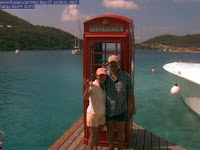
The British phone booth Web cam at Marina Cay's fuel dock. Thanks, Pusser's!Instead of assuming our luggage would arrive when we did, we packed some toiletries and clothes in our carry-ons.

Instead of using a smaller, less expensive charter company, we went with the biggest and best, the Moorings, out of Road Town harbor on Tortola.

Smooth sailing!Instead of going with a smaller boat, we went with a forty-foot Beneteau, the 403 Club. It made for a smoother ride and much more cabin room, plus it included such niceties as an auto-pilot and an electric anchor windlass.

Instead of staying at an expensive hotel the night before our charter began, we stayed on the boat and got well-acquainted with its systems before heading out the next day.

Nan trimming the jib in rainy weatherInstead of sailing around Tortola clockwise, which is somewhat contrary to the prevailing easterly Trade Winds, especially on the north side of the island, we sailed counter-clockwise and enjoyed the benefits of never having to use the engine to make headway.

Instead of assuming the boat would have adequate water and fuel, and that every mooring area would have a water and fuel dock, we planned our itinerary to include strategic refueling stops at Marina Cay and Sopers Hole.
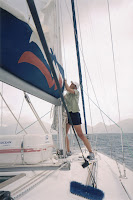
Vicky bringing down the sail in bad weatherInstead of assuming that we would be able to get a day mooring at the Baths--no anchoring allowed!--we spent the previous night at the closest overnight spot, Manchioneel Bay on Cooper Island. We were underway by 6:15 the next morning and were the first boat to arrive at the Baths that day.

Instead of thinking I knew where I was going as we tried to enter North Gorda Sound and almost heading out to open sea by mistake, I checked and rechecked the chart, and entered the sound safely through the Mosquito Island channel.

Instead of using a long line to attach our dinghy to our Marina Cay mooring while we refueled, and then running over it and fouling our propeller on the return, we tied the dinghy up close to the buoy and motored up to it extra-cautiously.
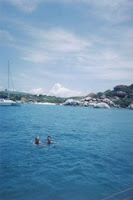
Monica and Vicky swimming at the BathsInstead of thinking there would be plenty of moorings available at Jost Van Dyke, we sailed early from Tortola's Cane Garden Bay to White Bay and tied off our dinghy to an open mooring buoy, then made a side trip to Sandy Cay. When we returned all the other moorings were taken.

Instead of arriving late to the Sopers Hole and Norman Island mooring areas and ending up with windy, noisy moorings, we made a point of sailing early in the day and were rewarded with quiet, protected moorings, the one at Norman Island being the best of the trip, with excellent snorkeling right next to the boat.
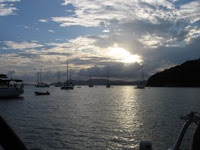
Sunset over the Bight at Norman IslandInstead of suffering twenty-plus knot winds, four to six foot swells and frequent squalls, we were lucky to have fifteen to twenty knot winds, minimal swells and partly cloudy skies--perfect weather almost the entire week.

As good as it was, the trip was not without incident:

Monica took a bad fall going down the steps into the cabin, cracking two ribs and bruising a wrist. She had taken off her sandy shoes in the cockpit before descending, and her wet feet slipped out from under her at the bottom, causing her to fall back hard against the steps. She was a trouper, only complaining when we made her laugh.

Back to base, safe and sound!We failed to notice an approaching boat as we were casting off the water dock at Sopers Hole and had to take evasive action, which resulted in us being pinned by the wind to the windward side of an adjacent dock. Fortunately, we didn't cause any damage to the boat, but I think I swore myself hoarse. We would have been forced to wait for the wind to die in order to make our escape, but a smart bystander directed a man in a dinghy to come under the dock from the leeward side and push our bow out into the wind while I gunned the engine and steered us out of there. It worked like a charm.
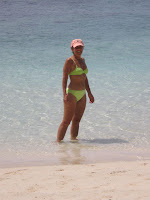
Nan on the beach at Smuggler's CoveHey, if everything went perfectly, it wouldn't be an adventure now, would it?

Here was our itinerary for the week:

Day 1, Saturday, May 5: Moorings Charter Base in Road Town, Tortola to Manchioneel Bay at Cooper Island.

Day 2, Sunday, May 6: Cooper Island to the Bitter End Yacht Club at North Gorda Sound, Virgin Gorda, with a four-hour stop at the Baths.

Day 3, Monday, May 7: Virgin Gorda to Marina Cay.

Mothers' Day luncheon at the Rhymers'Day 4, Tuesday, May 8: Marina Cay to Cane Garden Bay on the north coast of Tortola.

Day 5, Wednesday, May 9: Tortola to White Bay at Jost Van Dyke, with a side trip to Sandy Cay.

Day 6, Thursday, May 10: Jost Van Dyke to Sopers Hole at Tortola's west end.
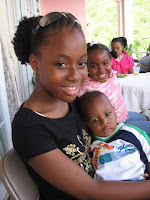
Sisters and cousinsDay 7, Friday, May 11: Tortola to the Bight at Norman Island, with an unsuccessful snorkeling stop at the Indians. This time, all the day moorings were already taken.

Day 8, Saturday, May 12: Norman Island to Moorings Charter Base.

Monica and Vicky flew home the next day, but Nan and I spent an extra week at a villa on Cane Garden Bay owned and operated by our friends, Allan and Joycelyn Rhymer. They invited us to a festive Mothers' Day luncheon and made the second half of our vacation a joy with their boundless hospitality.

Next time, north to Anegada!

Wednesday, May 4, 2005

Lin and Larry Pardey

The Pardeys are one of the most recognized couples in the sailing world. They have written several books on cruising, including the indispensable "Self-Sufficient Sailor". Nan and I attended a two-day seminar they gave in Denver in January, 2004 at the Marriott Inn in West Denver. We were surprised to see more than two hundred people in attendance when we entered the lecture room that Saturday evening. I guess this sailing bug is contagious.

The Pardeys started things out with a slideshow of their adventures on their sailboats, Seraffyn and Taleisin, which Larry the master boat builder had built himself. Their images were so enticing that everyone in attendance was soon longing for the open sea and faraway tropical islands. During intermission both Lin and Larry were available for questions as well as signings of their books, which were on sale in the lobby.

The following day was spent in lectures and question-and-answer sessions on topics important to anyone considering the cruising lifestyle. Larry and Lin said they had been sailing pretty much continuously since 1968 and that during that time they had been around the world four times, twice in each direction. Much of their experience is condensed in their many excellent books, in which the overriding principle is to keep it simple. To that end, they sail without a motor and have just the bare minimum of electronics on board, figuring that these are things upon which it would be too easy to become dependent, only to have them fail when most needed.

For me the most important topics were how to survive a storm and how to handle the paperwork of international boat travel. Larry handled the first topic and Lin the second. Larry said that with the proper equipment and techniques, any storm at sea is survivable. He showed us slides demonstrating heave-to procedures and the use of storm sails and sea anchors. Some of the slides were truly frightening: fifty- to sixty-foot waves towering over their little thirty-foot boat. Lin’s talk was a little more calming. She assured us that with the proper documents it was possible to travel the world, stopping at every place of interest, and never run into trouble with foreign authorities. She also touched on important topics like outfitting a serious first aid kit, getting the necessary immunizations and how to keep life back home manageable in terms of mail, banking and bill paying.

By the end of the day, you could see the dreamy look in many people’s eyes starting to turn alert and calculating as they began to think in concrete terms about giving up their workaday lives for ones of high adventure cruising the world’s oceans. I know I was one of them.

Saturday, April 16, 2005

Where's the Dinghy? Day 8

or, How We Learned Most of Cruising's Lessons in Just One Week

Day 8 (Saturday, May 8, 2004)

The next morning, we both awoke feeling hungover from the previous night’s wine. The only thing on our immediate agenda was to get the boat back to Conch Charters before noon. All we had to do was negotiate the six miles back across Sir Francis Drake Channel to Road Town, and our trip would be over. Partly because I wasn’t feeling well and partly because it was such a short distance, I didn’t bother to put up the sails. We just motored across the channel and circled around near the Conch Charters dock until someone responded to our call and came out in a dinghy to guide us into our boat’s slip. We worked on packing up our stuff and moving it to the dock until Miles came along to check us out. Miraculously, the only damage was to the boat hook, which was a little crumpled from being bent and straightened, but Miles didn’t notice and we didn’t mention it. He was more concerned with explaining to me the intricacies of our previous day’s impellor problem, which I already understood thoroughly from having experienced it firsthand. He gave us an exit survey to fill out while he poked around the boat. One of the questions was, “Did you circumnavigate Tortola?” I hadn’t really thought about it much before I read the question, but that was exactly what we had done. We didn’t do it very directly, and we certainly didn’t do it very gracefully, but we had managed to make our way around the island and return to our point of origin, safely and on time. We had faced many trials, and we had learned from each of them. I don’t know if Nan would agree, but I felt confident that we could handle almost anything at this point. I was already thinking ahead to our next trip, and ultimately to my dream of sailing around the world.

Epilogue

When people ask about our sailing trip, I tell them that we had quite a bit of trouble, everything from bad weather to mechanical problems. But I also tell them that I never said to Nan, “We’re screwed.” Everything, even the completely unexpected, was manageable in the end. In fact, at one point during the trip, what I said to Nan instead was, “Despite all the problems we’ve been having, I’m having the greatest time of my life.”

Sunday, March 20, 2005

Inspiration

When I was almost 11 years old, about the same age that I started to develop an interest in sailing, I remember reading a 1969 National Geographic article about a young man who had just become the youngest person ever to sail solo around the world. His name was Robin Graham, and he immediately became my hero. If someone just a few years older than I was could sail around the world, then why couldn’t I? This was the start of the dream.

I didn’t hear anything more about Robin until his book, Dove, taking its title from the name of his 24-foot sloop, was published a few years later, in 1972. I checked it out of the library and read it in just a few days. If the dream had been waning, it was quickly rekindled. I even had a name for my dream’s future sailboat: Impossible Dream. The Man from La Mancha must have been big at that time. (As coincidence would have it, I met Jim Whittaker, the first American to climb Mt. Everest, about five years ago at a book signing, and part of his slideshow focused on his family sailing around the world in their large steel-hulled sailboat, Impossible Dream.)

I reread Dove a few years ago in anticipation of taking a series of American Sailing Association sailing courses. It was just as I remembered it, but I had the greater appreciation that comes from age for the dangers and doubts that Robin experienced. As I retraced his route on the giant world map in my office, the reality of taking five years to sail 33,000 miles was staggering. But the dream persisted. And it started to evolve into a plan.