Showing posts with label sailboat. Show all posts

Tuesday, August 12, 2014

Boat Projects (continued)

Ralph climbing Whispering Jesse's mast with the ATN Mastclimber
Of course, they never end, but I finally saw enough light at the end of the tunnel last week to cease with the boat projects and actually go sailing, for the first time since we sailed the boat up from Isla Mujeres at the end of May.

The final major project was the installation of the Doyle Cradle Cover I had ordered back in June. The cover has built-in lazy jacks, which we have missed since our original ones disappeared during the major refit in 2010. Rigging the new ones would require a trip up the mast in a bosun's chair, and that in turn requires two very strong people. I had thought to enlist our friend Pompeii, but I have not seen him for a few weeks. Talking with new members Ralph and Stacie Gleason at the Coconut Grove Sailing Club's hurricane preparedness class a little over a week ago revealed that they owned one of ATN's Mastclimbers, a system akin to a rock climber's static rope ascenders and slings. Ralph told me he would be happy to help get the lazy jacks installed, and we met the following Saturday to get it done.

Ralph made short work of getting the Mastclimber rigged and moving up the mast. It turned out that there were still pad eyes on either side of the mast where we had intended to install new ones, but they were riveted to the mast instead of screwed, which presented a small problem with attaching the small blocks that would lead the lazy jacks up to the mast and then down to cleats near the deck where they could be adjusted. Ralph suggested some small shackles, and I scavenged a couple from the boat's junk box. We used a messenger line to run them up to him and then followed them with the lazy jacks themselves. When I tightened them from below, the cover lifted off the boom and took on a nice, sleek shape. While he was up there, Ralph removed the rubber boots from the ends of the spreaders, where they had been slowly deteriorating for the last few years. Replacing them, if ever, is a project for a later date.

Drilling and tapping the holes for the forward pad eyes to attach the Doyle Cradle CoverRalph and I took the water taxi back to the Sailing Club and ate some lunch before heading out to where his boat, a Beneteau First 35.5 named Lasata, was moored. He was trying to get his two Honda 2000i generators working, after over a year in storage, so he could fire up his boat's central air conditioning. It has been seriously hot and humid in Miami this summer, much too hot to try to sleep on a boat without air conditioning. I watched as Ralph took apart one of the carburetors and cleaned it with Gumout. Old gasoline had formed some serious gunk that was preventing fuel from reaching the engine. It finally took some major cleaning of the carburetor's jets the next day to get the generators running again. I filed away what I had seen for when I someday have my own generator and need to maintain it.

Nan and I made a few trips to the boat last week to finish the Cradle Cover installation. I found that the included "self-tapping" screws would not tap into the steel mast and made a trip to Home Depot for an actual tap. Ralph suggested using WD-40 to lubricate the tap as it cut into the pilot holes I had drilled, and that made a big difference. I was then able to secure the pad eyes for hoisting up the forward end of the cover and the cleats for adjusting the lazy jacks. Some rolling hitches on the topping lift to hoist the aft end of the cover almost completed the job.

A view of the new Doyle Cradle Cover, with Mark seeking shade under Whispering Jesse's dodger
This past Saturday morning, after our routine long walk with Scout, I texted Ralph to see if he wanted to join us for a sail. He agreed, if he could bring his son Mark with him. We met at the Sailing Club, spent a little time rerunning the reefing lines through the cover, though they are not yet perfect, and motored out into Biscayne Bay. I noticed that though I was pushing the throttle forward, we were not gaining any speed beyond three knots. Ralph went below to check on the engine and discovered a leak in one of the fuel lines. It was spitting diesel fuel instead of feeding it to the engine, limiting how fast we could go. Once we had cleared the "number one" green marker at the far end of Dinner Key Channel and easily hoisted the mainsail on its new TideTrack, we shut off the engine and sailed south with a nice ten- to twelve-knot southeasterly wind. We soon forgot about the fuel leak as we tacked and jibed around the Bay.

It felt wonderful to be out sailing again, but I suspect our suspiciously slow speeds under sail may have been due to the growth that has accumulated on the hull since arriving in Miami. We'll need to get it cleaned soon, and add some new zincs to the propeller shaft. That, and the engine issue, should put us squarely into our next round of boat projects.

Monday, February 17, 2014

Strictly Sail at the Miami Boat Show

John Kretschmer speaking at the Miami Boat Show
On Saturday morning, I took the train downtown alone and then walked to the Miamarina at Bayside to attend Strictly Sail at the Miami International Boat Show. Nan had wanted to go with me, but she was back in Wisconsin attending to her ailing mother and dealing with the terrible weather there.

I arrived just in time to see our friend John Kretschmer's talk, Force 10 - Storm Sailing Strategies. I have seen John speak a number of times, but I never tire of his stories and I always learn something new. What impressed me most was his progression of strategies to use as the weather worsens. Heaving-to, which essentially parks the boat and creates a protective "slick" to windward, is useful in all conditions unless there is the danger of a lee shore. Fore reaching, which is sailing a tight near reach with reefed sails, is the next strategy and is useful to maintain sea room or to make headway if the intended direction is to windward. The final strategy is to run before the waves and weather, with minimal sails or bare poles, but this requires diligent manual steering to prevent the boat from diving into the troughs. The hour went quickly and good questions followed. I caught up with John and his wife Tadji outside the tent and chatted briefly. John told me that his article about sailing the Mediterranean in a recent issue of Cruising World had won an award. I congratulated him and suggested that he let me post it on his website. He said he would check with the magazine and let me know, then he was off to a meeting with the Jeanneau people.

The Doyle StackPack at the Super Sailmakers booth
I wandered over to the Super Sailmakers booth to see about two of their products, the Doyle StackPack and the Tides Sailtrack System. The StackPack is a sail cover and lazy jack system that contains the sail as it's coming down the mast and controls it in a zippered nylon cover--no more leaping around a heaving deck piling your sail onto the boom with sail ties in your teeth! And the Sailtrack System replaces the mast's existing track with one that is virtually frictionless, making it possible for one person to hoist the sail easily from the cockpit using the aft-led halyard, a task that normally takes three strong people in our boat--one pulling hard on the halyard at the mast, one cranking on the winch, and one tailing--because there is so much friction on the existing track. Back in July 2012, Peter Grimm of Super Sailmakers had demonstrated these systems at the JK University workshop on blue water passage making I attended in Fort Lauderdale. Peter wasn't at the booth but Bob Meagher was, and he was happy to show me how it all worked and provide me with a discounted "boat show quote." I told him I would be placing an order right after we sail the boat up to Miami from Mexico this coming May.

My final stop was at the namesake booth of ATN Sailing Equipment, presided over by Etienne Giroire. Nan and I met Etienne at a party at John Kretschmer's house back in November, and after listening intently to John's boat show talk, I very much wanted to talk with Etienne about his patented Gale Sail, a super strong Dacron storm sail that hanks over a fully furled jib or staysail as a much safer alternative to a partially furled headsail, which could chafe its lines and blow open with disastrous results. Etienne also provided me with a discounted boat show quote, and I told him I would try to purchase the sail before we leave for Mexico in May. It could be useful for the upcoming trip.

There was much more to see, like all the brand-new sailboats flying their advertising streamers at the piers and all the discounted-but-still-expensive boat goodies, but I had seen what I came to see and I still had a long walk back to the train station.

Sunday, January 26, 2014

Quick trip to Isla Mujeres

Water spout above Isla Mujeres on January 15, 2014
On Wednesday, January 15, I flew down to Mexico for a quick five-day trip to check on Whispering Jesse, our 1980 Valiant 40. Nan had flown down there the Saturday before and had assured me through text messages that everything appeared to be fine with the boat. After dropping off my baggage and saying hello to our friends at El Milagro Marina, where Nan had us staying, I drove our rented golf cart down to Marina del Sol, where the boat has been slipped since late last August, to check for myself.

When I arrived at the marina, Gualberto, the dockmaster, was out on the pier checking lines. He and I shook hands and started talking about how the boat had fared, him in accented Spanish and me in broken Spanish and hand gestures, when someone pointed at the sky and yelled, "Mira!" (Look!). There was a water spout surging by on the Caribbean side of the island, close enough that we could see the water spiraling up and hear the hissing as it went. The photo here does not do it justice.

The boat's exterior looked a little the worse for wear, especially the wooden cap rail and coamings. The sanding and Cetol finishing that looked so perfect after 2011's major refit now look flaky and dull. The protective blue plastic tarp I had rigged above the companionway, where the dodger would normally be, looked oxidized and ready to shred in a high wind.

Inside the cabin, I checked the bilge and found it dry except at its deepest point. This was a relief. The stuffing box maintenance that Nazario and I had done last August was working to prevent much water from entering the bilge, and the bilge pump and float switch appeared to be doing their jobs effectively. Everything else inside looked exactly as I had left it, except for a light dusting of mold on most of the wooden surfaces. The boat has three dorades, cowling vents that keep outside air blowing in, but even with the fresh air, the humid climate inevitably causes some mold.

Whispering Jesse in wet storage at Marina del SolThe original plan called for moving the boat to El Milagro that day, but the wind was howling out of the north, even in the protected lagoon where Marina del Sol is located. I didn't want to risk getting blown back into adjacent boats as I attempted to power out of the slip and make the immediate left turn necessary to avoid running aground in the lagoon's muddy bottom. The wind didn't let up the next day either, so with just three days left in the trip, it stopped being worthwhile to move the boat, get its canvas and rigging set for sailing, and then undo it all and move the boat back, all for maybe one day of good sailing.

I spent the time on projects instead, starting with a refrigerator thermostat replacement. Charlie, who is sailing with his wife Karen on their Pearson 386, Leap, in the western Caribbean, looked at the refrigerator with me when they were in Isla Mujeres last summer. I told Charlie that the refrigerator would get "coldish," but not cold enough to keep food from spoiling. Right away, Charlie said that it sounded like a bad thermostat. That had never occurred to me, even after getting the coolant pressure checked three different times, and verifying that the compressor was working and that electricity was getting to the thermostat. When we were back in the USA, I compared photos to what was available online and found the right replacement at rparts.com. It took some effort to jiggle the old thermostat out of its tight fitting and get the new one connected up properly, but when I powered it up, I could feel the cold plate getting colder than it had ever been before. Pushing my luck, I filled a plastic ice tray, and put it in the little slot next to the cold plate. Sure enough, I had ice cubes the next day. Thank you, Charlie!

Then it was time to attack the mold. I filled a dish pan with warm water and a half-cup of Clorox bleach, and went to work with an old dish sponge. The mold wiped off easily, but it still took more than two hours to wipe down every wooden surface inside the boat. With any luck, the bleach will keep the mold from growing back until we return in late May to sail up to Miami.

As a final boat check, I started the engine and it fired right up. Everything seems to be working well, but the list of projects I have planned for when we get the boat closer to home is still fairly extensive. That's fine with me, though. It will be the first opportunity, since we bought the boat almost four years ago, for almost unlimited time together.

Tuesday, June 25, 2013

Boat problem

See the crack in the skeg just ahead of the rudder? Not good!
Shortly after we arrived here in Isla Mujeres, I put on my snorkeling gear to take a look at the growth accumulating on Whispering Jesse below the waterline. What I saw under there shocked me: the skeg that the rudder is attached to was separating from the hull! There was a wide crack at the juncture between the skeg and the hull that ran all the way around and a second crack that ran all the way down the forward edge of the skeg. I could see inside the crack that the structure of the skeg was still intact, but it appeared that the only thing holding the outer layer of fiberglass in place was the hardware that attaches it to the rudder.

The boat's hull had been professionally cleaned at Delegal Creek Marina in late March, and I'm sure the gentleman who did the job would have told me if he had seen anything suspicious. So the damage must have occurred either during the shakedown sail we did before our big trip down here or sometime during the trip itself. The logical assumption is that it happened when we ran aground on a sandy shoal during low tide at the entrance to the Delegal Creek channel. The boat pivoted on its keel as it rounded into the wind, and it's possible that the skeg contacted the shoal as well. We were stuck there for over an hour until the rising tide lifted us off, which would be plenty of time to create the kind of damage that now exists.

The scary thing about this is that it means we sailed all the way from Savannah to Isla Mujeres--over a thousand miles--with the damaged skeg. If I had snorkeled under the boat when we reached Florida, where the water was less murky, and seen the damage, I probably would have ended the trip right there.

Now we're in Mexico and the repair may be difficult and expensive, but it needs to be done before the boat can be sailed again. There is only one real boatyard with a lift here on Isla Mujeres. Fortunately, it is only a few hundred yards away, on the channel connecting the bay and the lagoon. We have received a haul and block quote from them already, and it was not unreasonable. With any luck, the repair estimate, which will need to wait until the boat is hauled and inspected, will also be reasonable. Before we motor over there, though, I am thinking it might be a good idea to go under the boat with some cord and lash the skeg together as best I can, just in case.

Tuesday, March 19, 2013

Air conditioning

Cruisair air conditioner on Whispering Jesse's cabin top
For the nearly three years we have owned Whispering Jesse, our 1980 Valiant 40, I have planned to replace the installed Webasto diesel heating system with a Webasto central air conditioning system. My thinking has been that I could just reuse the existing vents and ducts, and replace the one unit with the other. The only problem I could see was the expense. The air conditioning unit, seawater intake kit and basic duct work would add up to almost $2400, plus installation, which could easily run another $2000.

I was talking on the phone with my father about boat projects a few weeks ago, and he asked me why I wasn't considering a portable air conditioner like the ones he had seen at Best Buy. I told him we had personal experience with one in Isla Mujeres when our rented apartment's main air conditioner stopped working. It wasn't very effective. But my father's idea got me thinking about the air conditioners I have seen on sailboat cabin tops blowing cool air in through open hatches. After I got off the phone, I checked West Marine's website and found that they carried their own model that did exactly that, but it was over $1700 after you added in the cloth hood and rubber air deflector. Searching the Web, I discovered that the original model was produced by Cruisair. I went to eBay on a whim to see if there were any used ones for sale and was surprised to find three of them. I put in a bid on the one that appeared to be in the best condition, the seller offered a counter-bid, and I accepted it. It was a good deal at less than a third the price of the West Marine one, even with the expensive shipping--it weighs almost eighty pounds! I had it shipped to my folks' house in Savannah so I could try it out on the boat while I was out there.

Cruisair air conditioner as seen from cabin of Whispering Jesse
I'm happy to report that the new (to us) Cruisair air conditioner works well. After lugging the unit into place at the most central hatch, located just forward of the mast, I covered the open hatch and unit with the included hood, plugged in the power cord and turned the unit on from inside the cabin, where the controls are located. Cool air poured out immediately, and the fan noise was not too bad, like light white noise. When I went up on the deck to check the unit from that angle, I noticed that there was water around it on the deck, which would be expected from condensation, but it was minor and would be drained off by the scuppers.

I could see only two issues I would need to resolve. The first was that the hood did not fit snugly around the base of the hatch, but I think I can fix that with some bungee cords. The second was that the unit was not level due to its position at the lip of the hatch, though it probably needed to be if the bubble level on the top of the case was any indication. I found a block of wood in the marina dumpster left over from a recent construction project and put it under the forward edge of the unit. The bubble leveled right out.

When it's not living on the deck, the air conditioner will need to be manhandled down into the cabin and stored in the V-berth, which will end up being more of a large closet than a possible guest room once we get where we are going. My hope is that the air conditioner, in combination with sun shades rigged above the decks, will keep us tolerably cool in tropical marinas, especially at night when we're trying to sleep. We will see.

Wednesday, March 6, 2013

Another trip to Savannah


Whispering Jesse with the Aries wind vane removed
Hello from Savannah. I arrived here Saturday morning on the red-eye from points west. The weather has been mostly cool and windy, which has kept me off the golf courses and focused on boat projects. On Sunday, I was able to get the Aries wind vane removed from Whispering Jesse's stern, as the photo I took yesterday shows. It required turning the boat diagonally in its slip for pier access to the stern and then squeezing down inside the starboard lazarette with a wrench to keep the nuts from spinning while Billy and Garrett from the marina ratcheted off the bolts from the outside. We managed to remove the entire apparatus without dropping it or any tools into the water, which was more difficult than it sounds.

It was critical to remove the wind vane as my first project because Ray, the boat's previous owner, was driving down from Pennsylvania on Monday to pick it up. A gentleman from Atlanta had expressed an interest based on my previous blog post but later changed his mind. I thought I would end up advertising it for sale on Craigslist, but then Ray contacted me out of the blue. He has a new "project" sailboat and wanted wind vane self-steering for it, something he is very familiar with from his twenty years of experience with the Aries on his previous boat, which is now my boat. We reached a favorable deal and he mailed me a check.

It was good to see Ray. We had met only briefly in May 2010, when we took the boat, then named Little Walk, for a sail in Chesapeake Bay, along with Bob the broker and my friend John Kretschmer, who flew up from Fort Lauderdale to help me evaluate the boat for purchase. Ray had given me a thorough tour then and filled my head with too many details about the boat's many systems. Seeing him again after three years of ownership was an opportunity to get answers to my many questions.

Ray was pleased with the refit work. He stopped on the pier to admire his old boat in the last light of day and then breathed in its smell from the foot of the companionway steps. We dropped off his duffel bag and sleeping bag in the aft berth, where he would be spending the night, and took a brief look around the cabin. He lifted the bilge covers and had me flip the bilge pump switch to manual to clear a small accumulation of water, though we were unsure why it had not cleared with the switch set to automatic. I told him the refrigeration was not working well, and he showed me how to tell if the compressor was kicking in. We adjusted the rheostat in the fridge to the mid-point and checked the thermometer I had hanging in there, with the idea of checking it again when we returned from dinner.

The fridge was a few degrees cooler when we returned but still not cold enough to make ice. We turned on the cabin lights and used a flashlight to check the Webasto diesel heating system. Ray had installed it when he was living on the boat through the winter in Boston Harbor many years ago, but Nan's and my future sailing plans are much more tropical, so I told him I would be taking it out and putting in an air conditioner instead. He told me to take care with the removal of the components because they would have good resale value. If any readers are interested, please contact me by email using the address under "View my complete profile", or it may be time to consider Craigslist again.

Earlier on Monday, I met at the boat with Kevin, a project manager from Thunderbolt Marine, to discuss some boat projects that are beyond my abilities. The first was the removal of the Webasto system, but now it's a couple of days later and I already have two of the five heat exchangers removed. I expect to have the other three removed by the end of the day today. But I will still need some professional help getting the main unit out of the starboard lazarette, replumbing the fuel line, and closing off the exhaust through-hull. Kevin and I also discussed the refrigerator and several installations: the Garmin chartplotter and antenna I purchased during my last trip to Savannah; a marine-grade carbon monoxide detector; two or three cigarette-lighter-type electrical adapters; and a macerator pump for overboard pump-out of the head's holding tank. Kevin's specialty is fiberglass and paint, and he had some good ideas as we walked around the boat looking at various dings and scrapes that need touching up, including the four new scars on the stern where the wind vane used to be.

It's time to get back to the boat. More later...

CORRECTION: I discovered this afternoon that the people who installed the new engine took out the heat exchanger that was in the engine room, so there are four now, not five. And I am happy to report that they have all been removed. Ah, storage space!

Sunday, January 6, 2013

Gangplank

Nan is back in Wisconsin visiting family, so I spent the weekend in our freezing garage working on a gangplank for our sailboat, Whispering Jesse. It's based on an idea I've had about how to get our dog Scout up and down the steep companionway steps, and in and out of the water when we're at anchor. The gangplank, when not being used in the traditional manner to bridge the gap between the boat and a marina dock, would serve extra duty as a ramp into the cabin and, with floats attached to the end, as a ramp into the water. It's sized at 6'7" so that it can be secured in front of the port-side settee when not in use.

Several weeks ago, I found a good-quality pressure-treated 2x12 at Home Depot. A contractor friend cut it to the required length and then I let it season in the garage. Yesterday I used a vibration sander to remove any rough edges and smooth all the corners. I cut four lengths of cedar 1x2 using a mitre board to give the ends 45-degree angles and then fastened them 3 inches from each end on both sides using 2-inch stainless steel screws. They will act as friction reducers to save wear and tear on the heavy-duty non-skid tape and floating lines that will be attached after the wood is sealed with several coats of Cetol. But the sealing will need to wait until the temperature in the garage gets above 50 degrees, at least 20 degrees above where it is now.

Next, I drilled 5/8" holes 1-1/2'' from each corner for the floating lines, which are 4-foot lengths of Samson 3/8" Floatine multi-filament polypropylene. As a final touch, I wood-burned our boat's initials, "WJ", on one side at each end so there's no question about whose boat the gangplank goes with.

Thursday, November 29, 2012

Savannah: long list, little accomplished

Aries windvane on the stern of Whispering JesseSaturday, November 24: It's the fourth day of my trip out to Savannah and I'm not overly happy with what I've been able to get accomplished on my long list of boat projects. Of course, the list is overly ambitious and would realistically take a few weeks to complete, not the five days I have had available. And I don't want to leave any projects half-done. So when I stare at the Aries windvane bolted to the stern of the boat and try to figure out what it will take to remove it, the clock inside my head goes tick-tick-tick and I realize it will take more time than I have on this trip, especially if I try to remove the lag bolts secured through the hull. That would involve emptying out both lazarettes and squeezing down in there with a headlamp and some beefy wrenches. Instead, I work backward toward the windvane, removing the steering drum that was attached to the wheel and the numerous blocks that guided the lines between the windvane and the wheel. It's not much, but it's something.

Gluing the mitered teak molding pieces together
Before I undertook anything related to the windvane removal, I tried to repair a disconnected cockpit scupper using the part I had ordered from Defender Marine Outfitters. I lucked out with guessing the correctly sized plastic elbow fitting for the 1.5-inch scupper drain, but I still couldn't get it to fit. Either the thread spacing is wrong or the drain threads are stripped, which would explain why the previous fitting was only glued in place. I expect that I will end up gluing the new one in place, but I'll wait on that until I'm ready to use up an entire tube of 3M 5200 marine adhesive on this and other applications, since the whole tube will start to set up as soon as it is exposed to air.

My greatest success has been with constructing teak frames for the cockpit cut-outs. I spent a good part of yesterday afternoon using a mitre saw to cut L-shaped molding pieces to fit, and then some time this morning gluing the pieces together. I will need to fasten some small screws as well, but the glue should hold for that process.

Cockpit cut-outs where the new teak frames will goThe molding was part of an order I placed through the West Marine website a couple of weeks ago. West Marine offers free shipping to their stores for in-person pickup, which worked even better for me than drop shipping to my folks' house. While I was at the store on Abercorn Street, I noticed that the Garmin GPSMAP 740s Chartplotter/Sounder was on sale for $400 below list price. I had to think about it for two days, but I couldn't pass up a deal like that on a necessary piece of equipment and went back to buy the last one in stock, along with an external antenna. The installation looks tricky, so I'll wait and have Thunderbolt Marine do it when I return in the spring.

Tomorrow, I'll see if the teak frames fit, take some measurements for some other projects, see if the engine will start and stay cool, and then prepare the boat to be left alone for another winter.

Sunday, November 18, 2012

Redundant Sailboat Systems

Aries windvane mounted on the stern of Whispering Jesse
Sailors know the importance of having spare parts on board in the event of equipment failures that can be readily fixed. With more complex equipment, such as GPS units, sailors will typically have two or more units on board. This redundancy is largely driven by the need for safety. If you are far out to sea, depending for your navigation needs on your one-and-only handheld Garmin GPS, and it fails, then you are lost--or at least considerably less certain of exactly where you are.

It is with a sense for the importance of redundancy that I approach my sailboat's many systems. I have two VHF radios, three GPS units, two emergency beacons, and multiples of other equipment, including auto-pilots. My boat, a 1980 Valiant 40 that I purchased in May 2010, came with an Aries windvane and a Raymarine electronic auto-pilot. The windvane was bolted to the stern, but the Raymarine unit was still in its box--it had never been installed. As part of an extensive refit, the Raymarine unit was installed, and the Aries windvane was removed for hull work and then reinstalled. During the delivery trips (it took two) to get the boat to its current location in Savannah, Georgia, back in September and October 2011, the Raymarine auto-pilot proved itself to be invaluable, almost like having an extra crew member. The Aries windvane proved itself to be stuck. It is supposed to be hinged so that its trim rudder can be kicked up out of the water when not in use, but we could not get the locking mechanism to release. So we never even bothered to try out the system as a fallback for the Raymarine auto-pilot.

In the many months since those delivery trips, I have thought often about the Aries windvane and what to do about it. Instead of trying to fix it, I have decided to remove it. If it was working, it would be good to have as a redundant auto-pilot system, but I am willing to forego that option and steer manually when I need to. While I am out in Savannah this coming week, removing the Aries windvane will be near the top of my lengthy list of boat projects. I am thinking it may be easier to work on the hinge and get it to release with the mechanism resting on dry ground rather than hanging off the back of the boat. If I can get it to release, I will try to sell the whole Aries windvane system, including the original documentation, and put the proceeds toward a new Garmin chartplotter. If you know anyone who would be interested in a complete, working Aries windvane, please send me an email message. There's a link in my Blogger profile, which you can get to by clicking my photo under About Me.

Sunday, August 26, 2012

Defender - Marine Outfitter

Aqua Signal Series 40 port navigation light from defender.com
While I was in Savannah last April working on Whispering Jesse, I made several trips to the local West Marine store. The people there were very helpful with helping me find what I needed and ordering what they didn't have in stock. But on my last trip to the store, they were unable to help me. I had thought of West Marine as having absolutely everything I could ever need for our boat, but it turns out that they don't. I had walked in with a damaged port navigation light and a somewhat melted--it's a long story--plastic scupper fitting to see about replacements. The young lady at the check-out counter pulled out her catalogs and searched in vain. She took my contact information and said she would do some further research and call me with the results. I never heard from her.

Plastic elbow fitting from defender.com for scupper drain repair
Back home, I received an unsolicited marine catalog in the mail from an outfit called Defender. The slim catalog's newsprint pages were densely packed with listings of every imaginable boat part. I didn't find my parts in the catalog, but fortunately, Defender also has a densely packed website (defender.com), so I went there on the off chance that they would have what I needed. And they did. I had nothing to compare their prices against, but they seemed reasonable. The last time Nan and I were in Denver, we checked out a Honda Marine 5 HP outboard motor for our inflatable dinghy and were quoted a price of $2000. Defender carries Honda outboards, so I did a quick comparison check: $1556! That savings offsets the freight with a few hundred dollars leftover. If the savings on the parts are anything like the savings on the outboard, then there's no need to search any further. This November, a few weeks before I head out to Savannah again, I'll be placing an order for both the parts and the outboard with Defender.

CORRECTION 9/24/12: I went back and read the fine print in Defender's listing for their Honda outboards. It turns out that they can only sell them either as a "boat package" that includes a small fishing boat or inflatable dinghy and requires delivery to a commercial loading dock, or by themselves if you go to Waterford, Connecticut to pick them up. Those are not good options. We already have a Zodiac dinghy, and Waterford is a little out of the way. It looks like we'll be looking for an authorized dealer a little closer to home. But I'll still order the other parts, and anything else the boat needs, from Defender. You can't beat their prices.

Saturday, July 28, 2012

JK University

Back in April, when I was out in Savannah getting work done on Whispering Jesse and spending time with family, I took a few days to drive down to Fort Lauderdale for a blue water sailing seminar led by John Kretschmer. I planned to write an article about it for Cruising World magazine, and I obtained John's permission ahead of time, along with his assurance that he would contact the magazine for their approval. The idea was that John would benefit from the free publicity and I would earn another publishing credit. So I was surprised and disappointed when I received a polite rejection indicating that the magazine was aware of John's seminars and planned to write its own article about an upcoming one. I had been scooped!

Since it's not going to be published, I might as well post it here:

Caribe, a Beneteau First 456, is pulled over to the pier by John Kretschmer
JK University’s Blue Water Passage Making Workshops

Suppose you’re an experienced coastal cruiser looking to take your sailing to the next level, to blue water passage making. Where do you turn for instruction and guidance? If you’re like most sailors, you get started by reading books by such noted sailing authors as Jimmy Cornell and John Vigor. But books will only provide you with theory. What about practical, hands-on experience? It used to come only from taking the risk on your own by making an actual passage, or by signing on as crew for an experienced captain. More recently, there have been instructional passage-making trips offered by outfits such as Mahina Expeditions.

Now there is a new offering, mixing classroom instruction with practical experience to fill in the knowledge gaps of potential ocean-going sailors: JK University, named in tongue-in-cheek fashion after its founder, Capt. John Kretschmer. John is best known for the book he wrote about his delivery captain days, Flirting with Mermaids, and for the passage-making trips he offers through his outfit, John Kretschmer Sailing. He has partnered with Bob Pingel, a contributing editor to Sailing magazine, and Rick Thompson, a marine electronics expert, to provide four-day workshops designed to answer all the big passage-making questions, with an emphasis on safety and self-sufficiency: What are the best methods for avoiding hurricanes? How do I splice a rope for an anchor snubber?

John Kretschmer supervises a life raft launch in a swimming pool
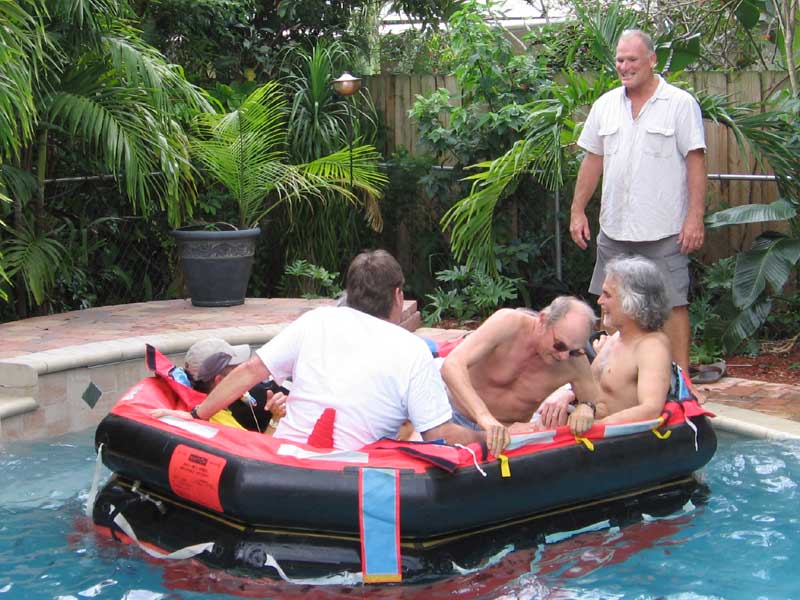
JK University’s Blue Water Passage Making Workshops are conducted three times a year in John’s hometown of Fort Lauderdale, Florida or in Solomons, Maryland. Both locations are close to water for easy access to ocean-going sailboats. Firsthand inspection of a well set-up vessel or two is one of the key components of “field trip Saturday,” along with the actual deployment of a Switlik life raft. Here is a typical workshop syllabus:

  • Introduction: Myths and realities about passage making
  • What makes a boat a blue water capable boat? Slideshow of 25 great boats
  • Outfitting: Necessary, nice, extravagant – 10 important items for a serious boat
  • Hands on – Rope
  • Inspecting boats: Caribe, a Beneteau First 456 performance cruiser and retrofit project, and Tioga, a brand-new Hylas 56
  • Hands on – The bullet-proof electrical system
  • Hands on – Standing rigging, discussion of rigging emergencies at sea
  • Passage planning, pilot charts, safety, weather, watch schedules, crew management, food preparation
  • Communications at sea: Satellite phones, wifi, SSB, VHF, AIS
  • Life raft launch
  • What’s new in cruising sails? A plan for optimizing “manageable” downwind performance; sail plans for storm sailing; how to spend money on cruising sails
  • Heavy weather: Dealing with storms, gales and squalls
  • Chart work and celestial navigation in the digital age: Thinking like a navigator

John Kretschmer discusses the merits of Tioga, a brand-new Hylas 56
Workshops run from early Thursday afternoon through late Sunday afternoon to help make scheduling as easy as booking a long weekend trip. The late start on Thursday and early finish on Sunday allow out-of-town attendees to arrive and depart without the expense of additional overnights.

To reserve your spot at the next JK University workshop, scheduled for February 7 to 10, 2013, please visit the John Krestschmer Sailing website at yayablues.com and click the Schedule link. In addition to a calendar of workshops, you’ll find all kinds of passage-making opportunities designed to help you build your confidence and broaden your experience.

Monday, July 2, 2012

Tides and Currents

Mom, Dan and Nan with Whispering Jesse at Thunderbolt Marine on April 16, 2012
This blog post is one I have been thinking about since I returned from my trip to Savannah back in mid-April. I almost skipped writing it entirely because it will prove to be a little embarrassing, but this blog is supposed to be about sailing, and sailing necessarily involves a healthy dose of learning from mistakes. So here it is:

Near the end of the Savannah trip, on the Friday before the weekend when family would start returning home, I invited everyone out for a sail on Whispering Jesse. My mother stayed behind, but my father, my sister Jane, her husband Josh, their twin sons Max and Ben, and my sister Susan were all up for it. So Nan and I spent some early morning time at the marina that day getting the boat ready: taking off the sail cover, replacing a missing mainsheet shackle, spraying the luff track with SailKote lubricant, and listening to the weather on the VHF. It was looking dark and blustery out to the east in the open ocean, and I was concerned that there might be too much wind for comfort. I checked the wind instruments and they were showing about 15 knots out of the east, counter to the prevailing westerlies.

When six family members arrived at a little after 9:00, we welcomed them aboard and gave them a quick tour of the boat. I had checked the tide table and the current would be running lightly against us as we backed out of the slip. With the transmission in reverse, we cast off the dock lines, and moved slowly back against the current, assisted by the wind. I put the transmission into forward and made a smooth turn to starboard to put us out into Delegal Creek, heading down the estuary toward Ossabaw Sound. We followed the line of channel markers out toward open water and were surprised when the depth meter continued to register single digits of foot depth under the keel. Slack tide would not occur until 1:00 in the afternoon, so shallow water was to be expected, but we were more than a half-mile from shore. In addition to being shallow, Ossabaw Sound is also prone to shoaling, and we lightly bounced the keel over a few sandy ones as we headed out to sea.

The current was flowing opposite the wind, creating significant chop and whitecaps and making for a bumpy ride. I let my nephews, who are learning to sail dinghies at home in Seattle, take turns at the wheel, but they didn't seem too confident with steering a larger boat in choppy conditions and willingly relinquished control back to me. We continued to motor out through the waves, spraying the people sitting up at the bow who were looking for dolphins. When we reached a depth where it would have been safe to head directly into the wind and raise the mainsail, I decided against it. It was just a little too rough for inexperienced sailors and I didn't want to scare anyone. Instead, we turned around and headed in for calmer waters. We followed the southern shore of Skidaway Island for a ways, spotting several dolphins in the shallow waters, until everyone was ready to return to shore.

I phoned Jimmy, the dockmaster, as we passed the channel's entrance markers, and asked if he could meet us at the pier to receive a dock line. He said he would, and he was standing at the corner of the fuel dock as we approached. It is difficult to judge current from a moving boat, so it did not appear that it was running significantly faster than it had been when we departed almost two hours before, but it most definitely was. To steer the boat back into the slip, I would need to make a tight 180-degree turn to starboard against the current. As I began the turn, putting the boat's beam to the current, the force of the water started pushing the boat sideways, leaving no room to complete the turn. I cranked the transmission into reverse, to back up against the current and get the bow pointed at the slip, but the little folding, two-blade propeller was no match for the strong current. The boat crashed sideways into a barnacle-encrusted piling and my neighbor's bow anchor, and there we were pinned. We quickly moved fenders into position to keep the anchor and piling from grinding against the hull and cap rail and causing further damage. And then we tried to figure out what to do. Jimmy had climbed over the neighbor's boat to see how he could help and said that he didn't think we would be able to move the boat until slack tide, still a couple of hours away. He then assisted everyone but Nan, my father and me in getting off the boat by way of the neighbor's boat. One of my sisters had called my mother and she arrived to take the rest of the group back home.

We were resigned to waiting for slack tide until Joel and his wife Bonnie, who own a Cat Ketch they keep at a slip across from ours, came over to see how they could help. Joel is an old salt and according to Bonnie, he has extensive experience with boat rescues. He suggested floating a long anchor line down from the adjacent pier, tying it off at the bow and using it in conjunction with a stern line, to control the boat's rotation, to pull the boat across to an empty slip at the adjacent pier. It worked like a charm. We didn't even need to use the engine; it just took Joel and a marina employee to pull the boat over while I steered. My father, Nan and I secured the boat in the slip to await slack tide and thanked everyone for their help. Joel said he would be around later if we needed assistance with getting the boat back into her own slip, and we told him that after the morning's experience, we would appreciate all the help we could get.

After lunch, my father, Nan and I returned to the marina to find the water almost motionless. Joel was expecting us, and he suggested using the anchor line again but as a safety measure this time. He tied it to a stern cleat and played it out like a leash as I backed out of the slip, turned the stern to port, put the transmission into forward, and turned to starboard to slowly glide into the opposite slip. Jimmy was waiting to receive a dock line, and we soon had the boat secured in her home slip. We thanked Joel and Jimmy profusely and headed for home.

Nan and I decided we owed Joel a thank-you gift and went to find a liquor store for a good bottle of wine. When we returned to the marina, Joel and Bonnie were working on replacing the portlights on their boat. We gave them the wine and thanked them again for their help. We got to talking boats, and Bonnie said that people walking on the pier frequently stopped to admire Whispering Jesse, that she is such a pretty boat. She asked if she could see what the boat was like on the inside. We said sure and opened her up for a little tour. Bonnie commented about the roomy cabin and its abundant storage space as I showed them around and answered their questions.

Back on the pier, Joel and I assessed the damage to the boat's starboard beam. There were some deep gouges in the teak cap rail and in the fiberglass below from the flukes of my neighbor's anchor, and some significant scratching from the barnacles on the piling, but it was all merely cosmetic and could be made to look as good as new. All in all, we were lucky that it wasn't much worse. Joel said he knew a guy who specialized in boat carpentry who could take care of the cap rail and any other wood-related issues. I told him I would get his phone number when I returned to Savannah, which is now starting to look like next Thanksgiving weekend.

I talked with Jimmy the next day when we sought him out to give him a tip for his services. He said that he would have been fine with me just pulling the boat up to the fuel dock and leaving her there until slack tide before moving her into her slip. How I wish he had suggested that when I called him to take a dock line!

The moral of this story: Tides and currents are serious forces, especially in tight quarters where they make maneuvering extremely difficult. Check the tide tables, and try to time marina arrivals and departures to correspond with the slack tide periods between ebbs and flows. When in doubt, stay put if you're already secure, and look for temporary alternatives, like anchoring or tying up at an easier location, if you're trying to dock. Most importantly, don't be in a hurry. Take the time to evaluate the situation and make a common-sense plan. Someday, I hope to have enough time to take my own advice.

Friday, December 23, 2011

Midship cleats?

Whispering Jesse docked at Spring Cove Marina in September 2011
With Whispering Jesse safely slipped at the Delegal Creek Marina in Savannah, my thoughts have turned to boat improvement projects. The list is long, but one of the simpler projects would be to add midship cleats for securing spring lines.

Unlike most modern sailboats, which feature a toe rail mounted around the perimeter of the deck, our 1980 Valiant 40 features a full cap rail. It essentially lowers the deck about six inches below the top level of the hullsides, offering protection from slips as well as a place to stand on the leeward beam when the boat is heeling. There are hawseholes at the bow and stern to accommodate bow and stern cleats for securing dock lines, but there are no hawseholes at the beam, obviously, because the beam is frequently underwater while the boat is underway.

Thus, there are no cleats amidship, and spring lines must be rigged from the bow or stern, as shown in the photo above. This is inconvenient for a couple of reasons. In some docking situations, the spring lines end up being excessively long, reducing their effectiveness at holding the boat in place. And because of their position, the spring lines tend to rub against the hull and cause minor damage, especially when they are occasionally dipping into the water, picking up sediment and sea life. Before Mike and I moved Whispering Jesse to an adjacent slip at Delegal Creek Marina the morning after our arrival there, the overnight rubbing of a spring line caused some damage to the boat's adhesive name letters on the port side near the stern. So adding a pair of midship cleats might not be a bad idea.

Stainless steel cleat manufactured by New Found Metals
Searching the Internet, I found that New Found Metals (http://www.newfoundmetals.com/), the manufacturer of our boat's spiffy new stainless steel portlights, also makes ten-inch stainless steel cleats that look just like our boat's stock ones. I'm thinking they could be attached directly to the cap rails, but I will get advice from a boatyard first. It might be more prudent to mount them to the deck, near the closely-spaced chainplates on either beam, and then also attach chocks on the cap rail to limit chafing.

It's looking like Nan and I will be headed out to Savannah in early April, along with assorted family members, to work on the boat and do some sailing to nearby destinations, perhaps Tybee Island or Hilton Head Island. I will keep you posted on plans for the trip, as well as on other future boat projects.

Tuesday, November 1, 2011

Charleston to Savannah: A Comedy of Errors

Fort Sumter guards the entrance to Charleston Harbor
Whispering Jesse is now safely slipped at the Delegal Creek Marina on Skidaway Island, southeast of Savannah, Georgia. My crewmate Mike and I sailed her there over the weekend of October 15-16. Mike was a tremendously good sport to join me after last month's storm adventure (Just a Squall? No, not at All!), especially considering that he had had surgery to repair torn thumb ligaments from a work-related accident the previous week and was wearing a cast on his right hand. He had enough trouble holding a fork; I couldn't imagine him trying to work the boat's many lines.

It should have been a simple trip, just a hundred miles down the coast from Charleston, South Carolina, but things started to go wrong before we even started. The plan called for my parents to pick us up at the Savannah airport on Friday evening and drive us up to the City Marina in Charleston, but Mike and I were on separate flights and his arrived more than an hour and a half late, too late to make the drive up to Charleston. We spent the night at Mom and Dad's house in Savannah instead and left early the next morning.

Preparing to turn southwest and follow the sailboat ahead
By the time we thanked my parents for the ride, prepped the boat and checked out of the marina, it was almost noon and the tide had turned. Instead of helping to ease us out of the slip, the current was preventing us from leaving. I needed to back up and to starboard to avoid the boats on the adjacent pier and move out into the seaway, but the current was so strong that it pushed the boat sideways as soon as it cleared the slip, pinning it against the slip's finger pier. I started to wonder when the tide would turn again to free us when two gentlemen who had witnessed our predicament came to our assistance. They helped Mike and me get the boat back into the slip without crashing into the pier and coached us for a more successful exit. I stood on the forward side of the boat's wheel, facing the stern for more effective steering, and put the engine into reverse. The gentlemen released the lines and we motored smoothly backward until we cleared the slip. But as I turned to starboard to miss the catamaran behind us, the current took control and pushed us sideways again, brushing us past the two boats between us and the seaway. Finally free of the pier, I looked for the fuel dock on the other side of the seaway, where we had planned to top off the tank, but there was no way we would have been able to stop there given the current, so we motored on, trusting that the new fuel gauge really was wired backwards, as we suspected, and was reading almost full, not nearly empty.

A passing shrimp boat on Sunday morning
With the strong current, it felt like we were really motoring through Charleston Harbor, but the knotmeter was registering zero. In the quick month that the boat had been slipped at City Marina, the hull must have picked up enough sea creatures to foul the meter's little spinner. It made me wonder about what else might be growing down there. The anemometer wasn't working either. Mike said that he remembered it registering better than 35 knots during last month's storm, right before it stopped working entirely. Well, at least the depth gauge was still functioning. We would be sailing through shallow waters and would be dependent on it.

As we turned southwest at the second or third buoy after passing Fort Sumter, I looked at my watch and tried to figure out how long it would take us to reach Hilton Head Island, our planned stop for the night. At an average speed of five knots (according to my handheld GPS), for a distance of about sixty miles, we would arrive shortly after midnight. So much for that idea. We would be sailing overnight instead, as we had done sailing from Morehead City to Charleston, after negotiating Chesapeake Bay and the ICW from Solomons, Maryland the month before.

Mike and his green cast scout for buoys up the Vernon River--already lost!
The wind was out of the west, and we were able to cut the engine and sail a near reach for a while in the early afternoon. The jib would have been flapping at that angle, so we flew the Yankee-cut staysail instead. It worked reasonably well for a while, until the wind moved to the south and picked up strength. It seems no matter what tack I take, the wind follows around until it is right off my nose. We fired up the engine again and doused the sails. Soon we were crashing directly into three- to five-foot waves.

We hadn't planned on cooking dinner, but Mike is resourceful. He cut up and fried a sausage we had in the cooler and served it on Saltines. Washed down with a beer, it wasn't too bad, just a little salty. We watched the sun set as we finished our beers and then prepared for the long night ahead. We flipped on the running lights, put on warm jackets and checked our position using my laptop's charting software. We agreed on two-hour watches, and I took the first one while Mike napped below.

There is a line of lighted buoys about five miles off the coast, and we spent the night following them while dodging the many shrimp boats. The boat continued to pound into the waves, which worked loose the electrical connection to the bow's portside running light. I hoped the tri-color on the top of the mast would be sufficient for us to be seen by the shrimpers, who were lit up like daylight as they worked the shallow waters off the coast.

Mike and his green cast coil a dock line at Delegal Creek Marina
The night passed uneventfully, though sleeping was a challenge due to the boat's up and down motion through the waves. The wind began to wane toward dawn, and I was able to get a couple of hours of uninterrupted sleep. Mike woke me up at six to take the last watch and I took a quick look at the laptop's chart. We were almost directly across from the entrance to Ossabaw Sound. I flipped on my headlamp to check the full-size paper chart for better detail on the depths we would encounter. There were shoals to be avoided, and they were complicated by the fact that high tide was still six hours away.

When I sighted the first lighted buoy inside the sound, I ran down to check the laptop for a position, but it would not come up. I had not planned on running it all night and the battery had run down. I checked the handheld GPS instead, but the detail was woeful. At least it gave us an idea of where we were, along with our latitude and longitude, which we could check against the paper chart, which unfortunately cut off at the edge of where we hoped to pick up Delegal Creek. The northern track through the sound looked like a narrow slot through treacherous shoals, so I opted for the southern track, south of Raccoon Island, which joined up with a dredged channel that is part of the ICW.

The view of Whispering Jesse in her slip from the observation tower at Delegal Creek Marina
We inadvertently steered to a buoy too far ahead, missing the closer one that was way off to port, and hung up on a sandy shoal. Fortunately, the tide was coming in by now and we managed to bump our way into deeper water, but not before missing the entrance to Delegal Creek. I checked the GPS and it looked nothing like what I was expecting. I kept waiting to see an inlet off to starboard, but it never materialized. We continued to motor up the sound, passing marshes, piers and nice waterfront houses, until I spotted the Diamond Causeway, which is the bridge that connects Skidaway Island to the mainland. We had gone quite a ways up the Vernon River and were now way around on the west side of Skidaway Island. I turned a quick one-eighty in the narrow channel and headed back the way we had come, knowing that if we kept the island to port we would eventually find Delegal Creek.

Almost an hour later, across an expanse of marsh, we spotted the observation tower that marks the Delegal Creek Marina. Mike and I looked at each other with expressions that said, "How could we have missed it?" We both figured we were so busy trying to get off the shoal that we didn't look in the right direction when we should have. We rounded past the signs that mark the marina's entrance and warn of a buried electrical cable, motored up the creek and found an empty slip at the marina. I called my parents to let them know we had arrived safely and to arrange a ride, and Mike and I took our time securing Whispering Jesse in her new home.


Saturday, October 8, 2011

Just a Squall? No, not at All!

Mike at the helm and Kurt with the banana ride out the storm off the coast of Charleston
When Mike woke me up shortly before the end of his three-to-six watch, he said, “John, you should come up and look at this.” I was in the cockpit moments later, staring at the wall of darkness off our stern. Even in the pre-dawn light, it looked ominous. I checked the wind. It was still blowing lightly out of the south, enough for us to have the mainsail up in conjunction with the diesel engine to keep us moving southwest toward Savannah.

We were far enough offshore that the VHF weather channel would not come in clearly. Neither Mike nor Kurt, who had joined us in the cockpit, could remember any storm forecasts. It’s just a squall, I thought, like the ones that blow quickly through the Caribbean at this time of year.

Within minutes, the wind had clocked around one hundred eighty degrees and piped up to almost twenty knots. The sail started flapping and I told Mike to steer into the wind to avoid an accidental jibe. The sea lumped up in a hurry, with swells approaching eight to ten feet. Now we were pointed directly into the wind and the sail was flapping like crazy. I had Mike fall slightly off the wind to keep the sail full and the bow pointed into the waves. Cold rain fell like BBs, mixing with the warm spray coming off the waves. As the boat crested, I looked for signs of lightness beneath the dark clouds, but there was only blackness from sea to sky. The sun had come up, but it was not penetrating the clouds anywhere that we could see.

We took turns at the helm as each of us went below to put on rain gear. As time went by, we commented on how much distance we were losing toward our destination. Still there was no lightness below the clouds. Waves crashed over the boat and drove water through the leaky hatches and into the cabin. Everything below was getting soaked. Anything that was not secured had been pitched onto the floor. We could hear the cooler crashing around, but nobody wanted to go below to secure it. We had each thrown up by now, and Mike admitted to having thrown up twice. Going below would only trigger another bout.

After two hours of fore-reaching, we decided it was pointless to believe we would eventually sail out of the storm’s leeward edge. This was no squall. No, not at all! We were about thirty miles away from Charleston Harbor, and I suggested that we try to sail there instead of continuing on to Savannah. I offered to pay for a hotel room if we made it. Thoughts of hot showers, good food and warm beds immediately focused our efforts. To reach Charleston, we would need to turn around and resume a southwesterly heading. But the mainsail would need to come down first.

Mike volunteered to go forward and manage the sail as Kurt lowered it. With the boat pitching wildly, Kurt and I did not envy him. Mike moved carefully to the mast as I steered the boat directly into the wind, causing the sail to flap dangerously. Kurt released the cam on the halyard and it went flying through its brake but hung up on a slipknot when the sail was only halfway down. Mike threw his body over the boom and lashed a sail tie around what he could. I punched the autopilot’s button and ran down the companionway stairs to grab a marlinspike for Kurt. Mike returned to the cockpit and worked with Kurt to untie the knot, then went forward again, but not before putting on a harness and clipping its leash to a lifeline. He had come close to falling overboard the first time and was taking no chances. He managed to get the sail tied well enough and returned to the cockpit.

I turned the boat around and aimed for the sea buoy that marks the beginning of the shipping lane entrance to Charleston Harbor. If the boat had been pitching before, now it was rolling dramatically from side to side as we surfed up and down the faces of huge waves at an angle that was the shortest path to our destination but also uncomfortably close to beam on. We wedged ourselves into corners of the cockpit and trusted the boat to fully right itself before the next wave surged beneath us.

Through it all, the trusty diesel engine kept up a steady two thousand RPMs, moving us to safety at six knots. By late morning, we had spotted the sea buoy, about fifteen miles offshore, and knew we were on course for Charleston Harbor. The red and green buoys that followed were up to a mile apart and difficult to locate. We scanned with the binoculars at wave crests to spot them and adjusted course accordingly. More than an hour later, I spotted the immense Arthur J. Ravenel Bridge through the mist, our first sight of land in almost two days. The sea turned slowly from blue to green, and the waves died down to a point where the boat was no longer surfing but merely lumbering.

I checked the signal strength on my cell phone, then called my parents in Savannah to let them know we were safe but that we would be ending the trip in Charleston. They had not been aware of the bad weather but agreed to drive up and get us the next day.

The stars and stripes that fly above Fort Sumter came into view. I thought about the fort’s historical significance as the place where the Civil War began and tried to imagine cannonballs hurtling toward ships sailing in the same waters we were now motoring through. It was a sobering thought. We continued past the fort and followed the buoys up the Ashley River to City Marina. By three o’clock, we were safely secured in a slip, where Whispering Jesse will stay until Mike and I return to sail the remaining distance to Savannah next week.

Sunday, October 2, 2011

Photos from the Sailing Trip

Here is a selection of photos with captions from the September sailing trip that give an idea of our route and what we experienced along the way. Click the photos to see full-size versions.

The morning of Saturday, September 10. Whispering Jesse is finally ready to go after a week of preparation. My crewmembers, Mike and Kurt, and I departed from Spring Cove Marina at about 11:00, bound for Savannah, Georgia by way of Chesapeake Bay, the Intracoastal Waterway and open ocean.

Sunset on Chesapeake Bay, Saturday, September 10. We sailed overnight to Norfolk, Virginia to make up for starting two days later than planned. Note the almost complete lack of wind. The mainsail was up but we motored through the night.

Mike and Kurt in the cockpit at sunset on Chesapeake Bay. The autopilot was not working for the first two days of the trip, so we needed to steer manually and follow a compass heading.

Sunday, September 11, the tenth anniversary of 9/11. Sailing into Norfolk Harbor, we passed the USS Cole, which was attacked by terrorists on October 12, 2000 while it was in the Yemeni port of Aden. There were many military people and civilians on hand for a ceremony in the harbor to commemorate the attack, with flyovers, and gun and shell salutes.

Whispering Jesse at the Waterside Marina in downtown Norfolk, located at Mile Marker 0 on the Intracoastal Waterway. My old Aspen friend Keith, who lives in Virginia Beach now, met us for breakfast at a local cafe. It was good to see him and catch up after more than twenty years.

After breakfast with Keith, we departed Norfolk Harbor and entered the Intracoastal Waterway. Here we are temporarily tied up to the wall of the  Great Bridge Lock. After the lock filled to the waterline visible in the photo, the gate at the far end opened and we were on our way.

Just a half-mile from the Great Bridge Lock, we passed beneath the Great Bridge Bascule Bridge, which is timed to open in conjunction with the lock. Both the bridge and the lock were damaged by Hurricane Irene in late August, so we were happy to see them both working again.

We spent the night about three miles farther on, at the Centerville Marina, not wanting to negotiate the ICW in the dark, even with a nearly full moon. The next morning, Monday, September 12, when this photo was taken, we were past the Centerville Turnpike Swing Bridge before its rush hour closing at 6:30. The ICW at this point is a narrow canal through swampy wasteland.

One of Mike's photos, taken later in the day as we were motoring in Albemarle Sound. We might have been able to sail if there had been any wind, but the water was extremely shallow. Note the tannin brown color of the water.

Approaching the Alligator River Swing Bridge at dawn on Tuesday, September 13. We spent the previous night at the Alligator River Marina. The little cafe there had the best crab cakes of the entire trip. It rained hard after dark, and there was still significant water on deck the next day. Note the truck headlights on the causeway.

Later in the morning, between East Lake and Belhaven, we encountered a bear swimming across the canal. Mike was at the helm and steered around what he at first thought was a "tree trunk iceberg." The bear was spooked by the boat, turned around and swam back the way he had come. See his nose and ears?

One of Kurt's photos and one of the few of me, probably from earlier in the trip, that shows the boat's new bimini and sunshade as seen from the companionway.

Another of Kurt's photos, an artistic self-portrait reflected off one of the dorade cowls.

We left the ICW behind at Morehead City, North Carolina and entered the open ocean on Wednesday, September 14. After five straight days of motoring through calm water, there was finally some wind. It was a joy to hoist the sails and turn off the engine. We celebrated with a Captain's Hour at sunset.