

On Thursday morning, Nan and I are off to Panama to begin the sailing trip I wrote about last August in "A change in plans". Since I wrote it, there have been other changes in the plans. Instead of sailing from May 1 to 15, we will be sailing from April 24 to May 7, and instead of ending the trip in Key West, Florida, we will be ending it in Isla Mujeres, Mexico. The shorter distance means that we can take our time and explore more areas of coastal Central America.
According to Captain John, the for-sure stops are Providencia, a small Colombian island off the coast of Nicaragua; Roatan in the Bay Islands off Honduras; and South Water Cay and Placencia in Belize. With our added time, other likely stops could include Corn Island, off Nicaragua; Cayos Cochinos in the Bay Islands of Honduras; Banco Chinchorro and Cozumel, islands off the east coast of Mexico's Yucatan Peninsula; and Punta Allen, along that same coast.
Our starting point will be Bocas del Toro, Panama, where John left his cutter-rigged Kaufman 47 sailboat, Quetzal, after his last trip. Bocas is on the Caribbean side of Panama, close to the border with Costa Rica, but we can't fly there directly from the United States, so we will be flying into Panama City and spending a night at a hotel right on the Panama Canal. I hope to do a tour of the Canal the next day since we don't catch our puddle jumper to Bocas until mid-afternoon. We'll meet up with the rest of the crew and spend the night on the boat before taking care of final provisioning and shoving off by noon on Saturday.
We're looking forward to returning to Isla Mujeres again, at the end of our trip, after our month-long stay there last fall. We have asked John if we could arrive a day earlier than planned so we can spend a little more time with our friends there. I am still working on Los Sabores de Isla Mujeres (Tastes of Isla Mujeres) with Juan and Paula, and we would like to take a look at Teresa and Luis's apartment on Laguna Macax as a possible future rental.
It is my hope to update this blog with photos and descriptions over the course of our trip, depending on the availability of Internet access, so please check back starting later this week. Away we go!
About Me

- John Lichty
- Savannah,
Georgia, USA
"Go confidently in the direction of your dreams. Live the life you have imagined." --Henry David Thoreau
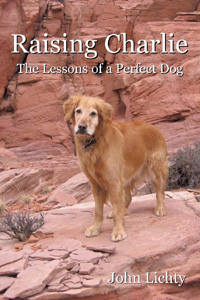 Raising Charlie: The Lessons of a Perfect Dog by John Lichty
Subscribe To

 Posts
All Comments
Posts
All Comments

Monday, April 19, 2010

Monday, April 12, 2010
Climbing Mt. Garfield
 The skyline to the northeast of Grand Junction is dominated by Mt. Garfield, western Colorado's version of the Rock of Gibraltar. Anyone who has ever driven through the area on Interstate 70 is familiar with this imposing peak. I have driven past it hundreds of times myself and wondered how hard it would be to climb. Yesterday, I finally found out. (Click the photos for full-size views.)
Last week, my friend and neighbor, Rich, who had already climbed Mt. Garfield three times before, invited Nan, Scout and me to climb it with him. Nan declined because she knew her legs would be sore after a trail race she was scheduled to run on Saturday, but I was up for it and Scout is always up for anything.
 The weather was perfect when we arrived at the trailhead, sunny and warm but with a cool breeze. Rich with his hiking poles and Scout with his doggie enthusiasm quickly pulled ahead going up the steep lower slopes. I splayed out my feet, leaned into the slope and grunted upwards until my calves and glutes were screaming. I stopped for a long pull off my CamelBak and looked up the trail to see how Rich and Scout were doing. They were already standing at the top of the first plateau, in the shade of a large hoodoo, waiting for me.
 From where I caught up to Rich and Scout, the trail flattened out somewhat as it wound up through large broken rocks. That stretch gave way to a beautiful meadow and then a long traverse across the face below the summit. When the trail turned right into a wide, deep gully for the final approach, the rocky climbing began again. At one point, we reached a place where Scout couldn't figure out how to get up a rocky ledge. He paced back and forth whining until I climbed back down and gave him a boost.
  The trail gradually leveled out and we found ourselves walking along the top of the sheer cliff that forms Mt. Garfield's distinctive summit. It was extremely windy, so we didn't risk getting close enough to be blown over the edge. Scout, with his ears blowing out like wings and his tongue flapping in the corner of his mouth, danced fearlessly along the edge until we called him back.
There is an old, bare flagpole that marks the summit. As windy as it is up there, a flag would be blown to shreds in a matter of days. We managed to find a calm spot and sat down to eat lunch. There wasn't any shade, so Scout hung out in my shadow to cool down. Rich and I shared our lunch with him, admired the views, took more photos and then headed back down the way we had come up, taking small to steps to avoid slipping on the grit that covered the dry slopes.
 It took about an hour and a half to get to the top and another hour to get down, not too bad for a climb that covers two thousand vertical feet in just two miles. If you get a chance to try it yourself, try to pick a cool, cloudy day and take plenty of water for you and your dog. The entire climb is up south-facing slopes that could turn into a reflector oven on hot days. It's also not a place you would want to be in a thunderstorm. Take care and have fun.
Monday, March 29, 2010
Happy Birthday to Charlie
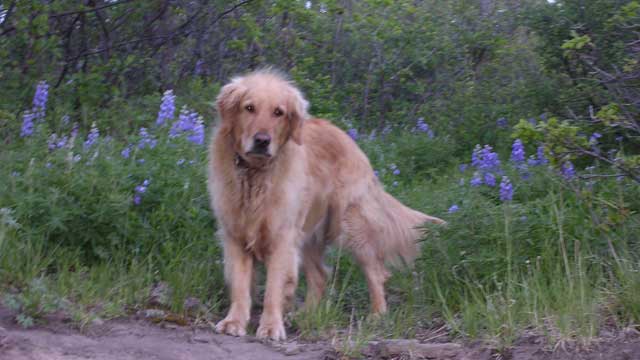 Today would have been our dog Charlie's twelfth birthday. I have been thinking about him today, as I still do every day, even though he died almost two years ago. Yesterday, I watched his YouTube video again, and it made me teary, just like it always does. He was such a good boy.
A little over a week ago, I was a guest on Wisconsin Public Radio's "At Issue with Ben Merens" to discuss the lessons we learn from our dogs, using "The Lessons of a Perfect Dog" from Raising Charlie as a starting point. Ben had just had to put his dog Maestro to sleep earlier that week, so it was an emotional hour. Listeners called in with their own dog stories, mostly in commiseration with Ben, and it became clear to me that everyone who has been through the loss of a beloved dog shares the same grief. Our dogs are family and losing them hurts as much as losing a family member.
Monday, March 22, 2010
Welcome to Grand Junction!
 Last month, when I read about the billboard in Wyoming, Minnesota, that featured a smiling, waving George W. Bush, with the caption, "Miss me yet?", I thought it was one of the most ridiculous things I had ever heard of. But the good citizens of my fair city, Grand Junction, Colorado, must have taken it as a challenge because one of them recently one-upped it in a big way. Yes, the billboard above is real. It sits near the intersection of 1st and Grand, about two miles from my home. Go ahead and click on it if you want to see the full 800x600 view.
The thinking behind this message is so foreign to me that I didn't even understand it at first. Obviously, Jimmy Carter's thought bubble is meant to imply that our current president, Barack Obama, has taken over the title of "worst president," but Obama has only been in office for just over a year. It's a little too soon to be making that kind of judgment, unless you're basing your opinion on factors other than job performance, like the man's skin color. Racism is alive and well here, and it was on full display at candidate Obama's rally in September 2008 and at President Obama's town hall meeting on health care in August 2009.
The more difficult thing for me to understand is Jimmy Carter in the role of previous "worst president." I will grant you that I didn't vote for him in either 1976 or 1980, but I most certainly did not vote for Gerald Ford or Ronald Reagan either. I voted for Independents in both of those elections. But Jimmy Carter as worst president? I don't get it. Like President Obama, he inherited an economic mess from the previous administration, and he was unlucky to be in office when the Iranians decided to take some Americans hostage. Still, he narrowly lost to Reagan in 1980, so how bad could he have been? Former President Carter is now widely regarded as the most effective former president in history, acting, along with his wife Rosalynn, as America's ambassador to the world.
I don't care how much Karl Rove tries to sugar-coat it in his new book, George W. Bush will go down in history as the worst president ever--far worse than even Andrew Johnson, the first president ever to face impeachment. We will be living with the unconscionable economic and political damage of the Bush years for decades to come. President Obama was elected to begin the repairs, but he has no cooperation from the party that helped to wreck things in the first place. Yesterday's purely partisan vote on health care reform is clear evidence of that.
A more realistic billboard might show Republicans Mitch McConnell, John Boehner, Eric Cantor and Mike Pence laughing hysterically and giving us all the finger. Now that's a message I could understand.
Wednesday, March 17, 2010
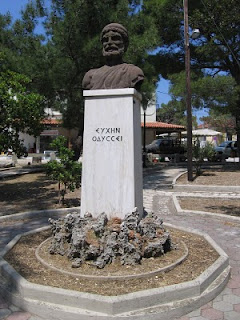
The Odd-yssey
Despite assurances from Editor Sue at Latitudes & Attitudes magazine that she would publish it eventually, it has been almost two years since I submitted the following article from our somewhat ill-fated Odyssey trip. St. Patrick's Day seems as good a day as any to post it on the blog. Don't tell her you saw it here first!
 The Odd-yssey
When Capt. John Kretschmer mentioned that he was thinking of re-creating the Odyssey by sailing from Troy to Ithaca, I couldn’t believe it. What a great idea! We were at the end of a successful passage from Fort Lauderdale to the Bahamas and back, and we were feeling that sense of accomplishment that makes you think you’re ready for whatever’s next. Follow in the footsteps of Ulysses, one of history’s greatest adventurers? Sure, why not? If he did it in a primitive galley, we could surely do it in a modern sailboat. And if it took him ten years, we could certainly do it in two weeks. These thoughts sustained me through the fifteen months of planning and preparation leading up to our voyage, which began on April 23 of 2008 and ended on May 7.
 There is much to be said in favor of spontaneity. Decide to do something and then go do it. No hesitation. No second-guessing. The fifteen months between the idea and the execution for the Odyssey trip gave us too much time to consider and then reconsider our plans. The original plan, based on the route detailed in Tim Severin’s The Ulysses Voyage: Sea Search for the Odyssey, called for us to fly into Izmir, on the west coast of Turkey, and then travel up the coast to the marina at Ayvalik, where we would meet up with Capt. John and his forty-seven foot 1987 Kaufman cutter, Quetzal. Our crew would consist of John, me, my wife Nan, and Harry and Velinda from the Bahamas trip. Since there are no marinas near the ancient ruins of Troy, in the furthest northwest corner of the Anatolian peninsula, we would travel overland to pay homage at the site of the Trojan War and its famous horse before retracing our route to begin our sail.
 From Ayvalik we would sail west along the north coast of the island of Lesbos and then roughly southwest toward the Doro Channel between the islands of Evvia and Andros. Ulysses (called Odysseus in Greek) had carefully worked his way counter-clockwise around the northern Aegean Sea, sailing during the day and camping on shore at night, but we wanted to get to the locations where the main events of Homer’s epic tale had reputedly taken place, starting with the Cyclops encounter on the southern coast of Crete. From there we would sail to the island of Gramvousa, off the northwest corner of Crete.
  Severin postulated that this was the place where Aeolus, the Ruler of the Winds, gave Ulysses the leather bag of wind he would need to cross back to the Greek mainland. After working our way west and north around the fingers of the Peloponnese peninsula, we would sail right past Ulysses’ home island of Ithaca, as he had also done, into the area where his encounters with Circe, the Clashing Rocks, the Sirens, Scylla and Charybdis had taken place. We would then retrace our route south to Ithaca before sailing north again to end our voyage in Corfu.
 By December the plans had changed. Instead of starting in Turkey, which would require greater travel expenses and the customs complication of arriving by plane but leaving by boat, it was decided that we would start in Athens and make a quick trip across the Aegean to Troy. John had worked a deal to have the Travel Channel film the voyage for a TV documentary, and they were counting on getting footage of us at Troy. John had also added another crewmember, Kevin.
 Nan and I arrived in Athens a few days before we were to set sail so we could tour the city and see the sights, including the Acropolis and the Parthenon. The evening before our Wednesday departure, we met up with everybody at the marina in Piraeus for dinner and a chart briefing. It was good to see John, Harry and Velinda again, and to meet Kevin. Nan was meeting them all for the first time. Over wine and authentic Greek food, we discussed the trip ahead. Everyone was excited to get going, even after John informed us that the deal with the Travel Channel had fallen through.
 After final fueling and provisioning, we were underway before noon the next day. Almost immediately, we experienced engine trouble. John had replaced the alternator the day before to correct a charging problem, and the belt slipped, filling the cockpit with burned-rubber smoke as it disintegrated. We sailed slowly along in the light winds as John worked in the engine compartment to replace the belt, but it was his last replacement so we agreed not to run the engine at more than 2,000 RPMs, the equivalent of five knots, for the rest of the trip.
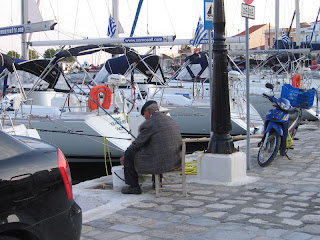 In the late afternoon, we arrived at Cape Sounion, about twenty-five miles southeast of Piraeus, and anchored within sight of the Temple of Poseidon. This was the first of our touchpoints with the Odyssey route, but we were coming at it from the wrong direction. Ulysses and his men stopped here on their way from Troy.
On Thursday morning, we set out early with the idea of making an overnight passage northeast to Turkey. By afternoon, the wind from the north had picked up dramatically and we were tightly pinched to make headway against it in eight-foot swells as we approached the Doro Channel. We were beginning to wonder if the meltemi, the strong northerly winds that occur every summer in the Aegean, had arrived early. John had purposely planned the trip early in the season to avoid the meltemi, but there was no getting around the fact that the wind was going to prevent us from getting to Turkey as planned. We steered toward the closest logical landfall at Gavrio, on the southern coast of Andros, but even the leeward harbor offered little protection as the winds continued building to gale force.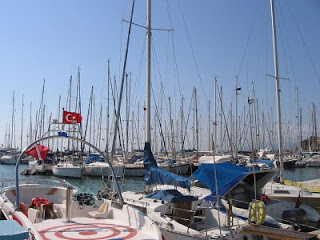 Our Med mooring put us perpendicular to the wind, requiring several lines from the boat to the quay just to hold us in place. Relieved to be safely ashore, we found a cozy taverna for dinner and a discussion of our options. We all agreed that if the strong winds continued, we would not be able to continue our northeastern tack. John proposed sailing east instead, staying in the lee of the Greek islands to temper the wind, and arriving in Turkey at Kusadasi, almost 200 miles south of Troy. The implication was clear: we would not be going to Troy. To ease the disappointment, John suggested we take an extra day in Turkey to visit Ephesus, the ancient Greek ruins located a short drive north of Kusadasi, perhaps figuring that some ruins were better than none.
 The wind was still howling on Friday morning, pinning us in place for the day. We wandered around Gavrio, shopped for provisions and killed time in an Internet café. Nan and I checked into a harborside hotel, hoping for a better night’s sleep and a decent shower. That evening we all watched as the local people celebrated Greek Orthodox Good Friday by parading through the streets carrying their church’s tabernacle and playing the funeral dirge on bugle and drums.
There was a small window of opportunity the following day, so we carefully exited the harbor and headed southeast along the protected coasts of Andros and Tinos. The wind picked up predictably as we crossed the gap to Mykonos, where we spent our fourth night at the new harbor north of town. It would have been worth the trip into town to see the distinctive “Greeky” architecture of white adobe buildings with bright blue trim for which Mykonos is known, but we lacked ground transportation and it was still off-season for most businesses.
 We awoke to rain on Sunday morning. The winds had moved on, replaced by dark clouds. We motored most of the distance east to the island of Ikaría, named for Icarus from Greek mythology, and arrived at Kirikos as the town was preparing to celebrate Greek Orthodox Easter. While we were tying up in the town’s small harbor, some local people were busy hanging Judas in effigy at the end of the dock. Later, when it was dark enough, we watched from a harborside taverna as they set the dummy on fire. The gathered crowd cheered as the fireworks stuffed inside were ignited, sending rockets in all directions. We had to admit we had never seen an Easter celebration to rival this one.
The clouds cleared but the wind didn’t return for the next leg of our trip east, to the island of Samos, just west of the Turkish coast. We moored at the new marina east of Pythagoria, the reputed birthplace of Pythagoras, the ancient mathematician credited with the theorem that bears his name. We made the muddy hike up and over the hill that separates the marina from town and were rewarded with a beautiful stroll along a stone boardwalk lined with tavernas on the one side and pastel-colored fishing boats on the other.
 There was still no wind for our final push to Turkey on Tuesday morning, so we motored with limp sails while dodging the many cruise ships going to and coming from Kusadasi. We arrived in the early afternoon and were immediately captivated by the place. Turkey was very much like Greece in its terrain and climate, but everything about it was more pleasant. It was cleaner and better organized, the people were friendlier, and the food was better. There was a noticeable sense of pride and patriotism. All of this was clearly evident at a neighborhood street market we stumbled upon as we wandered the city streets. Despite the language and culture differences, and the fact that we were the only Americans in the crowded market, the merchants were happy to assist us in buying spices and souvenirs.
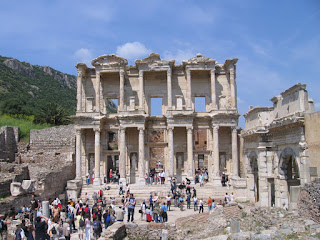
 Ephesus, our substitute Troy, was made memorable by Emre, our personal guide. He admitted at the beginning of our day trip the next day that he was hung over from drinking too much raki, but that didn’t prevent him from filling our heads with all the known history of the famous ruins, everything from the significance of the bull busts that topped one ancient wall to the fact that Marc Antony and Cleopatra had celebrated their honeymoon here.
Our couple of days in Turkey were the highlight of our trip, but it had taken us a full week to get there. We needed to be 500 miles to the west, all the way to Corfu, within another week to make our travel connections. We would need to hurry. Crete, the site of the most memorable Odyssey events, would need to be skipped. Not only that, we would need to make a series of overnight passages, with very few landfalls.
 Our first passage had us leaving Kusadasi before dawn and sailing continuously for more than 300 miles over two nights and three days to reach Methoni, at the southwest corner of the Peloponnese peninsula. We spent the night anchored offshore from the beach that draws summer crowds to this scenic town and its well-preserved Venetian-era castle.
Short on fuel from frequent light-air motoring, we were lucky to find a fuel truck willing to deliver on a Sunday morning when we pulled into the harbor at Pylos, just a few miles up the coast from Methoni. Then it was north to Ithaca on our second overnight passage.
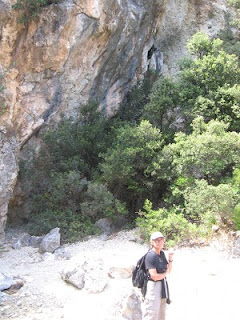 Early the next morning, we anchored in the beautiful harbor of Vathi on Ithaca. Not counting Methoni and Pylos, where Ulysses and his crew must have stopped on their way north, Ithaca was only the second touchpoint of our Odyssey trip after the Temple of Poseidon on Cape Sounion. We planned to make the most of it, renting cars to drive to the Cave of the Nymphs in the northern part of the island, where Ulysses hid his treasure after returning home. The cave had collapsed during the 1953 Kefalonia earthquake so there was not much to see, but standing at the shore below, it was easy to imagine Ulysses washing up in the crystalline waters of Polis Bay after twenty years away from home.
We headed north in the afternoon for the island of Corfu, our last overnight passage and the last leg of our trip. The capital city of Corfu, with its imposing Venetian citadel and Great Cross, were a welcome sight through the mist the next morning. We sailed past the city a few miles to the town of Gouvia, where Corfu’s primary marina is located, and Med moored for the final time.
 Nan and I went off in search of the hotel we had booked for the next three nights, and John went off to see if he could clear us in to Greece at the marina’s customs office. We had cleared in and out of Turkey at the Kusadasi marina, but since leaving Turkey, we had never been in one place long enough or during business hours on a weekday to clear back in to Greece. When Nan and I returned to the boat to pack up and move, John informed us that since it was off-season and the marina’s customs office was closed, we would all need to go into Corfu city to clear in. Tired, hungry and grubby, Nan and I stood with the others at the bus stop, regretting that we hadn’t made a detour to Samos or somewhere right after we left Turkey to take care of this necessary detail. Three hours later, after trudging through the rainy cobblestone streets, visiting first one office and then another and then yet another, and waiting interminable periods in sterile waiting rooms, we were cleared. Nan and I caught the first taxi we could find back to the marina, packed up and caught another taxi to the hotel.
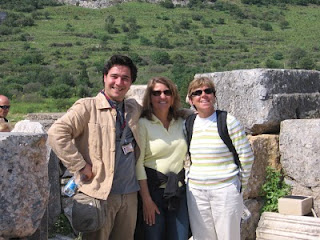
 After showers, clean clothes, an excellent meal and a good night’s sleep, we felt human again. We ate breakfast at the hotel and then walked back to the marina. John was preparing the boat to be left on its own for a few weeks, and he and Kevin were packing up so they could catch a flight to Athens that afternoon. Harry and Velinda were going to stay on the boat for a few days to take in the sights of Corfu. We talked the nice owners of the Hinckley next to us into taking our picture, then we exchanged contact information, shook hands and hugged. Our Odyssey was over.
 While it is certainly true that we in no small way duplicated the voyage of Ulysses, I believe that our adventure in his part of the world more than lived up to Capt. John’s hope for it when he wrote in an email message before the trip: “I am searching for the spirit of Odysseus as much as anything.”
 The Odd-yssey
When Capt. John Kretschmer mentioned that he was thinking of re-creating the Odyssey by sailing from Troy to Ithaca, I couldn’t believe it. What a great idea! We were at the end of a successful passage from Fort Lauderdale to the Bahamas and back, and we were feeling that sense of accomplishment that makes you think you’re ready for whatever’s next. Follow in the footsteps of Ulysses, one of history’s greatest adventurers? Sure, why not? If he did it in a primitive galley, we could surely do it in a modern sailboat. And if it took him ten years, we could certainly do it in two weeks. These thoughts sustained me through the fifteen months of planning and preparation leading up to our voyage, which began on April 23 of 2008 and ended on May 7.
 There is much to be said in favor of spontaneity. Decide to do something and then go do it. No hesitation. No second-guessing. The fifteen months between the idea and the execution for the Odyssey trip gave us too much time to consider and then reconsider our plans. The original plan, based on the route detailed in Tim Severin’s The Ulysses Voyage: Sea Search for the Odyssey, called for us to fly into Izmir, on the west coast of Turkey, and then travel up the coast to the marina at Ayvalik, where we would meet up with Capt. John and his forty-seven foot 1987 Kaufman cutter, Quetzal. Our crew would consist of John, me, my wife Nan, and Harry and Velinda from the Bahamas trip. Since there are no marinas near the ancient ruins of Troy, in the furthest northwest corner of the Anatolian peninsula, we would travel overland to pay homage at the site of the Trojan War and its famous horse before retracing our route to begin our sail.
 From Ayvalik we would sail west along the north coast of the island of Lesbos and then roughly southwest toward the Doro Channel between the islands of Evvia and Andros. Ulysses (called Odysseus in Greek) had carefully worked his way counter-clockwise around the northern Aegean Sea, sailing during the day and camping on shore at night, but we wanted to get to the locations where the main events of Homer’s epic tale had reputedly taken place, starting with the Cyclops encounter on the southern coast of Crete. From there we would sail to the island of Gramvousa, off the northwest corner of Crete.
  Severin postulated that this was the place where Aeolus, the Ruler of the Winds, gave Ulysses the leather bag of wind he would need to cross back to the Greek mainland. After working our way west and north around the fingers of the Peloponnese peninsula, we would sail right past Ulysses’ home island of Ithaca, as he had also done, into the area where his encounters with Circe, the Clashing Rocks, the Sirens, Scylla and Charybdis had taken place. We would then retrace our route south to Ithaca before sailing north again to end our voyage in Corfu.
 By December the plans had changed. Instead of starting in Turkey, which would require greater travel expenses and the customs complication of arriving by plane but leaving by boat, it was decided that we would start in Athens and make a quick trip across the Aegean to Troy. John had worked a deal to have the Travel Channel film the voyage for a TV documentary, and they were counting on getting footage of us at Troy. John had also added another crewmember, Kevin.
 Nan and I arrived in Athens a few days before we were to set sail so we could tour the city and see the sights, including the Acropolis and the Parthenon. The evening before our Wednesday departure, we met up with everybody at the marina in Piraeus for dinner and a chart briefing. It was good to see John, Harry and Velinda again, and to meet Kevin. Nan was meeting them all for the first time. Over wine and authentic Greek food, we discussed the trip ahead. Everyone was excited to get going, even after John informed us that the deal with the Travel Channel had fallen through.
 After final fueling and provisioning, we were underway before noon the next day. Almost immediately, we experienced engine trouble. John had replaced the alternator the day before to correct a charging problem, and the belt slipped, filling the cockpit with burned-rubber smoke as it disintegrated. We sailed slowly along in the light winds as John worked in the engine compartment to replace the belt, but it was his last replacement so we agreed not to run the engine at more than 2,000 RPMs, the equivalent of five knots, for the rest of the trip.
 In the late afternoon, we arrived at Cape Sounion, about twenty-five miles southeast of Piraeus, and anchored within sight of the Temple of Poseidon. This was the first of our touchpoints with the Odyssey route, but we were coming at it from the wrong direction. Ulysses and his men stopped here on their way from Troy.
On Thursday morning, we set out early with the idea of making an overnight passage northeast to Turkey. By afternoon, the wind from the north had picked up dramatically and we were tightly pinched to make headway against it in eight-foot swells as we approached the Doro Channel. We were beginning to wonder if the meltemi, the strong northerly winds that occur every summer in the Aegean, had arrived early. John had purposely planned the trip early in the season to avoid the meltemi, but there was no getting around the fact that the wind was going to prevent us from getting to Turkey as planned. We steered toward the closest logical landfall at Gavrio, on the southern coast of Andros, but even the leeward harbor offered little protection as the winds continued building to gale force.
 Our Med mooring put us perpendicular to the wind, requiring several lines from the boat to the quay just to hold us in place. Relieved to be safely ashore, we found a cozy taverna for dinner and a discussion of our options. We all agreed that if the strong winds continued, we would not be able to continue our northeastern tack. John proposed sailing east instead, staying in the lee of the Greek islands to temper the wind, and arriving in Turkey at Kusadasi, almost 200 miles south of Troy. The implication was clear: we would not be going to Troy. To ease the disappointment, John suggested we take an extra day in Turkey to visit Ephesus, the ancient Greek ruins located a short drive north of Kusadasi, perhaps figuring that some ruins were better than none.
 The wind was still howling on Friday morning, pinning us in place for the day. We wandered around Gavrio, shopped for provisions and killed time in an Internet café. Nan and I checked into a harborside hotel, hoping for a better night’s sleep and a decent shower. That evening we all watched as the local people celebrated Greek Orthodox Good Friday by parading through the streets carrying their church’s tabernacle and playing the funeral dirge on bugle and drums.
There was a small window of opportunity the following day, so we carefully exited the harbor and headed southeast along the protected coasts of Andros and Tinos. The wind picked up predictably as we crossed the gap to Mykonos, where we spent our fourth night at the new harbor north of town. It would have been worth the trip into town to see the distinctive “Greeky” architecture of white adobe buildings with bright blue trim for which Mykonos is known, but we lacked ground transportation and it was still off-season for most businesses.
 We awoke to rain on Sunday morning. The winds had moved on, replaced by dark clouds. We motored most of the distance east to the island of Ikaría, named for Icarus from Greek mythology, and arrived at Kirikos as the town was preparing to celebrate Greek Orthodox Easter. While we were tying up in the town’s small harbor, some local people were busy hanging Judas in effigy at the end of the dock. Later, when it was dark enough, we watched from a harborside taverna as they set the dummy on fire. The gathered crowd cheered as the fireworks stuffed inside were ignited, sending rockets in all directions. We had to admit we had never seen an Easter celebration to rival this one.
The clouds cleared but the wind didn’t return for the next leg of our trip east, to the island of Samos, just west of the Turkish coast. We moored at the new marina east of Pythagoria, the reputed birthplace of Pythagoras, the ancient mathematician credited with the theorem that bears his name. We made the muddy hike up and over the hill that separates the marina from town and were rewarded with a beautiful stroll along a stone boardwalk lined with tavernas on the one side and pastel-colored fishing boats on the other.
 There was still no wind for our final push to Turkey on Tuesday morning, so we motored with limp sails while dodging the many cruise ships going to and coming from Kusadasi. We arrived in the early afternoon and were immediately captivated by the place. Turkey was very much like Greece in its terrain and climate, but everything about it was more pleasant. It was cleaner and better organized, the people were friendlier, and the food was better. There was a noticeable sense of pride and patriotism. All of this was clearly evident at a neighborhood street market we stumbled upon as we wandered the city streets. Despite the language and culture differences, and the fact that we were the only Americans in the crowded market, the merchants were happy to assist us in buying spices and souvenirs.
 Ephesus, our substitute Troy, was made memorable by Emre, our personal guide. He admitted at the beginning of our day trip the next day that he was hung over from drinking too much raki, but that didn’t prevent him from filling our heads with all the known history of the famous ruins, everything from the significance of the bull busts that topped one ancient wall to the fact that Marc Antony and Cleopatra had celebrated their honeymoon here.
Our couple of days in Turkey were the highlight of our trip, but it had taken us a full week to get there. We needed to be 500 miles to the west, all the way to Corfu, within another week to make our travel connections. We would need to hurry. Crete, the site of the most memorable Odyssey events, would need to be skipped. Not only that, we would need to make a series of overnight passages, with very few landfalls.
 Our first passage had us leaving Kusadasi before dawn and sailing continuously for more than 300 miles over two nights and three days to reach Methoni, at the southwest corner of the Peloponnese peninsula. We spent the night anchored offshore from the beach that draws summer crowds to this scenic town and its well-preserved Venetian-era castle.
Short on fuel from frequent light-air motoring, we were lucky to find a fuel truck willing to deliver on a Sunday morning when we pulled into the harbor at Pylos, just a few miles up the coast from Methoni. Then it was north to Ithaca on our second overnight passage.
 Early the next morning, we anchored in the beautiful harbor of Vathi on Ithaca. Not counting Methoni and Pylos, where Ulysses and his crew must have stopped on their way north, Ithaca was only the second touchpoint of our Odyssey trip after the Temple of Poseidon on Cape Sounion. We planned to make the most of it, renting cars to drive to the Cave of the Nymphs in the northern part of the island, where Ulysses hid his treasure after returning home. The cave had collapsed during the 1953 Kefalonia earthquake so there was not much to see, but standing at the shore below, it was easy to imagine Ulysses washing up in the crystalline waters of Polis Bay after twenty years away from home.
We headed north in the afternoon for the island of Corfu, our last overnight passage and the last leg of our trip. The capital city of Corfu, with its imposing Venetian citadel and Great Cross, were a welcome sight through the mist the next morning. We sailed past the city a few miles to the town of Gouvia, where Corfu’s primary marina is located, and Med moored for the final time.
 Nan and I went off in search of the hotel we had booked for the next three nights, and John went off to see if he could clear us in to Greece at the marina’s customs office. We had cleared in and out of Turkey at the Kusadasi marina, but since leaving Turkey, we had never been in one place long enough or during business hours on a weekday to clear back in to Greece. When Nan and I returned to the boat to pack up and move, John informed us that since it was off-season and the marina’s customs office was closed, we would all need to go into Corfu city to clear in. Tired, hungry and grubby, Nan and I stood with the others at the bus stop, regretting that we hadn’t made a detour to Samos or somewhere right after we left Turkey to take care of this necessary detail. Three hours later, after trudging through the rainy cobblestone streets, visiting first one office and then another and then yet another, and waiting interminable periods in sterile waiting rooms, we were cleared. Nan and I caught the first taxi we could find back to the marina, packed up and caught another taxi to the hotel.
 After showers, clean clothes, an excellent meal and a good night’s sleep, we felt human again. We ate breakfast at the hotel and then walked back to the marina. John was preparing the boat to be left on its own for a few weeks, and he and Kevin were packing up so they could catch a flight to Athens that afternoon. Harry and Velinda were going to stay on the boat for a few days to take in the sights of Corfu. We talked the nice owners of the Hinckley next to us into taking our picture, then we exchanged contact information, shook hands and hugged. Our Odyssey was over.
 While it is certainly true that we in no small way duplicated the voyage of Ulysses, I believe that our adventure in his part of the world more than lived up to Capt. John’s hope for it when he wrote in an email message before the trip: “I am searching for the spirit of Odysseus as much as anything.”
Sunday, March 14, 2010
George Carlin's "The Planet is Fine"
Comedian George Carlin died almost two years ago. If he were still alive, I'm sure he would offer us his unique perspective on the recent earthquakes devastating parts of the planet. But since he's gone, we'll need to settle for one of his finest monologues, from August 2007, to explain our current situation:
Happy Pi Day! And happy birthday, Albert Einstein!
You got people like this around you? The country’s full of them now. People walking around all day long, every minute of the day, worried about everything! Worried about the air. Worried about the water. Worried about the soil. Worried about insecticides, pesticides, food additives, carcinogens. Worried about radon gas. Worried about asbestos. Worried about saving endangered species.Thank you, George!
Let me tell you about endangered species, all right? Saving endangered species is just one more arrogant attempt by humans to control nature. It’s arrogant meddling. It’s what got us in trouble in the first place. Doesn’t anybody understand that? Interfering with nature. Over ninety percent—over, way over—ninety percent of all the species that have ever lived on this planet—ever lived—are gone. Whooissssht! They’re extinct. We didn’t kill them all. They just disappeared. That’s what nature does. They disappear these days at the rate of twenty-five a day—and I mean regardless of our behavior. Irrespective of how we act on this planet, twenty-five species that were here today will be gone tomorrow. Let them go gracefully. Leave nature alone. Haven’t we done enough?
We’re so self-important. So self-important. Everybody’s going to save something now. Save the trees. Save the bees. Save the whales. Save those snails. And the greatest arrogance of all: Save the planet. What?! Are these fucking people kidding me? Save the planet? We don’t even know how to take care of ourselves yet. We haven’t learned how to care for one another! We’re going to save the fucking planet? I’m getting tired of that shit. Tired of that shit. Tired. I’m tired of fucking Earth Day. I’m tired of these self-righteous environmentalists, these white bourgeois liberals who think the only thing wrong with this country is there aren’t enough bicycle paths. People trying to make the world safe for their Volvos. Besides, environmentalists don’t give a shit about the planet. They don’t care about the planet. Not in the abstract, they don’t. Not in the abstract, they don’t. You know what they’re interested in? A clean place to live. Their own habitat. They’re worried that some day in the future, they might be personally inconvenienced. Narrow, unenlightened self-interest doesn’t impress me.
Besides, there is nothing wrong with the planet. Nothing wrong with the planet. The planet is fine. The people are fucked. Difference! Difference! The planet is fine. Compared to the people, the planet is doing great. It’s been here four and a half billion years. Did you ever think about the arithmetic? The planet has been here four and a half billion years. We’ve been here, what, a hundred thousand? Maybe two hundred thousand? And we’ve only been engaged in heavy industry for a little over two hundred years. Two hundred years versus four and a half billion. And we have the conceit to think that somehow we’re a threat? That somehow we’re going to put in jeopardy this beautiful little blue-green ball that’s just a-floating around the sun?
The planet has been through a lot worse than us. Been through all kinds of things worse than us. Been through earthquakes, volcanoes, plate tectonics, continental drift, solar flares, sun spots, magnetic storms, the magnetic reversal of the poles, hundreds of thousands of years of bombardment by comets and asteroids and meteors, worldwide floods, tidal waves, worldwide fires, erosion, cosmic rays, recurring ice ages. And we think some plastic bags and some aluminum cans are going to make a difference? The planet, the planet, the planet isn’t going anywhere. We are! We’re going away. Pack your shit, folks. We’re going away. And we won’t leave much of a trace, either. Thank God for that. Maybe a little styrofoam. Maybe. A little styrofoam. The planet’ll be here and we’ll be long gone. Just another failed mutation. Just another closed-end biological mistake. An evolutionary cul-de-sac. The planet’ll shake us off like a bad case of fleas. A surface nuisance.
You want to know how the planet’s doing? Ask those people at Pompeii, who are frozen into position from volcanic ash, how the planet’s doing. You want to know if the planet’s all right, ask those people in Mexico City or Armenia or a hundred other places, buried under thousands of tons of earthquake rubble, if they feel like a threat to the planet this week. Or how about those people in Kilauea, Hawaii, who built their homes right next to an active volcano, and then wonder why they have lava in the living room.
The planet will be here for a long, long, long time after we’re gone. And it will heal itself, it will cleanse itself, because that’s what it does. It’s a self-correcting system. The air and the water will recover, the earth will be renewed, and if it’s true that plastic is not degradable, well, the planet will simply incorporate plastic into a new paradigm: The earth plus plastic. The earth doesn’t share our prejudice towards plastic. Plastic came out of the earth. The earth probably sees plastic as just another one of its children. Could be the only reason the earth allowed us to be spawned from it in the first place. It wanted plastic for itself. Didn’t know how to make it. Needed us. Could be the answer to our age-old philosophical question, why are we here? Plastic, assholes!
So. So the plastic is here. Our job is done. We can be phased out now. And I think that’s really started already, don’t you? I mean, to be fair, the planet probably sees us as a mild threat. Something to be dealt with. And I’m sure the planet will defend itself in the manner of a large organism, like a bee hive or an ant colony can muster a defense. I’m sure the planet will think of something. What would you do if you were the planet trying to defend against this pesky, troublesome species? Let’s see. What would…? Hmm. Viruses. Viruses might be good. They seem vulnerable to viruses. And viruses are tricky. Always mutating and forming new strains whenever a vaccine is developed. Perhaps this earth virus could be one that compromises the immune system of these creatures. Perhaps a human immune-deficiency virus, making them vulnerable to all sorts of other diseases and infections that might come along. Any maybe it could be spread sexually, making them a little reluctant to engage in the act of reproduction.
Well, that’s a poetic note. And it’s a start. And I can dream, can’t I? You see, I don’t worry about the little things. Bees. Trees. Whales. Snails. I think we’re part of a greater wisdom than we will ever understand. A higher order. Call it what you want. You know what I call it? The Big Electron. The Big Electron. Whoaaa! Whoaaa! Whoaaa! It doesn’t punish. It doesn’t reward. It doesn’t judge at all. It just is. And so are we. For a little while.
Happy Pi Day! And happy birthday, Albert Einstein!
Friday, March 5, 2010
Formatting a book for Kindle
I just finished formatting Raising Charlie for Amazon's Kindle reading device, and it wasn't easy. At first, I wasn't sure I would even be able to do it myself, but then I was looking at my Author Central page on Amazon's website and saw a link titled "Publish your content on Kindle". It brought up Amazon's Digital Text Platform, a step-by-step process that I could follow to publish a book for Kindle and have it be available for sale through Amazon.com. The fill-in-the-blanks part of the process was simple enough, except that I needed to purchase a new ISBN number for the electronic version of my book, which I did through Bowkers (https://www.myidentifiers.com/).
The difficult part of the process was converting my original manuscript so it would look right and work correctly on the Kindle. There is a note in the "Upload & Preview Book" section that reads, "For optimal results, please upload files in MS Word, HTML, or PRC format." The manuscript was in Microsoft Word format, so I thought I would try to upload it in that format first. The preview, which appeared in a small, onscreen version of a Kindle, looked terrible. I went back to Word and did a "Save As" to "Web Page" format to convert the manuscript into HTML. When it was uploaded and previewed, it looked better than the Word version, but my embedded images were missing.
An extensive Google search on "Kindle images" brought up all kinds of advice about resizing and formatting, but the best advice I found was to use a free software application called Mobipocket Creator. It creates the PRC format that Amazon mentioned in their note and gives the user the greatest control over how the finished file will look and work, including the ability to add a front cover image and a table of contents. My first few uploads and previews using the new software were big improvements over Word and HTML, but my images were still missing. On a whim, I tried using Word's "Web Page, Filtered" format, and when I imported the resulting file into Mobipocket Creator and then uploaded and previewed it, there were my images. They were much too big, of course, but that was a relatively easy fix.
At this point, I realized that I was not going to be absolutely confident about how my book would look on the Kindle unless I could see it firsthand, so I ordered one from Amazon. It arrived on Wednesday. Before I continue, I need to say that the Kindle is the coolest device I have seen since the iPhone came out. If you're a serious reader and you travel frequently, you owe it to yourself to get one.
After I figured out how to operate my new Kindle, I downloaded my first book, What the Dog Saw by Malcolm Gladwell, to see how a Kindle book should look. I also connected the Kindle to my computer so I could copy over the latest PRC version of my manuscript. It didn't look too bad, but it needed some final tweaking before it would look as good as Mr. Gladwell's book.
I opened the manuscript in Word again and deleted any page breaks that were there for the purposes of the printed book. The Kindle has its own unique way of handling pages, and it doesn't even use page numbers. Instead, I inserted page breaks only at the top of text sections that should begin on new pages, while also deleting any hard returns and indents that were there for appearance only. I resized the paw-print and dog-bone separator images by fifty percent, using Word's built-in image formatting, and was pleased with the results. I found that the twenty photos in the middle of the book resized well automatically if they were in landscape orientation but were too big if they were in portrait orientation. Some of these large images worked well at a seventy-five percent reduction and others at sixty percent depending on how much caption text was beneath each one. Finally, I added a chapter header for the photographs section so it would become an item in the table of contents rather than just be a series of pages at the end of a chapter, as it is in the printed book.
The upload and preview process took a tremendous amount of trial and error. I probably uploaded at least twenty different versions of the manuscript, first to Amazon's Digital Text Platform and then to the new Kindle, before I was finally happy, uploaded the finished version, and clicked the Publish button. Having the Kindle to use for previews was the key. It doesn't make sense to self-publish Kindle versions of books without one.
Amazon does a final review of every book submitted for Kindle publishing, which takes two to three days, so Raising Charlie should be available in Kindle version by early next week sometime at Amazon.com. Look for it there!
The difficult part of the process was converting my original manuscript so it would look right and work correctly on the Kindle. There is a note in the "Upload & Preview Book" section that reads, "For optimal results, please upload files in MS Word, HTML, or PRC format." The manuscript was in Microsoft Word format, so I thought I would try to upload it in that format first. The preview, which appeared in a small, onscreen version of a Kindle, looked terrible. I went back to Word and did a "Save As" to "Web Page" format to convert the manuscript into HTML. When it was uploaded and previewed, it looked better than the Word version, but my embedded images were missing.
An extensive Google search on "Kindle images" brought up all kinds of advice about resizing and formatting, but the best advice I found was to use a free software application called Mobipocket Creator. It creates the PRC format that Amazon mentioned in their note and gives the user the greatest control over how the finished file will look and work, including the ability to add a front cover image and a table of contents. My first few uploads and previews using the new software were big improvements over Word and HTML, but my images were still missing. On a whim, I tried using Word's "Web Page, Filtered" format, and when I imported the resulting file into Mobipocket Creator and then uploaded and previewed it, there were my images. They were much too big, of course, but that was a relatively easy fix.
At this point, I realized that I was not going to be absolutely confident about how my book would look on the Kindle unless I could see it firsthand, so I ordered one from Amazon. It arrived on Wednesday. Before I continue, I need to say that the Kindle is the coolest device I have seen since the iPhone came out. If you're a serious reader and you travel frequently, you owe it to yourself to get one.
After I figured out how to operate my new Kindle, I downloaded my first book, What the Dog Saw by Malcolm Gladwell, to see how a Kindle book should look. I also connected the Kindle to my computer so I could copy over the latest PRC version of my manuscript. It didn't look too bad, but it needed some final tweaking before it would look as good as Mr. Gladwell's book.
I opened the manuscript in Word again and deleted any page breaks that were there for the purposes of the printed book. The Kindle has its own unique way of handling pages, and it doesn't even use page numbers. Instead, I inserted page breaks only at the top of text sections that should begin on new pages, while also deleting any hard returns and indents that were there for appearance only. I resized the paw-print and dog-bone separator images by fifty percent, using Word's built-in image formatting, and was pleased with the results. I found that the twenty photos in the middle of the book resized well automatically if they were in landscape orientation but were too big if they were in portrait orientation. Some of these large images worked well at a seventy-five percent reduction and others at sixty percent depending on how much caption text was beneath each one. Finally, I added a chapter header for the photographs section so it would become an item in the table of contents rather than just be a series of pages at the end of a chapter, as it is in the printed book.
The upload and preview process took a tremendous amount of trial and error. I probably uploaded at least twenty different versions of the manuscript, first to Amazon's Digital Text Platform and then to the new Kindle, before I was finally happy, uploaded the finished version, and clicked the Publish button. Having the Kindle to use for previews was the key. It doesn't make sense to self-publish Kindle versions of books without one.
Amazon does a final review of every book submitted for Kindle publishing, which takes two to three days, so Raising Charlie should be available in Kindle version by early next week sometime at Amazon.com. Look for it there!
Friday, February 26, 2010
Lost in Space
When I was a kid in the sixties, my friends and I were crazy about the NASA space program. Astronauts were our heroes, and my friend, Gary Benskin, wanted to be one when he grew up. He even built a model of the Gemini 4 space capsule, complete with astronaut Ed White floating outside it for the first American space walk.
Back then, during the Cold War, when the United States was competing with Russia in the "space race," every launch was a huge deal. My teacher would wheel a TV into our classroom so we could watch the live telecasts from Cape Canaveral. We studied astronomy and built "scale" models of the solar system. Even The Weekly Reader featured articles about space. I remember one story that included a photo of a test rocket that would be able to land on an airport runway instead of splashing down in the ocean. That, of course, was the space shuttle, which has dominated the space program since the last manned mission to the moon in December 1972 by Apollo 17 but is destined to be sidelined later this year.
I sometimes ask people what they think is the pinnacle of human history. Most don't have an answer, but when I tell them that for me, it is the Apollo 11 moon landing on July 20, 1969, they usually agree. Unfortunately, it has been all downhill since then. Sure, we have sent probes out to explore our solar system and beyond, and we have built some impressive space stations, but we have not revisited the moon in almost forty years. When I saw 2001: A Space Odyssey in 1968 ("Thank you, Arthur C. Clarke"), I imagined that the future would be just like that: shuttles whisking people between the earth and space, scientists colonizing the moon, and astronauts exploring deep space with the help of intelligent robots. Almost none of that has happened, and for me, that is the greatest unrealized dream and deepest disappointment of my life.
Now the Obama administration is scrapping the Constellation program, which would have put us back on the moon by 2020. The implication is that we would be better off putting our resources into planning a manned mission to Mars, but NASA authorities say that there are too many unknowns to be able to meet that same timeline, or any timeline for that matter, without the research and development that would have come out of the Constellation program. So the space program will be essentially operating without a long-range plan. For people my age, who had hoped to see man walk on Mars in our lifetimes, who had even dreamed of going there themselves one day, this is terrible news.
Back then, during the Cold War, when the United States was competing with Russia in the "space race," every launch was a huge deal. My teacher would wheel a TV into our classroom so we could watch the live telecasts from Cape Canaveral. We studied astronomy and built "scale" models of the solar system. Even The Weekly Reader featured articles about space. I remember one story that included a photo of a test rocket that would be able to land on an airport runway instead of splashing down in the ocean. That, of course, was the space shuttle, which has dominated the space program since the last manned mission to the moon in December 1972 by Apollo 17 but is destined to be sidelined later this year.
I sometimes ask people what they think is the pinnacle of human history. Most don't have an answer, but when I tell them that for me, it is the Apollo 11 moon landing on July 20, 1969, they usually agree. Unfortunately, it has been all downhill since then. Sure, we have sent probes out to explore our solar system and beyond, and we have built some impressive space stations, but we have not revisited the moon in almost forty years. When I saw 2001: A Space Odyssey in 1968 ("Thank you, Arthur C. Clarke"), I imagined that the future would be just like that: shuttles whisking people between the earth and space, scientists colonizing the moon, and astronauts exploring deep space with the help of intelligent robots. Almost none of that has happened, and for me, that is the greatest unrealized dream and deepest disappointment of my life.
Now the Obama administration is scrapping the Constellation program, which would have put us back on the moon by 2020. The implication is that we would be better off putting our resources into planning a manned mission to Mars, but NASA authorities say that there are too many unknowns to be able to meet that same timeline, or any timeline for that matter, without the research and development that would have come out of the Constellation program. So the space program will be essentially operating without a long-range plan. For people my age, who had hoped to see man walk on Mars in our lifetimes, who had even dreamed of going there themselves one day, this is terrible news.
Tuesday, February 16, 2010
Mathew Brady’s Assistant (A Fictional History)
Alexander Gardner, a twenty-nine-year-old Scotsman from Glasgow, attended Prince Albert and Queen Victoria’s Great Exhibition in London’s Hyde Park in May, 1851. There he viewed an exhibit of photographs by the American photographer, Mathew Brady, and was inspired to apply his interest in chemistry to the relatively new science of photography.
When Alexander returned home, he began to experiment with the collodion, or wet-plate, process of taking and developing photographs, which resulted in prints that were far superior in quality to those created using the more common daguerreotype process.
Wanting to impress his wife, Margaret, with his newfound talent, Alexander set up his camera and tripod in the parlor of their home on a sunny Saturday afternoon for a family portrait. The shutter had not yet been invented, so exposure was controlled by removing and then replacing the lens cap. This made it impossible for Alexander to both take a photograph and be a subject in it at the same time. Thus, his first family photograph was of Margaret and their two children alone.
It was bedtime before Alexander emerged from his improvised darkroom with a finished print of the family photograph in his hands. He hurried up the stairs to the bedroom to show it to Margaret, who was seated at her dressing table brushing her hair. She saw him in the mirror, turned to see the photograph, and gasped.
“What is it, dear?” Alexander asked in alarm.
“Well, I recognize the children, but who is that woman standing with them?”
“Why, that’s you, of course.”
“But it can’t be! I look nothing like that!” She turned back to the mirror and pointed at her reflection. “That is how I look! Your picture is completely wrong!”
Thinking quickly, Alexander held the photograph in front of his chest and moved next to where Margaret was sitting. Catching her eye in the mirror, he asked, “Is this better?”
Margaret shifted her focus to the reflection of the photograph and narrowed her eyes in concentration. “Yes. It is. Now it looks right.” She picked up her hairbrush and resumed brushing her hair. “I never want to see that awful picture again.”
Deeply disappointed, Alexander lay awake in bed long into the night trying to think of a possible solution to this unexpected problem. His wife had never seen an image of herself that was not a reflection and so believed the reflection to be her true image. But the camera did not take reflections; it took only true images. As dawn began to lighten the edges of the window shades, he believed he had found an answer.
Alexander went through his family’s Sunday morning routine with no hint of what he was planning. At breakfast, when the children asked about the previous day’s photograph, he met Margaret’s eyes and said, “It didn’t turn out well, so I destroyed it. We’ll try again later today, after lunch. I promise.” Margaret raised her eyebrows as if to ask what he could possibly have in mind but said nothing. They finished breakfast, dressed in their finest clothes, and walked to church.
Later, while Margaret prepared lunch in the kitchen and the children played outside, Alexander quietly got up from reading his newspaper in the parlor, carried his camera and tripod up to the bedroom, and then returned to his reading.
As they finished lunch, the children reminded their father about his promise to take another photograph. Alexander responded as if he had forgotten, “Yes, that’s right. I did promise, didn’t I?” He pushed away from the table and stood up. “Well, let’s go try our luck.”
He led his family into the parlor. “Father, where is the camera?” the younger child asked.
“I thought we would try something different,” he replied. “I moved it up to the bedroom.”
The children giggled as he led them and Margaret up the stairs. In the bedroom, the camera and tripod stood facing Margaret’s dressing table. Her chair was positioned to the right facing the camera, across from a short stool, with the dressing table’s full-length mirror between the two seats. Alexander escorted Margaret to her chair and placed the younger child on her lap. He posed the older child on the stool and then walked to the back of the camera. He had prepared a wet plate earlier, so all he needed to do was to adjust the focus. As he looked through his viewfinder, he noticed the perplexed expressions on his family’s faces and smiled.
“All right. Now, Margaret, you and I are going to switch places.” He walked over and plucked the child from her lap. Margaret stood up and walked uncertainly to the camera as Alexander sat and positioned the child on his lap.
“That’s it, dear,” Alexander said. “But instead of standing behind the camera, step to the side of it. There! Do you see it?”
Margaret looked at the scene before her and did indeed see it. Her image was reflected in the mirror as though she were standing with her family seated in front of her.
Alexander directed her and the children, “Margaret, all you need to do is reach out with your right hand and remove the lens cap, count to ten, and then replace it. Children, you must remain absolutely still.”
Margaret moved her hand toward the camera and noticed her reflected hand moving in the mirror. With her fingers touching the lens cap, her reflected hand appeared to be resting behind Alexander’s shoulder. She moved her left hand to position it so it looked like it was resting on her older child’s back. The effect was so real that she couldn’t help but smile. Her family smiled back to see her so delighted. Without moving, she removed the lens cap, counted to ten, and then replaced it. Alexander let out an animated sigh of relief, and the children laughed. Margaret laughed as well, with love for her clever husband.
When it was developed and printed, the family gathered to inspect the new photograph. Margaret appeared to be exactly centered in the frame of her dressing table mirror, with her family seated before her. If one overlooked the fact that had she actually been standing there, there would have been a noticeable reflection of her back in the mirror, then the trick was a success, except for a very slight blurring of her arm behind Alexander’s shoulder.
“It’s perfect, dear,” said Margaret. “I love it.”
Within five years, Alexander Gardner and his family had immigrated to the United States, where his expertise in using the collodion process to create large portraits, called Imperial photographs, was in great demand. Alexander contacted Mathew Brady in Washington, D.C., and was promptly hired as his assistant and gallery manager. When the Civil War began, Brady undertook to make a photographic record of it, and Alexander became Brady’s chief field photographer, taking many of the most famous battlefield photographs, including the controversial Home of a Rebel Sharpshooter. He also took the last photographs of President Abraham Lincoln, four days before his assassination, and photographed the conspirators after their arrest and at their execution.
When Alexander returned home, he began to experiment with the collodion, or wet-plate, process of taking and developing photographs, which resulted in prints that were far superior in quality to those created using the more common daguerreotype process.
Wanting to impress his wife, Margaret, with his newfound talent, Alexander set up his camera and tripod in the parlor of their home on a sunny Saturday afternoon for a family portrait. The shutter had not yet been invented, so exposure was controlled by removing and then replacing the lens cap. This made it impossible for Alexander to both take a photograph and be a subject in it at the same time. Thus, his first family photograph was of Margaret and their two children alone.
It was bedtime before Alexander emerged from his improvised darkroom with a finished print of the family photograph in his hands. He hurried up the stairs to the bedroom to show it to Margaret, who was seated at her dressing table brushing her hair. She saw him in the mirror, turned to see the photograph, and gasped.
“What is it, dear?” Alexander asked in alarm.
“Well, I recognize the children, but who is that woman standing with them?”
“Why, that’s you, of course.”
“But it can’t be! I look nothing like that!” She turned back to the mirror and pointed at her reflection. “That is how I look! Your picture is completely wrong!”
Thinking quickly, Alexander held the photograph in front of his chest and moved next to where Margaret was sitting. Catching her eye in the mirror, he asked, “Is this better?”
Margaret shifted her focus to the reflection of the photograph and narrowed her eyes in concentration. “Yes. It is. Now it looks right.” She picked up her hairbrush and resumed brushing her hair. “I never want to see that awful picture again.”
Deeply disappointed, Alexander lay awake in bed long into the night trying to think of a possible solution to this unexpected problem. His wife had never seen an image of herself that was not a reflection and so believed the reflection to be her true image. But the camera did not take reflections; it took only true images. As dawn began to lighten the edges of the window shades, he believed he had found an answer.
Alexander went through his family’s Sunday morning routine with no hint of what he was planning. At breakfast, when the children asked about the previous day’s photograph, he met Margaret’s eyes and said, “It didn’t turn out well, so I destroyed it. We’ll try again later today, after lunch. I promise.” Margaret raised her eyebrows as if to ask what he could possibly have in mind but said nothing. They finished breakfast, dressed in their finest clothes, and walked to church.
Later, while Margaret prepared lunch in the kitchen and the children played outside, Alexander quietly got up from reading his newspaper in the parlor, carried his camera and tripod up to the bedroom, and then returned to his reading.
As they finished lunch, the children reminded their father about his promise to take another photograph. Alexander responded as if he had forgotten, “Yes, that’s right. I did promise, didn’t I?” He pushed away from the table and stood up. “Well, let’s go try our luck.”
He led his family into the parlor. “Father, where is the camera?” the younger child asked.
“I thought we would try something different,” he replied. “I moved it up to the bedroom.”
The children giggled as he led them and Margaret up the stairs. In the bedroom, the camera and tripod stood facing Margaret’s dressing table. Her chair was positioned to the right facing the camera, across from a short stool, with the dressing table’s full-length mirror between the two seats. Alexander escorted Margaret to her chair and placed the younger child on her lap. He posed the older child on the stool and then walked to the back of the camera. He had prepared a wet plate earlier, so all he needed to do was to adjust the focus. As he looked through his viewfinder, he noticed the perplexed expressions on his family’s faces and smiled.
“All right. Now, Margaret, you and I are going to switch places.” He walked over and plucked the child from her lap. Margaret stood up and walked uncertainly to the camera as Alexander sat and positioned the child on his lap.
“That’s it, dear,” Alexander said. “But instead of standing behind the camera, step to the side of it. There! Do you see it?”
Margaret looked at the scene before her and did indeed see it. Her image was reflected in the mirror as though she were standing with her family seated in front of her.
Alexander directed her and the children, “Margaret, all you need to do is reach out with your right hand and remove the lens cap, count to ten, and then replace it. Children, you must remain absolutely still.”
Margaret moved her hand toward the camera and noticed her reflected hand moving in the mirror. With her fingers touching the lens cap, her reflected hand appeared to be resting behind Alexander’s shoulder. She moved her left hand to position it so it looked like it was resting on her older child’s back. The effect was so real that she couldn’t help but smile. Her family smiled back to see her so delighted. Without moving, she removed the lens cap, counted to ten, and then replaced it. Alexander let out an animated sigh of relief, and the children laughed. Margaret laughed as well, with love for her clever husband.
When it was developed and printed, the family gathered to inspect the new photograph. Margaret appeared to be exactly centered in the frame of her dressing table mirror, with her family seated before her. If one overlooked the fact that had she actually been standing there, there would have been a noticeable reflection of her back in the mirror, then the trick was a success, except for a very slight blurring of her arm behind Alexander’s shoulder.
“It’s perfect, dear,” said Margaret. “I love it.”
Within five years, Alexander Gardner and his family had immigrated to the United States, where his expertise in using the collodion process to create large portraits, called Imperial photographs, was in great demand. Alexander contacted Mathew Brady in Washington, D.C., and was promptly hired as his assistant and gallery manager. When the Civil War began, Brady undertook to make a photographic record of it, and Alexander became Brady’s chief field photographer, taking many of the most famous battlefield photographs, including the controversial Home of a Rebel Sharpshooter. He also took the last photographs of President Abraham Lincoln, four days before his assassination, and photographed the conspirators after their arrest and at their execution.
Wednesday, February 10, 2010
"Plain Sailing"
Shortly after our Spanish Virgin Islands sailing trip last April, fellow crewmember and well-known author Dallas Murphy emailed me a copy of his manuscript-in-progress, Plain Sailing: Learning to See Like a Sailor, A Sail Trim Manual for New Sailors. I took my time working through it, and I was impressed. It was packed with information I have never read anywhere else. It filled some gaps in my understanding of sail performance and reignited my desire to experiment with achieving perfect sail trim.
I have searched the Internet since then for signs that Plain Sailing had been published so I could buy a copy, but there have been no references to it. On a whim, I emailed Dallas recently with the idea of helping him get the book published if that was what it would take. He appreciated my offer but informed me that the book had been commissioned by a friend who owned a one-man publishing business, so he was committed to following through with him.
Well, it was worth a try. When Plain Sailing is finally published, it will be a reference that every sailor would find useful. Keep an eye out for it.
I have searched the Internet since then for signs that Plain Sailing had been published so I could buy a copy, but there have been no references to it. On a whim, I emailed Dallas recently with the idea of helping him get the book published if that was what it would take. He appreciated my offer but informed me that the book had been commissioned by a friend who owned a one-man publishing business, so he was committed to following through with him.
Well, it was worth a try. When Plain Sailing is finally published, it will be a reference that every sailor would find useful. Keep an eye out for it.
Subscribe to:
Posts (Atom)
