Showing posts with label John Kretschmer. Show all posts

Sunday, November 18, 2018

John Kretschmer at Coconut Grove Sailing Club

John Kretschmer at Coconut Grove Sailing Club
During the whirlwind tour to promote his new book "Sailing to the Edge of Time", John Kretschmer spent an evening at the Coconut Grove Sailing Club in Miami on Saturday, November 17. His presentation was open to the public and very well attended. Some of the stories John recounted from his book were already familiar from past experiences and previous books, but it was entertaining to sit with an enthusiastic audience and listen to them again. Every copy of the book that John and his wife Tadji brought with them was sold and signed, including one bought by me for my father, who enjoyed John's previous book, "Sailing a Serious Ocean".

Before the event, John and Tadji met me at the clubhouse for a launch ride out to the mooring field to see Whispering Jesse, my wife Nan's and my 1980 Valiant 40 sailboat. John had advised me on purchasing the boat back in 2010 during one of his professional sailing passages that Nan and I crewed on, a multi-day trip from Bocas del Toro, Panama to Isla Mujeres, Mexico, with stops in Providencia, Roatan, and Belize. We reviewed the detailed boat survey that was emailed to me while we were in Roatan and decided it was worth a trip to Baltimore to see the boat, then named Little Walk. After the passage, John met me in Baltimore for a sea trial with the boat's owner and his broker. There were some issues, mostly of the deferred maintenance type, but none that would preclude buying the boat if the price was right. The owner and I eventually reached an agreement and Little Walk became Whispering Jesse.

John Kretschmer aboard Whispering Jesse
During the purchase process, John had recommended his sister and brother-in-law's marina and boatyard in Solomons, Maryland as the place to go to get the boat refitted, so that became the first stop after my friend Kevin Harrison and I sailed the boat away from Baltimore. The boat was in the boatyard for over a year's worth of work, during which time John was occasionally on site to teach one of his popular sailing workshops. I met him there during one of my frequent visits and we checked together on progress with the refit.

That was back in 2011 and John had not seen Whispering Jesse since then, so it was a pleasure to show him how well the boat had turned out. John, Tadji and I wandered around the deck and up to the bow, where John commented about how much more effective a manual windlass, like the installed Simpson-Lawrence one, could be over an electric one. I told them about my experience with Hurricane Irma and how the three-anchor strategy and arriving late to the hurricane hole had probably saved the boat, when so many others had been lost. We went down below and I opened a bottle of red wine. John commented about how much interior space there was for a forty-foot boat. Tadji seemed suitably impressed by the layout and classic features, so different from modern production sailboats.

I wished that there had been time to take a quick sail, to get John's impressions of the boat's handling and whether new sails were in order, but that will need to wait for another visit.

Monday, February 17, 2014

Strictly Sail at the Miami Boat Show

John Kretschmer speaking at the Miami Boat Show
On Saturday morning, I took the train downtown alone and then walked to the Miamarina at Bayside to attend Strictly Sail at the Miami International Boat Show. Nan had wanted to go with me, but she was back in Wisconsin attending to her ailing mother and dealing with the terrible weather there.

I arrived just in time to see our friend John Kretschmer's talk, Force 10 - Storm Sailing Strategies. I have seen John speak a number of times, but I never tire of his stories and I always learn something new. What impressed me most was his progression of strategies to use as the weather worsens. Heaving-to, which essentially parks the boat and creates a protective "slick" to windward, is useful in all conditions unless there is the danger of a lee shore. Fore reaching, which is sailing a tight near reach with reefed sails, is the next strategy and is useful to maintain sea room or to make headway if the intended direction is to windward. The final strategy is to run before the waves and weather, with minimal sails or bare poles, but this requires diligent manual steering to prevent the boat from diving into the troughs. The hour went quickly and good questions followed. I caught up with John and his wife Tadji outside the tent and chatted briefly. John told me that his article about sailing the Mediterranean in a recent issue of Cruising World had won an award. I congratulated him and suggested that he let me post it on his website. He said he would check with the magazine and let me know, then he was off to a meeting with the Jeanneau people.

The Doyle StackPack at the Super Sailmakers booth
I wandered over to the Super Sailmakers booth to see about two of their products, the Doyle StackPack and the Tides Sailtrack System. The StackPack is a sail cover and lazy jack system that contains the sail as it's coming down the mast and controls it in a zippered nylon cover--no more leaping around a heaving deck piling your sail onto the boom with sail ties in your teeth! And the Sailtrack System replaces the mast's existing track with one that is virtually frictionless, making it possible for one person to hoist the sail easily from the cockpit using the aft-led halyard, a task that normally takes three strong people in our boat--one pulling hard on the halyard at the mast, one cranking on the winch, and one tailing--because there is so much friction on the existing track. Back in July 2012, Peter Grimm of Super Sailmakers had demonstrated these systems at the JK University workshop on blue water passage making I attended in Fort Lauderdale. Peter wasn't at the booth but Bob Meagher was, and he was happy to show me how it all worked and provide me with a discounted "boat show quote." I told him I would be placing an order right after we sail the boat up to Miami from Mexico this coming May.

My final stop was at the namesake booth of ATN Sailing Equipment, presided over by Etienne Giroire. Nan and I met Etienne at a party at John Kretschmer's house back in November, and after listening intently to John's boat show talk, I very much wanted to talk with Etienne about his patented Gale Sail, a super strong Dacron storm sail that hanks over a fully furled jib or staysail as a much safer alternative to a partially furled headsail, which could chafe its lines and blow open with disastrous results. Etienne also provided me with a discounted boat show quote, and I told him I would try to purchase the sail before we leave for Mexico in May. It could be useful for the upcoming trip.

There was much more to see, like all the brand-new sailboats flying their advertising streamers at the piers and all the discounted-but-still-expensive boat goodies, but I had seen what I came to see and I still had a long walk back to the train station.

Sunday, November 17, 2013

Sailing a Serious Ocean

Sailing a Serious Ocean: Sailboats, Storms, Stories, and Lessons Learned from 30 Years at Sea by John KretschmerThis past Wednesday evening, Nan and I went down to the Coconut Grove Sailing Club for a lecture and book signing by our friend John Kretschmer. His new book, Sailing a Serious Ocean: Sailboats, Storms, Stories, and Lessons Learned from 30 Years at Sea, came out at the end of October, and this event was the kick-off of his far-flung book tour.

There was a great turn-out by club members and the general public to hear John talk about the book and his long history in sailing, and then to buy a copy for him to sign. I wanted to get three copies but then others would have missed out on the limited supply, so I settled for one and had John sign it for my father, who had so enjoyed one of John's earlier books, At the Mercy of the Sea: The True Story of Three Sailors in a Caribbean Hurricane.

John Kretschmer speaking about his new book at the Coconut Grove Sailing Club
I downloaded John's new book to my Kindle almost as soon as it was available and finished reading it a few days later. It's packed with excellent information about everything from choosing the proper ocean-going sailboat to deciding the best tactics for different storm conditions. Here's the Amazon review I wrote:
I have known John Kretschmer since 2007 and sailed with him on four of his trips, including the Odyssey trip he details in this book. Sailing with John is an opportunity for sailors looking to broaden their horizons to mitigate the inherent danger. His steady demeanor and many years of offshore experience turn potentially terrifying storms into exciting learning experiences. When conditions are calmer, there is time for talk, and John is happy to share his hard-earned advice and recount his incredible sea stories. Reading his new book had me smiling and nodding in recognition. It’s all in there, all that John has learned over the course of his sailing career, what worked and what didn't, illustrated through real-life examples. This book is one that every active or armchair sailor will want to read and keep for reference.
It was good to see John and his wife Tadji, if only briefly. We chatted before the lecture and he mentioned that he would be home in Fort Lauderdale until he leaves in early January to sail his boat Quetzal from the Canary Islands to Antigua. He said the four of us should plan on getting together for dinner sometime before then.

Wednesday, March 6, 2013

Another trip to Savannah


Whispering Jesse with the Aries wind vane removed
Hello from Savannah. I arrived here Saturday morning on the red-eye from points west. The weather has been mostly cool and windy, which has kept me off the golf courses and focused on boat projects. On Sunday, I was able to get the Aries wind vane removed from Whispering Jesse's stern, as the photo I took yesterday shows. It required turning the boat diagonally in its slip for pier access to the stern and then squeezing down inside the starboard lazarette with a wrench to keep the nuts from spinning while Billy and Garrett from the marina ratcheted off the bolts from the outside. We managed to remove the entire apparatus without dropping it or any tools into the water, which was more difficult than it sounds.

It was critical to remove the wind vane as my first project because Ray, the boat's previous owner, was driving down from Pennsylvania on Monday to pick it up. A gentleman from Atlanta had expressed an interest based on my previous blog post but later changed his mind. I thought I would end up advertising it for sale on Craigslist, but then Ray contacted me out of the blue. He has a new "project" sailboat and wanted wind vane self-steering for it, something he is very familiar with from his twenty years of experience with the Aries on his previous boat, which is now my boat. We reached a favorable deal and he mailed me a check.

It was good to see Ray. We had met only briefly in May 2010, when we took the boat, then named Little Walk, for a sail in Chesapeake Bay, along with Bob the broker and my friend John Kretschmer, who flew up from Fort Lauderdale to help me evaluate the boat for purchase. Ray had given me a thorough tour then and filled my head with too many details about the boat's many systems. Seeing him again after three years of ownership was an opportunity to get answers to my many questions.

Ray was pleased with the refit work. He stopped on the pier to admire his old boat in the last light of day and then breathed in its smell from the foot of the companionway steps. We dropped off his duffel bag and sleeping bag in the aft berth, where he would be spending the night, and took a brief look around the cabin. He lifted the bilge covers and had me flip the bilge pump switch to manual to clear a small accumulation of water, though we were unsure why it had not cleared with the switch set to automatic. I told him the refrigeration was not working well, and he showed me how to tell if the compressor was kicking in. We adjusted the rheostat in the fridge to the mid-point and checked the thermometer I had hanging in there, with the idea of checking it again when we returned from dinner.

The fridge was a few degrees cooler when we returned but still not cold enough to make ice. We turned on the cabin lights and used a flashlight to check the Webasto diesel heating system. Ray had installed it when he was living on the boat through the winter in Boston Harbor many years ago, but Nan's and my future sailing plans are much more tropical, so I told him I would be taking it out and putting in an air conditioner instead. He told me to take care with the removal of the components because they would have good resale value. If any readers are interested, please contact me by email using the address under "View my complete profile", or it may be time to consider Craigslist again.

Earlier on Monday, I met at the boat with Kevin, a project manager from Thunderbolt Marine, to discuss some boat projects that are beyond my abilities. The first was the removal of the Webasto system, but now it's a couple of days later and I already have two of the five heat exchangers removed. I expect to have the other three removed by the end of the day today. But I will still need some professional help getting the main unit out of the starboard lazarette, replumbing the fuel line, and closing off the exhaust through-hull. Kevin and I also discussed the refrigerator and several installations: the Garmin chartplotter and antenna I purchased during my last trip to Savannah; a marine-grade carbon monoxide detector; two or three cigarette-lighter-type electrical adapters; and a macerator pump for overboard pump-out of the head's holding tank. Kevin's specialty is fiberglass and paint, and he had some good ideas as we walked around the boat looking at various dings and scrapes that need touching up, including the four new scars on the stern where the wind vane used to be.

It's time to get back to the boat. More later...

CORRECTION: I discovered this afternoon that the people who installed the new engine took out the heat exchanger that was in the engine room, so there are four now, not five. And I am happy to report that they have all been removed. Ah, storage space!

Saturday, July 28, 2012

JK University

Back in April, when I was out in Savannah getting work done on Whispering Jesse and spending time with family, I took a few days to drive down to Fort Lauderdale for a blue water sailing seminar led by John Kretschmer. I planned to write an article about it for Cruising World magazine, and I obtained John's permission ahead of time, along with his assurance that he would contact the magazine for their approval. The idea was that John would benefit from the free publicity and I would earn another publishing credit. So I was surprised and disappointed when I received a polite rejection indicating that the magazine was aware of John's seminars and planned to write its own article about an upcoming one. I had been scooped!

Since it's not going to be published, I might as well post it here:

Caribe, a Beneteau First 456, is pulled over to the pier by John Kretschmer
JK University’s Blue Water Passage Making Workshops

Suppose you’re an experienced coastal cruiser looking to take your sailing to the next level, to blue water passage making. Where do you turn for instruction and guidance? If you’re like most sailors, you get started by reading books by such noted sailing authors as Jimmy Cornell and John Vigor. But books will only provide you with theory. What about practical, hands-on experience? It used to come only from taking the risk on your own by making an actual passage, or by signing on as crew for an experienced captain. More recently, there have been instructional passage-making trips offered by outfits such as Mahina Expeditions.

Now there is a new offering, mixing classroom instruction with practical experience to fill in the knowledge gaps of potential ocean-going sailors: JK University, named in tongue-in-cheek fashion after its founder, Capt. John Kretschmer. John is best known for the book he wrote about his delivery captain days, Flirting with Mermaids, and for the passage-making trips he offers through his outfit, John Kretschmer Sailing. He has partnered with Bob Pingel, a contributing editor to Sailing magazine, and Rick Thompson, a marine electronics expert, to provide four-day workshops designed to answer all the big passage-making questions, with an emphasis on safety and self-sufficiency: What are the best methods for avoiding hurricanes? How do I splice a rope for an anchor snubber?

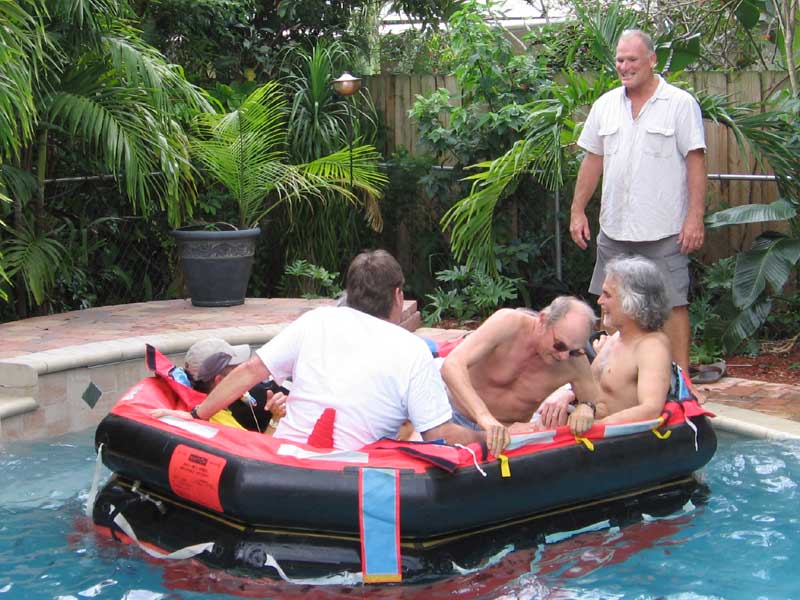
John Kretschmer supervises a life raft launch in a swimming pool
JK University’s Blue Water Passage Making Workshops are conducted three times a year in John’s hometown of Fort Lauderdale, Florida or in Solomons, Maryland. Both locations are close to water for easy access to ocean-going sailboats. Firsthand inspection of a well set-up vessel or two is one of the key components of “field trip Saturday,” along with the actual deployment of a Switlik life raft. Here is a typical workshop syllabus:

  • Introduction: Myths and realities about passage making
  • What makes a boat a blue water capable boat? Slideshow of 25 great boats
  • Outfitting: Necessary, nice, extravagant – 10 important items for a serious boat
  • Hands on – Rope
  • Inspecting boats: Caribe, a Beneteau First 456 performance cruiser and retrofit project, and Tioga, a brand-new Hylas 56
  • Hands on – The bullet-proof electrical system
  • Hands on – Standing rigging, discussion of rigging emergencies at sea
  • Passage planning, pilot charts, safety, weather, watch schedules, crew management, food preparation
  • Communications at sea: Satellite phones, wifi, SSB, VHF, AIS
  • Life raft launch
  • What’s new in cruising sails? A plan for optimizing “manageable” downwind performance; sail plans for storm sailing; how to spend money on cruising sails
  • Heavy weather: Dealing with storms, gales and squalls
  • Chart work and celestial navigation in the digital age: Thinking like a navigator

John Kretschmer discusses the merits of Tioga, a brand-new Hylas 56
Workshops run from early Thursday afternoon through late Sunday afternoon to help make scheduling as easy as booking a long weekend trip. The late start on Thursday and early finish on Sunday allow out-of-town attendees to arrive and depart without the expense of additional overnights.

To reserve your spot at the next JK University workshop, scheduled for February 7 to 10, 2013, please visit the John Krestschmer Sailing website at yayablues.com and click the Schedule link. In addition to a calendar of workshops, you’ll find all kinds of passage-making opportunities designed to help you build your confidence and broaden your experience.

Sunday, June 12, 2011

More fun with Google Maps

My friend Capt. John Kretschmer departed from Solomons, Maryland yesterday morning on a transatlantic passage in Quetzal, his 1987 Kaufman 47. With fair winds and good weather, he and his crew should arrive in Cork, Ireland on or about July 11. Since I maintain his website for him, John asked if I would post position updates from his SPOT beacon as he sent them via email. I agreed that I would, but I wanted to do more than just copy and paste the latitude and longitude coordinates and their associated links. I have seen other sailing websites that display images showing passage progress, point by point, but when I looked into them, I found that they either required a subscription fee or they only covered coastal areas. This led me back to Google Maps and its My Maps features, but I found that I couldn't position placemarks exactly by latitude and longitude. Some searching on Google revealed that the only way to do this is to import placemarks from outside sources, using a KMZ or KML file format. Well, I found that the process of creating, exporting and importing placemarks in these formats is not explained very well anywhere that I could find, so here is an explanation of how I created the position chart for John's transatlantic passage:

First of all, you need a software application that will create KMZ or KML files. The one I already had installed was Google Earth, which I don't use very often anymore since Google Maps came online. Then you need the latitude and longitude, in Google-friendly format, from the SPOT beacon's email message. Here is some of what is contained in a SPOT message:

Latitude:36.99486
Longitude:-75.95612
GPS location Date/Time:06/12/2011 10:50:38 EDT
http://maps.google.com/maps?f=q&hl=en&geocode=&q=36.99486,-75.95612&ll=36.99486,-75.95612&ie=UTF8&z=12&om=1

The highlighted text above contains the latitude and longitude and can be copied and pasted into Google Earth's search feature. (It may be necessary to paste the entire Web address into Notepad or another text editor in order to make the latitude and longitude selectable.)

After Google Earth rotates the earth and zooms in on the latitude and longitude, it shows a new placemark on its map and also under the search feature. Right-clicking on either placemark brings up a menu of choices. Choose "Save Place As...", and then choose a folder location on your computer. The default file name and type are fine. Click the Save button.

Open Google Maps (http://maps.google.com/) and click on My Maps. Create a new map or edit an existing one. Click the Import link, browse to the KMZ file created above, and click the Upload button. Just as in Google Earth, Google Maps shifts its focus to display the new placemark, which may then be edited for icon, title and description by right-clicking and choosing Properties.

That's all there is to it. It's not exactly intuitive but it's also not too complicated a process to follow in order to get exact latitude and longitude coordinates into Google Maps.

If you would like to follow Quetzal's transatlantic passage in Google Maps, please click here. It will be updated daily so be sure to check back frequently. Thank you.

Sunday, March 6, 2011

Seasickness

Photo of rolling waves by John Kretschmer
If you've never experienced it, you might not appreciate how debilitating seasickness can be. Unfortunately, I am someone who has a propensity for becoming seasick, having suffered it four times in my life (so far).

The first time was on a small ferry in Lake Superior. Some friends and I were at the tail end of a long backpacking trip on Isle Royale in late summer of 1980. We had run out of food the night before and expected to be able to buy something at the ferry dock, but all they offered was small bottles of Roxy soft drinks. I drank a cream soda and could feel it sloshing around in my empty stomach as the ferry encountered a serious storm and huge swells on its way back to Copper Harbor, Michigan. It was raining too hard to be out on deck, so all the passengers were crowded into the overheated cabin. Despite the NO SMOKING signs, an old man was smoking a Camel straight cigarette near where we were sitting. The combination of nauseating factors hit me suddenly and I knew I was going to throw up. I raced to the head, where I was assaulted by the smell of scented Charmin toilet paper. I dropped to my knees, grabbed the toilet's rim and puked as hard as I ever had. It was nothing but cream soda and stomach acid. I expected to feel better, but waves of nausea kept me dry heaving for the next half-hour, sweat exploding off my face and spittle dripping down my chin. I had never felt that bad in my entire life. If someone had handed me a gun, I probably would have killed myself. The nausea finally passed and I was able to ride out the remaining couple of hours without further incident. To this day, though, the smell of Charmin causes me to gag.

The second and third times I was seasick were minor incidents. The second time, Nan and I were snorkeling in Isla Mujeres during a trip in 1998. The water was choppy and waves kept washing over our snorkels. I was swallowing a lot of sea water, especially as I tried to climb back aboard our heaving boat. I tried to get my balance by standing in the middle of the deck and surfing with the motion, but nausea overcame me and I puked my breakfast and several ounces of sea water over the side. The third time, I was on my first trip with John Kretschmer, sailing from Fort Lauderdale to the Bahamas in January 2007. The weather had been bad for a few days so we had been sailing up and down the Florida coast while waiting for a break that would allow us to sail across the Gulf Stream. On the third day, we set sail from Dinner Key early in the morning, headed northeast toward the entrance to the Port of Miami. John said we would worry about breakfast after we were safely out to sea, but I was hungry and found some Saltines in a drawer. I ate a few even though they smelled and tasted slightly of diesel fuel. It was extremely choppy in the channel as we headed toward open ocean, and the boat bucked enough to lift us off our seats. I felt what was becoming a familiar feeling of nausea overwhelming me and turned my head to puke the Saltines onto the rail, where the waves eventually washed them overboard. In both of these incidents, I felt much better after throwing up.

Most recently, during the first day of our sailing trip last spring from Bocas del Toro, Panama to Isla Mujeres, no amount of puking would make me feel better. I was hungover from too much wine the night before, and it was unbearably hot and humid at the marina we were starting from, adding to my feelings of dehydration. As we left port, the swells mounted dramatically, causing the boat to pitch and roll in the light winds. I could feel my stomach matching pace, and I found myself swallowing hard and staring at the horizon, wishing the inevitable would pass. Nan noticed my discomfort and commented on how pale I was. She told John that she thought I was going to be sick, and that triggered it. I turned and puked my breakfast onto the rail in two big waves. Nan helped me down into the cabin and I laid down on one of the settees, close to the boat's center of gravity to reduce the motion effects. I napped for a while, but when I woke up and tried to sit upright, I immediately felt sick again and staggered to the head to throw up. Nan wiped my sweaty face with a wet towel and helped me back to the settee. She gave me a Meclizine pill and some water to wash it down with, but I threw it back up immediately. I laid down and napped again until mid-afternoon, when I finally felt well enough to go back up to the cockpit. Nan gave me another Meclizine pill, and I was able to keep it down. I took another one twelve hours later and kept them up for three or four days. After that, I was fine.

What is the moral of these stories? Seasickness is serious business. If it happens to a crewmember during a short-handed sailing passage, it could be disastrous. The best way to handle it is pre-emptively. If one has a history of seasickness, as I most certainly do, it is critical to begin a regimen of anti-nausea medication a few days before setting sail and to continue with it for at least the first few days at sea. The first days aboard are always the most difficult, as the body adjusts to the rhythms of the boat, but it is usually safe to discontinue medication after a few days to avoid the drowsiness and other side effects of the medication. The prescription drug Meclizine, which is commercially known as Antivert or Dramamine Less Drowsy, has worked well for me when I have used it. Now if I would just think ahead and remember to take it before I need it, I might be able to avoid ever being seasick again.

Tuesday, February 1, 2011

Cape Horn to Starboard

Cape Horn to Starboard by John KretschmerI recently finished reading my friend John Kretschmer's first book, Cape Horn to Starboard: The Classic Chronicle of Rounding the Horn in a 32-foot Sloop. It had been out of print for a few years, but it was republished last fall with a new introduction and afterword. I have enjoyed all of John's other books, so I was excited to read this one. It didn't disappoint.

In the fall of 1983, when he was only 25 years old, John and his crew sailed a Contessa 32 from New York to San Francisco by way of Cape Horn, replicating the route of the nineteenth-century clipper ships. His youth and relative lack of sailing experience proved to be an asset, as he didn't know what he didn't know, or he never would have considered such a crazy adventure. As John wrote to me in an email message last week, "Rereading the galleys I was amazed at my own audacity, what was I thinking?"

The feat gained him and his crew instant fame for sailing the smallest boat to date around the Horn. John states modestly in his afterword that their arrival in San Francisco must have occurred on "a slow news day" based on the grand reception they received from Mayor Dianne Feinstein and the local news media and later from Dan Rather and CBS News. When the commotion died down, John embarked on a career as a delivery captain, which is detailed in his second book, Flirting with Mermaids: The Unpredictable Life of a Sailboat Delivery Skipper.

John and I are the same age, so as I read his book I couldn't help but think about what I was doing with my life while John was sailing around the Horn. All I was doing was trying to get a second degree, in engineering this time, and working part-time at a Milwaukee hospital, where I met my future wife, Nan. My greatest ambitions revolved around planning annual backpacking trips with my friend, Dave Beckwith. It all seems so "small potatoes" compared to what John was doing. Maybe, at an unconscious level, that's why my ambitions now are so, well, ambitious.

Tuesday, December 14, 2010

Christmas Letter 2010

Christmas card photo 2010: Nan, Scout and John at Redlands Mesa Golf Club with the Colorado National Monument in the backgroundChristmas 2010

Dear Family and Friends,

It’s hard to believe we’re almost through the first decade of the new millennium. Fears of Y2K seem quaint now compared to the real difficulties we all face these days. If anything, all the economic and political uncertainty has strengthened our relationships and made them that much more important: We’re all we have.

The year saw us still doing our fair share of travel. We continued our recent spring tradition of sailing with our friend, Capt. John Kretschmer, aboard his 47-foot sailboat, this year sailing from Bocas del Toro, Panama to Isla Mujeres, Mexico over two weeks. Nan and I flew into Panama City and spent a night at a hotel located at the Pacific end of the Panama Canal, right next to the appropriately named Balboa Yacht Club. The next day, we took a puddle jumper over to Bocas, on the Caribbean side, and met up with John and the rest of the crew. We sailed north for two days to the tiny island of Providencia, a Colombian island off the coast of Nicaragua. From there, over three days, we rounded west and made landfall in Roatan, one of the Bay Islands of Honduras. We spent a pleasant few days there, touring the island with a friend of John’s, and snorkeling in the crystal waters off the West End. We sailed north again, heading for Lighthouse Reef and its Great Blue Hole, but the seas were rough and we couldn’t risk the reef’s dangerous entrance, so we sailed overnight to San Pedro, on Belize’s Ambergris Caye. Our final passage took us past Cozumel to Isla Mujeres, our favorite place in Mexico. In two short days there, we raced around touching base with all of our local friends, distributing birthday gifts and fond greetings.

As soon as we returned home, I flew to Baltimore to inspect a sailboat for sale. Capt. John met me and offered his expert advice. A few weeks later, I was the proud owner of a 1980 Valiant 40 cutter, now named Whispering Jesse, in fulfillment of the dream I established in my blog of the same name almost six years ago. A week later, my sailing buddy Kevin met me in Baltimore and we sailed the boat down to Solomons, Maryland, where refitting work is being done to prepare her for bluewater passages. If all goes as planned, a small crew and I will set sail in March for Savannah, where my folks have a vacation home, and spend some time sailing with family in local waters. From there, Isla Mujeres and other Caribbean destinations beckon, as preludes to a trip around the world, but plans are still being formulated.

Nan’s mother, Mary Claire, is 87 now and still living at home, cared for by Nan’s younger sister, Amy. Over the summer, Nan made a few trips home to Manitowoc to spend time with her mother and give Amy a break. She timed her trips to take advantage of running races in the area. Nan has carried on with her running pursuits, racing almost every weekend through the spring, summer and fall, and usually placing in the top three in her age group. When she was in Manitowoc in October, Nan was joined by Amy for a trip down to Milwaukee to run in a lakefront event, their first race together.

I made it home to Wauwatosa just once this year, as a side trip on my way to Solomons to check on the sailboat’s refit progress and spend a weekend with my friend Curt and his family in the DC area. Sister Jane and her sons were in Tosa from Seattle and sister Susan’s family lives across town in Shorewood, so it was almost a family reunion. The actual reunion took place later in the trip, when everyone traveled to Chicago for the reunion of the Allen clan, my mother’s relatives. Close to a hundred showed up for an all-day barbecue and reminiscence.

Nan and I returned to Isla Mujeres in September. We had planned to stay for two weeks but cut our trip short due to terrible weather caused by hurricanes Karl and Matthew, which struck well to the south in the Yucatan peninsula but still managed to cause massive amounts of rainfall where we were.

Our card photo this year was taken at the eleventh tee of the Redlands Mesa Golf Club, where we have been members for three years. It’s located within easy walking distance of our home, so the photo gives a good idea of where we live and the views we enjoy of the Colorado National Monument. The golf is pretty dramatic, too, like playing at the bottom of the Grand Canyon.

The holidays are Nan’s and my time to let you know how much we care about you, even if this letter and card are the only communication you receive from us all year. Know that you are always in our thoughts. Here’s to a warm and wonderful holiday season and a prosperous New Year!

Love,

John, Nan and Scout

Monday, November 8, 2010

Circumnavigation Routes, Part 7

During our sailing trip this past spring from Bocas del Toro, Panama to Isla Mujeres, Mexico, the subject of circumnavigating came up, as it always does when Nan and I sail with John Kretschmer. Being in the Caribbean at that moment, we spent most of our time talking about the best ways to sail that particular sea.

Several books are devoted to advice about sailing the "Thorny Path" from the east coast of the United States to the Virgin Islands by way of the Bahamas, which is, as the name implies, a relentless bashing to windward. Most recommend avoiding it by staying to the north and sailing as far to the east as possible using the variable winds of those latitudes before turning south into the easterly trade winds and aiming directly for the Virgin Islands. For those with the patience to pick and choose their wind opportunities, there are books that prescribe the path itself, like Bruce Van Sant's Gentleman's Guide to Passages South: The Thornless Path to Windward, which was recommended to me by my friend Paul Caouette but which Amazon tells me is out of print.

John Kretschmer is a proponent for sailing the Caribbean islands from south to north, or more accurately, from southeast to northwest, using the trade winds to natural advantage instead of fighting them. He has crossed the Atlantic several times, and this south-to-north route is part of his normal return trip, but what about those wanting to sail directly from the United States? John says the best way is to circumnavigate the Caribbean in a counter-clockwise direction. When he first mentioned this idea, during our sailing trip last year in the Spanish Virgin Islands, I imagined that he meant sailing from Florida to Mexico, following the Central American coast to the south and then the north coast of South America to the east, arriving in Trinidad and then island-hopping back to Florida.

During this year's discussions, I discovered how wrong I was. John said that sailing east along the north coast of South America is even more of a thrashing than the Thorny Path. Instead, he recommended sailing east from Mexico's Yucatan peninsula to Cuba's southern coast to stay in the lee of the trade winds and then using the evening land breezes to make progress to the east past Hispaniola and Puerto Rico. One would still need to island-hop to windward from the Virgin Islands down to Trinidad, but then one would be in position to reverse course and enjoy the downwind sail back through the islands, hitting any points of interest missed on the way down. Hang a right at Puerto Rico, and negotiate the Turks and Caicos and the Bahamas to arrive back at the original starting point.

This is the route I hope to take beginning next spring, when Whispering Jesse is set to sail. Depending on what we find along the way, it may take a year or more to return home. Then what? As John has suggested, why not get Europe out of the way sooner rather than later?

Sunday, October 24, 2010

Another Trip to the Boatyard

Me, Pete and Curt in our matching Packer caps at the Packers-Redskins gameTwo weeks ago, I made another trip out east to check on the progress being made on Little Walk's refit at Spring Cove Marina in Solomons, Maryland. It was also an opportunity to attend the Annapolis Boat Show and to spend some more time with my friend Curt and his family in Falls Church. I arrived at Curt's on Friday evening and tried to muster some interest in the boat show, but there were no takers.

I went to the boat show by myself but met up with my friend Kevin Harrison, who helped me sail Little Walk from Baltimore to Solomons, and his girlfriend Beth. The three of us walked around together on some impressive new sailboats late in the afternoon. Before that, I attended a seminar on marine electrical systems and gathered information on some of the items I need to buy for the boat, like an inflatable dinghy and outboard. I also met with Scott from Handcraft Mattress Company to firm up an order for a new mattress for the aft berth, and talked with Collin from Chesapeake Rigging about his progress on rerigging the boat.

Whispering Jesse showing off her new Awlgrip hull paintOn the way back to Curt's, I called and found out that the family was at his son Pete's flag football game, so I joined them there. I learned that the rules have changed dramatically since we played it in gym class growing up, when the only difference between flag football and regular football was that you grabbed a flag instead of tackling. On Sunday, Curt, Pete and I attended the real deal, the Green Bay Packers versus the Washington Redskins game at Fedex Field. Like true Packer fans, we tailgated before the game, grilling brats, drinking beer and tossing the football around. Our seats in the end zone were better than expected, and we cheered as the Packers ran up an early lead, only to watch it evaporate in the second half, when a last-minute field goal attempt that would have won the game instead "doinked" off the upright right next to where we were sitting. The Packers lost to the Redskins in overtime.

The current state of Whispering Jesse's deckI drove down to Spring Cove Marina the next morning. Alan, one of the boatyard's managers, saw me in the parking lot and directed me to the paint shed, where Little Walk was waiting. Her new hull paint was dazzling, snow white with royal blue stripes. It made the rest of the boat look old and tired by comparison. I climbed up the ladder and noticed that the deck's traveler structure had been removed for the installation of new Harken traveler equipment by Chesapeake Rigging. I went below and saw that all the chainplates had been removed and that the water-damaged chainplate knee on the port side had been repaired. I went back down the ladder and saw that the boom had been painted but was covered with masking paper and resting on supports next to the boat. The mast was out back, having just been painted. It looked good, the same snow white as the hull, but the new sleeving that will reinforce its base had not been installed yet. I took a look at the masthead, which was missing its windvane and anemometer, and tried to figure out how to place a Windex as an analog backup to the electronic wind instruments.

Whispering Jesse's newly repaired chainplate kneeJohn Kretschmer, our frequent sailing companion, was conducting a celestial navigation seminar in the marina's lounge, so I walked over there to say hello. Jan, from our Bocas del Toro to Isla Mujeres trip this past spring, was there as well. We agreed to meet later, after the seminar was over, to look at Little Walk together. I left to go check in to the same hotel I stayed at the last time and try to catch up on some real-world work. When I returned late in the afternoon, Jan was gone but I found John talking with one of his seminar students, John Simonton, who is originally from Denver but is now living aboard his 37-foot sailboat in the marina. The three of us walked over to the boatyard for another look at Little Walk.

Whispering Jesse's mastheadAt this point in the refit process, the Little Walk name has been removed from the hull, so I feel it is appropriate to start referring to the boat by its new name, Whispering Jesse, even though it will be a few more months before the new name is affixed to the hull.

After the boat walkaround, John K. left to meet his sister Liz and brother-in-law Trevor, who are partners in Spring Cove Marina. John S. and I walked out to look at his boat and stood chatting on the dock next to it, agreeing to meet for dinner the following evening.

The next morning, I met with Don, the boatyard manager, to discuss the work on Whispering Jesse, what had been done and how to proceed. I mentioned that I had talked with the Beta Marine people at the boat show about a new engine and he proposed the idea of a remanufactured Perkins instead. It would greatly simplify the repowering process since it would be a like-for-like swap, and it would be less expensive since it would negate the need for new stringers and engine mounts. John Kretschmer and John Simonton examine Whispering Jesse's freshly painted mastHe called the dealer and they quoted him a price over the phone, which he added to his list of work items. We walked over to the paint shed together to look at the work in progress and figure out the best plan for future work. With the boat out of the weather in the paint shed, it would make sense to address the deck work, which will involve sanding down and applying Cetol to all the teak, and repairing, refinishing and repainting the deck fiberglass. This would also be the time to remove any attached equipment that will be replaced, like the manual windlass, dodger and bimini, or eliminated, like the wooden dinghy chocks and cable TV/phone hookup. I asked about bottom repair and painting, and Don recommended that we save that until just before the boat goes back into the water next spring.

Sunbrella fabric samples in heather beige, beige and toast, and clear plastic dodger windshield materialAs we were leaving the paint shed, I mentioned to Don that I wanted to meet with his recommended canvas people. He pulled out his phone to set up a meeting with Steve from Creative Canvas Designs. Steve and I met at the boat at nine o'clock the next morning and spent about an hour talking about a new dodger and bimini, a new sail cover, new hatch covers, and new interior cushions. We agreed to meet again the next day at his shop in Solomons to look at fabrics and foam. At that meeting, on a rainy Thursday morning, Steve showed me some Sunbrella samples in various shades of beige, which Don recommended for the exterior canvas because it reflects heat better and does not fade as quickly as darker colors. For the interior canvas, we're going to go with a bright royal blue to brighten the look of the dark wood paneling.

On my final day there, I met one last time with Don. He thought they would have the engine pulled within a week or two. They then would be able to paint the engine room, in anticipation of installing a new engine at the beginning of the new year. They would also continue work on the exterior wood and fiberglass. If it's at all possible, I would like to try to get out to see Whispering Jesse one more time before Christmas to check on progress. I'll keep you posted.

Thursday, July 15, 2010

Little Walk sails to Solomons Island

My 1980 Valiant 40, Little Walk, at Tony's dock near BaltimorePart 16 marked the end of the Boat Quest series. As of May 15, I am the proud owner of Little Walk, a 1980 Valiant 40. As one dream is made real, a new one is enabled. I now have the means to sail anywhere in the world. Where to go?

Well, the first stop is the boatyard, to make the necessary repairs and upgrades that will ensure safe travels. During our Central America sailing trip a few months ago, I spoke with John Kretschmer about my plans to sail the boat--if I ended up buying it--from Baltimore to Savannah, where my parents have a vacation home, to get the necessary work done. He had a better idea: his sister Liz and brother-in-law Trevor are partners in a marina and boatyard in Solomons Island, Maryland. Their people are experts at the kind of work I needed, and as an FOJ (Friend of John), they would take extra special care of me and my boat. What more could I ask for? John said he would contact them to make the necessary introductions.

That just left figuring out how to get the boat from the Riviera Beach area, southeast of Baltimore, to Solomons Island, a distance of about seventy-five miles. To be safe, I didn't want to sail alone, especially on an unfamiliar boat. I needed to find someone to go with me. The kicker was that the boat needed to be moved from its current location at Tony's dock within a week and a half, so I needed someone who would be available on short notice. Kevin Harrison, from our Odyssey sailing trip, came immediately to mind. He lives in Elizabethtown, Pennsylvania, only a hundred miles from where the boat was docked, and he would have just completed teaching the spring term at McDaniel College. I emailed him an invitation, and he emailed me back right away with an acceptance. We spoke over the phone a couple of days later to work out a strategy for meeting at the boat, driving two cars down to Solomons, and leaving one there for the return trip. Kevin agreed to bring his toolkit, just in case, and I agreed to provision for the short trip and cover his expenses.

Kevin and I met at the boat on Sunday morning, May 23. We hauled our stuff aboard, and I gave him a quick tour. He liked what he saw, except for all the bird poop on the deck. We took the time to wash down the deck so it would be clean and dry when we returned, and then we got into our respective cars for the drive down to Solomons.

Kevin aboard Little Walk at Tony's dockA couple of hours later, we met up again at the Spring Cove Marina's parking lot. We wandered around to get a feel for the place and its facilities and then walked into the office and asked to see Trevor. He came down from his office, and we spent a few minutes getting acquainted through our mutual connection to John Kretschmer. I ended the conversation by telling him we were headed back up to Baltimore to sail my boat down to the marina and that we would be back by early the next afternoon. He wished us well, and we left in my rental car to drive back up to the boat.

Tony was home when we returned, asleep in the hammock that overlooks his dock. He roused as we were preparing to depart and came down to talk with us. It's a good thing that he did, or we might have left the boat's meager fenders and dock lines behind. He assured us that they went with the boat. We thanked him, fired up the engine, and shoved off. There was only one problem: no water was coming out with the exhaust. I tried frantically to remember what Ray had said about where the water coolant seacock was located, but I had no idea. There had just been too many details during the orientation. I also forgot the way out of Rock Creek, because we found ourselves going up a dead-end tributary. It was time to call Ray. Fortunately, he answered--maybe he was expecting my call. He calmly told me to turn off the engine before it overheated and then directed me to look under the seat in the aft cabin for the seacock. I sent Kevin below to find it so I wouldn't lose the call, and he reported that as soon as he turned it, he could see water flowing through the associated filter's clear top. We fired up the engine again and looked over the side to see water coming out with the exhaust. The engine's temperature fell to about 110 degrees and stayed there. One disaster was averted. But we still didn't know where we were going. I still had Ray on the phone, so I tried to explain the landmarks around us. He didn't recognize anything but told me to follow the starboard-side shore until I could see the White Rocks Marina, which I should recognize from our sea trial sail. From there, I should know where to go. I thanked him and told him I would call later to let him know how we were doing.

View of my Valiant 40 Little Walk's bowKevin and I could have cheered when we reached the open water of Chesapeake Bay, but we noticed that the water was extremely shallow--no more than fifteen feet deep--even at White Rocks, a small formation of bird poop-covered rocks (thus the name), about a half-mile offshore, and we were concerned about running aground. After we passed the rocks, we rounded up into the wind, put up the sails, and bore off to the south for Annapolis, our destination for the day, all the while keeping an eye on the depth meter.

There was enough wind to just sail, and we were in no great hurry, so we cut the engine and trimmed the sails. The GPS showed us at six-plus knots, with occasional bursts over seven, not bad for the blustery, unsettled weather conditions. Kevin and I took turns at the helm since neither the windvane or electronic autopilots were working. Before long, we had passed under the William Preston Lane Jr. Memorial Bridge, which was our cue to turn west toward Annapolis. We started the engine and doused the sails as we passed the Naval Academy and sighted the public docks, where we picked up a mooring for the night. We settled up with the harbormaster who came out to greet us and then hailed a water taxi using the VHF radio. The taxi driver suggested the Middleton Tavern for dinner, so we gave it a try. Good steaks and atmosphere.

We were up by 5:00 the next morning to get an early start on the remaining sixty miles. I tried to boil water for instant coffee, but I couldn't figure out how to get the stove lit--guess I should have covered that in the orientation with Ray. We made due with juice and muffins as we motored out of Annapolis harbor and headed south for Solomons. Spring Cove Marina normally stops hauling boats out at about 2:00, so we motorsailed all the way to make good time in the hopes of meeting that deadline.

Sailing Little Walk, my Valiant 40, toward the William Preston Lane Jr. Memorial BridgeWe arrived at a little after 1:00 and were directed to tie up at the end of a T-shaped dock. Kevin wasn't feeling well and went to find a bathroom. I went off to find Trevor, who informed me that the haul-out bay was busy and that they wouldn't be able to haul my boat out for a day or two. Oh, well. At least we were there safely, even if we hadn't needed to leave Annapolis quite so early. Trevor introduced me to his wife Liz, who is John Kretschmer's sister, and we chatted for a few minutes, mostly about John and his escapades. The family resemblance was easy to see. Liz excused herself, and Trevor and I walked over to the haul-out bay, where I met Trevor's brother Alan, who was stepping a mast. We walked up to the shop and met Don, the boatyard manager, who was painting a mast. Don would be the person coordinating the work on Little Walk, so we set up a meeting for the next morning. To give him an advance idea of what was involved, I told him I would leave a copy of the boat survey on his desk.

Kevin and I hauled our stuff off the boat, readjusted the dock lines, and drove to a nearby hotel. After showers, we went off in search of a cold beer, which we found at the famous Tiki Bar, and then dinner at a waterfront restaurant. It had been a long day. After dinner, we returned to the hotel and called it an early night.

Kevin and I had compiled a short list of items the boat needed, so after breakfast the next morning, we went to the local West Marine store to see if we could find it all. We did. Those places are amazing, like boating toy stores. We returned to the boat to drop off the new goodies before my meeting with Don. When he showed up, Kevin wandered off to look at boats and said he would meet me at his car when I was ready to go. Don and I walked around on the deck, looking at the mast and rigging, and then went below to look at the chainplates and engine. He was pretty matter-of-fact about things, saying that a thirty-year-old boat should be expected to need the types of repairs we were considering. I mentioned that I wanted to get the ratty cushions reupholstered. He said I should pitch them, that the foam was old and disintegrating, and get new ones, plus a real mattress for the aft berth. He also suggested replacing the manual windlass with an electric one. I hadn't thought of any of these things, but he was right. All it would take is money, of course. Don said I should probably expect to pay almost what I had paid for the boat to get it into top condition, more if it needed a new engine. I nodded knowingly, but I was thinking, "Whoa! That's a lot more than I was expecting!" The first order of business was to pull the mast. Don thought they would have that done within a couple of weeks. We agreed to stay in touch about the work as it progressed, and I went off to find Kevin for the drive back to Baltimore and the flight home.

Thank you for all your help, Kevin!

Thursday, July 8, 2010

Boat Quest, Part 16

Base of Little Walk's mast showing recently painted-over corrosion and relatively clean bilgeNan and I returned home from our Central America sailing trip on Saturday, May 8. The following Monday, just two days later, I flew to Baltimore to take a second look at Little Walk. John Kretschmer flew up from Fort Lauderdale to meet me and take a look for himself. The two of us met Ray, the owner, and Bob, the broker, at the boat, which was docked at Ray's friend Tony's pier on Rock Creek, near Riviera Beach, southeast of Baltimore. John and I spent about an hour looking at the boat, inside and out, using copies of the marine survey as our guide. I took advantage of Ray's intimate knowledge of the boat and asked dozens of questions, which he answered patiently and proudly, providing me with an invaluable orientation on the boat's many systems. John checked the chainplates, mast and bilges, looked into every nook and cranny, and then started a conversation with Bob in the cockpit, while I continued the orientation with Ray and took photos until the camera batteries died.

Original Uniflite electrical panel next to navigation station--switches below control lights on deckThe weather was threatening rain, but we all agreed that we should take the boat out for a quick sea trial. Ray showed me how to power up the diesel engine and turn on the water coolant seacock. We let the engine idle for a few minutes to hear how it sounded before casting off the lines and motoring up the creek to Chesapeake Bay. Once we had reached open water, Ray revved the engine's RPMs up to cruising speed and insisted that I take the wheel. The boat steered smoothly and responsively, and the engine sounded smooth and steady. We put up the mainsail and unfurled the jib, and they filled immediately with the wind blowing in from the west ahead of the imminent rain. There was enough wind to just sail, so Ray cut the engine and we enjoyed the relative silence that followed. We tried different points of sail, and the boat handled nicely at every angle.

We could have stayed out all afternoon, but the sky was getting dark, and John and I had flights home to catch. Ray took the wheel as we sighted Tony's pier and slipped the transmission into neutral while we were still over a hundred yards away. Momentum carried us to a smooth stop just as the first raindrops began to fall. We quickly secured the boat and exchanged parting words. I thanked Ray profusely and told Bob I would call him within a couple of days.

Shelf next to Uniflite electrical panel showing VHF radio (working) and engine hours meter (not working)John and I drove to a seafood diner and ate lunch while discussing the boat. John said that it was in better shape than he expected given all the negative comments in the survey. He was pleasantly surprised by how "stock" it was, lacking much of the stuff that most owners pile into their boats. But he cautioned that the rigging and mast issues were serious and needed to be corrected before considering any bluewater sailing. He advised replacing the engine, to give the boat a fresh, reliable start in its new life. And he recommended replacing the furling gear, windlass and bimini with "beefier" gear that could stand up to bluewater conditions. Overall, though, he thought Little Walk was a sweet little boat and that if I could get her for a good price, I should go for it.

I called Bob a couple of days later to discuss a revised offer based on the marine survey and a ballpark estimate of the necessary repairs. He said that he doubted if Ray would accept the new offer but that he would run it past him. Bob called back a little later with a counter-offer from Ray. I wanted to accept it, but Nan insisted that I offer a thousand dollars less. Ray accepted it, Bob wrote it up, and we had ourselves a deal.

Sunday, June 20, 2010

Boat Quest, Part 15

The marine survey for Little Walk arrived by email while we were at the Barefoot Cay Marina on Roatan. I sat at the computer in the marina office and read all twenty pages of it immediately. There was an unexpectedly high level of detail about every aspect of the boat, and most of it was negative, like this paragraph from the introduction:
This model vessel is well-known for its bluewater sailing pedigree. However, this particular vessel is in need of a major refit prior to venturing beyond protected inland waters, including significant renewal of the electrical systems, rigging, safety equipment, etc.
The report didn't get much more positive in the pages that followed. It was broken down into seventeen sections, each with three columns: a title, like "Propulsion Engine"; a detailed description of the particular item or feature; and a statement about its condition. Unfortunately, the "SEE RECOMMENDATIONS" condition outnumbered the "Appeared Serviceable" and "Operational" conditions by a total of forty-four to thirty-seven. The recommendations were listed in a separate section near the end of the report. Under that section's title, it said: "Recommendations in BOLD are considered essential for the safety and proper function of the vessel." Almost all of the recommendations were in bold.

When I finished reading the report, I felt sick to my stomach. There was so much wrong with the boat. Would it be worth the time, effort and money to try to correct all of its problems? I walked down the dock to where Quetzal was slipped to talk with John Kretschmer. He could tell by the look on my face that the news wasn't good. He asked if I wanted him to read the report, and I told him I would appreciate it. We walked back to the marina office, I called it up on the computer, and then I left him alone.

When I caught up to him later, John was smiling. He said it sounded like the boat was in pretty good shape. This was coming from a man who has written hundreds of sailboat reviews for Sailing magazine and is the author of Used Boat Notebook. He knows boats, and he was saying that there was hope for Little Walk. "Really?" I said. "What about all those recommendations?" He said that most of them weren't all that critical and that he hadn't read anything that he considered to be a deal-breaker, like hull damage or deck delamination. And the best part, he said, was that the surveyor included a fair market value that was more than ten thousand dollars below my offer price. The broker and owner would need to adjust that price down accordingly, and I could probably negotiate an even lower price. If I was willing to spend the difference on improvements, I would come out of the deal with the boat in great condition for what I had expected to pay in the first place.

Photos and captions from the marine survey of Little Walk:

Photograph of Little Walk as seen from the starboard bow, taken at the time of survey on 4/26/2010. Photograph of Little Walk as seen from the starboard bow, taken at the time of survey on 4/26/2010.
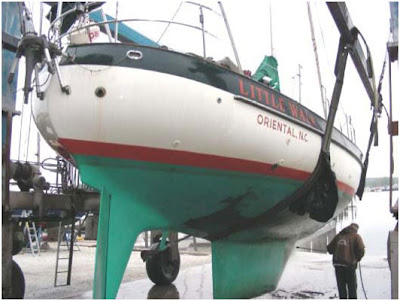
Photograph of Little Walk as seen from the starboard quarter, taken at the time of survey haul-out on 4/26/2010. Photograph of Little Walk as seen from the starboard quarter, taken at the time of survey haul-out on 4/26/2010.

Photograph of Little Walk as seen from the port bow, taken at the time of survey haul-out on 4/26/2010. Photograph of Little Walk as seen from the port bow, taken at the time of survey haul-out on 4/26/2010.
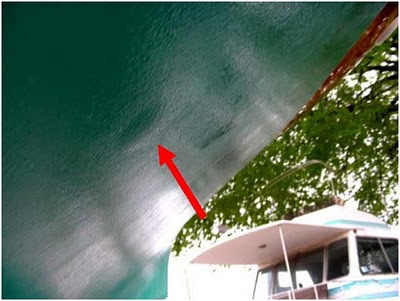
Photograph of a blister on the port aft hull bottom, taken at the time of survey on 4/26/2010. Blisters up to 3” diameter were found randomly throughout the hull finishes. Photograph of a blister on the port aft hull bottom, taken at the time of survey on 4/26/2010. Blisters up to 3” diameter were found randomly throughout the hull finishes.
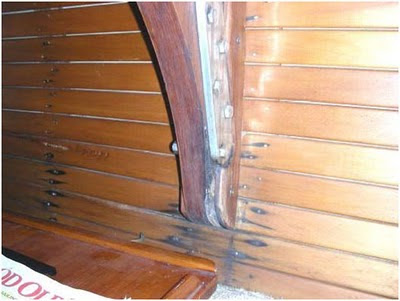
Photograph of a port cap shroud chainplate attachment to its plywood knee. The knee has deterioration along its bottom and there is likely crevice corrosion of the chainplate. All of the shroud chainplates need removal and inspection. Photograph of a port cap shroud chainplate attachment to its plywood knee. The knee has deterioration along its bottom and there is likely crevice corrosion of the chainplate. All of the shroud chainplates need removal and inspection.

Photograph of engine exhaust as seen from the starboard side, taken at the time of survey on 4/26/2010. The insulated piping is deteriorated, and there is minimal vertical separation between the point of seawater injection and the waterlift muffler. Photograph of engine exhaust as seen from the starboard side, taken at the time of survey on 4/26/2010. The insulated piping is deteriorated, and there is minimal vertical separation between the point of seawater injection and the waterlift muffler.

Sunday, June 6, 2010

"The Odd-yssey" in Latitudes & Attitudes

Of course, as soon as I had given up hope of Latitudes & Attitudes ever publishing my article about our 2008 Odyssey sailing trip, they finally did publish it in their May 2010 issue, along with fourteen of the eighteen photos I submitted. If you missed it at the newstand or at the seafaring.com website, you can still read it in its published format at Capt. John Kretschmer's website: "The Odd-yssey" by John Lichty.

Editor Sue took a few liberties that I wasn't overly happy about, and there are some misspellings in the photo captions, but the article finally made it to print and that's what matters. She even mailed me a check, which went immediately into the "boat fund."

If you would like to read the original article, in its original format, with all eighteen photos, which I posted here back in March when I was sure it would never get published, here's a link to it: "The Odd-yssey".

Monday, May 31, 2010

The rest of the Central America sailing trip

Me at the helm for the sail to Roatan's West EndThe next morning, after our terrific day with Eric and his family, we sailed the short distance around the corner to Roatan's West End and picked up a mooring. The idea was to shorten the distance we would need to sail to reach our next destination, Lighthouse Reef, off the coast of Belize, making it a long one-day sail instead of an overnight passage.

The West End is Roatan's original tourist area. The beaches are beautiful and the snorkeling is surprisingly good. The still-unpaved road that runs parallel to the water is lined with funky shops and restaurants. The area seems to be a magnet for "trustafarians" and Lonely Planet types. Capt. John and I drank beers at a beachfront bar while Nan and Jan explored, and then we all dinghied back out to the boat for sundowners and Capt. John's jambalaya.

Nan walking the sandy main road in Roatan's West EndWe were up at dawn the next day to take full advantage of the available daylight. The southern entrance into Lighthouse Reef is tricky and cannot be navigated safely at night. We made good time surfing a broad reach most of the day, accompanied by dolphins feeding on the fish fleeing our wake. Unfortunately, the late afternoon light and significant wave action when we arrived at the reef made it too difficult to exactly locate the entrance. We dropped anchor in shallow water outside the reef, with the idea of spending the night and trying again in the morning, but the holding ground was poor and the water too rough. Capt. John made the decision to press on for Ambergris Caye, off the coast of Belize, and we sailed on. So much for the Great Blue Hole. Maybe next time.

A dolphin surfs Quetzal's wake as we sail to Lighthouse ReefWe arrived at San Pedro on Ambergris Caye early the next morning. Unlike Lighthouse Reef, the entrance through the protective reef was well marked. The water inside the reef was extremely shallow, so we ended up anchoring a few hundred yards offshore and dinghying in. The first order of business was to clear in with Customs and Immigration, but we arrived before they were open, so Nan and I wandered up and down the main drag looking for an Internet café and a cheap hotel room for much-needed showers. We found both but returned to clear in with the crew first before going our separate ways. We regrouped for lunch at Elvi's Kitchen, probably the most famous restaurant on Ambergris Caye. The food was excellent, as was the Belikin, Belize's one and only local beer.

Street scene in San Pedro on Ambergris Caye, BelizeAfter lunch, John and Capt. John spent time in an Internet café while Jan, Nan and I did some gift shopping. Belizean Arts Gallery and Toucan Gift Shop offered the best native arts and crafts we could find. We met up again late in the afternoon for a wet-bottomed dinghy ride back to where Quetzal was anchored and spent a quiet night on the boat in anticipation of another early departure the next day.

Quetzal at anchor offshore of San Pedro on Ambergris Caye, BelizeThe final passage of our two-week trip was an overnight to Isla Mujeres, Mexico. Light winds on the second morning, as we passed Cozumel, prompted us to fly the spinnaker, but we doused all the sails as we approached the shallow water at Punta Sur, Isla Mujeres's southern point. Quetzal's old diesel engine, which had been giving us consistent trouble with overheating due to a worn-out heat exchanger, came close to calling it quits on the final stretch to Marina Paraiso, just south of the main downtown area. Capt. Doug Dorn, who met us in his dinghy to offer advice and assistance as we were approaching the marina, asked Capt. John why he didn't want to back into the slip instead of going in bow first. Capt. John told him that he was afraid the engine would give up for good if he shifted from forward to reverse; that's how close he thought it was.

Flying Quetzal's spinnaker on the way to Isla MujeresNan and I like to get off a boat when the trip is over instead of staying on until it's time to fly home. Mostly, it's a comfort thing: marinas are the hottest, buggiest, most humid places you could ever hope to stay. We had made reservations to stay at Color de Verano that night, in one of the new ground-floor studio units, so after we checked in with José in the marina office, we gave Louis, the owner, a call. He said he would open the unit for us, and I asked if he would also be willing to give us a ride there since he would be passing right by the marina on his way. He said he would pick us up in twenty minutes, so Nan and I hurriedly packed our duffel bags and made plans to meet the rest of the crew at Brisas Grill for dinner.

Louis and his wife Teresa have done a wonderful job with their Color de Verano building at the corner of Rueda Medina and Mateos. Nan and I had stayed there three times before, once in the third-floor apartment and twice in the penthouse, most recently for a month last fall. While we were there that last time, the ground floor, which once housed a coffee shop, was being converted into two studio apartments. They turned out beautifully, with creative art-deco touches and one-of-a-kind fixtures. Louis put us in the unit closest to the building's lobby, and after seeing how nice it was, we wished that we had made the reservation for two nights instead of just one, but Nan had been able to use credit card reward points to get a free night at the Privilege Aluxes hotel across the street for the next night.

Approaching Isla Mujeres, with Garrafon Park's tower visibleAs we walked down Rueda Medina toward Brisas Grill, who should we see but our Spanish tutor from last fall, Juan Torres. He has been impossible to reach since then, and he told us the reason was that his computer had died, so he had no email access. I asked if he would be interested in having me pay him to translate the cookbook I am writing in conjunction with Juan Gomez's family into Spanish. He said that he would be, but then he shrugged when I told him he would need a computer. On a whim, I offered to give him my laptop. His face lit up immediately. We still need to work out how to get it to him, and I will need to buy a replacement laptop, but having Juan involved with the project will make a huge difference.

Entering Brisas Grill was like a homecoming. Our great friend Juan Gomez greeted us with hugs, as did Ventura, Irving and the owner, Weimar. There were big smiles all around but obvious disappointment that we were there for only two days. We took a table on the beach and ordered two of Ventura's special margaritas. Capt. John, Jan and John joined us shortly and we all ate a fantastic dinner as the sun set on another day in paradise.

Quetzal slipped at Marina Paraiso next to Capt. Doug Dorn's boatWe had an appointment with Louis for the next morning. Back in January, when Nan and I were in Denver to celebrate her birthday, she had tossed out the idea of spending a year living in Isla Mujeres and renting Louis and Teresa's apartment overlooking Laguna Macax. We had looked at the apartment briefly during a previous visit when it was being built but had not seen it since its completion. Louis was more than happy to show it to us. He is rightly proud of the innovations he designs into everything he builds, whether it is a simple window or an elaborate chest of drawers. The apartment is located directly on the lagoon and has two levels, a main living area downstairs and a private rooftop deck with breezes and views upstairs. It would be perfect for us, and Louis said that our dog Scout would be more than welcome to join us.

Capt. Doug Dorn's little mascot MaggieNan and I returned to Brisas Grill for lunch and to make arrangements with Juan Gomez to stop by his house that evening with some gifts we had brought for his children. As we passed the beach across from Jax Bar and Grill on our way back to Color de Verano, we spotted Eloy, the old man who sells popcorn and chips on the beach, sitting on his adult tricycle with his basket full of snacks in the back. Last fall, we had noticed that he was in need of new shoes, so we promised we would get him some. We ran inside to get the new Reeboks we had brought for him and then ran out to the beach to give them to him. Eloy doesn't speak much English, but we could tell he was touched.

Marina Paraiso owners' son fishing for snapperWe spent the rest of the afternoon moving across the street to the Privilege Aluxes hotel and reading on the beach. It was a relief to escape the unseasonable heat with a quick dip in the cool ocean. It made me wish we weren't leaving the next morning. We regrouped back in our room and then drove our rented golf cart down to Juan and Paula Gomez's home in the Salina Grande colonia. It was fun to spend time with the family and see the photos from their daughter Paulina's first communion. We talked briefly about the cookbook, and I told them about inviting Juan Torres to do the translation. They promised to take more photos of Paula's dishes and send them to me. I hope to have the book close to completion by the time Nan and I return for two weeks in September.

Final crew dinner at Rolandi's: John, Jan, Capt. John, Nan and meWe met the rest of the crew that night at the central plaza and walked up Hidalgo to find a restaurant for our final meal together. We agreed on Rolandi's, Isla Mujeres's most popular restaurant for Italian food, and ate another excellent meal. We all had flights to catch the next morning, so we called it an early night and said our good-byes.