

Of course, as soon as I had given up hope of Latitudes & Attitudes ever publishing my article about our 2008 Odyssey sailing trip, they finally did publish it in their May 2010 issue, along with fourteen of the eighteen photos I submitted. If you missed it at the newstand or at the seafaring.com website, you can still read it in its published format at Capt. John Kretschmer's website: "The Odd-yssey" by John Lichty.
Editor Sue took a few liberties that I wasn't overly happy about, and there are some misspellings in the photo captions, but the article finally made it to print and that's what matters. She even mailed me a check, which went immediately into the "boat fund."
If you would like to read the original article, in its original format, with all eighteen photos, which I posted here back in March when I was sure it would never get published, here's a link to it: "The Odd-yssey".
About Me

- John Lichty
- Savannah,
Georgia, USA
"Go confidently in the direction of your dreams. Live the life you have imagined." --Henry David Thoreau
 Raising Charlie: The Lessons of a Perfect Dog by John Lichty
Subscribe To

 Posts
All Comments
Posts
All Comments

Showing posts with label Greece. Show all posts
Showing posts with label Greece. Show all posts
Sunday, June 6, 2010

Wednesday, March 17, 2010
The Odd-yssey
Despite assurances from Editor Sue at Latitudes & Attitudes magazine that she would publish it eventually, it has been almost two years since I submitted the following article from our somewhat ill-fated Odyssey trip. St. Patrick's Day seems as good a day as any to post it on the blog. Don't tell her you saw it here first!
 The Odd-yssey
When Capt. John Kretschmer mentioned that he was thinking of re-creating the Odyssey by sailing from Troy to Ithaca, I couldn’t believe it. What a great idea! We were at the end of a successful passage from Fort Lauderdale to the Bahamas and back, and we were feeling that sense of accomplishment that makes you think you’re ready for whatever’s next. Follow in the footsteps of Ulysses, one of history’s greatest adventurers? Sure, why not? If he did it in a primitive galley, we could surely do it in a modern sailboat. And if it took him ten years, we could certainly do it in two weeks. These thoughts sustained me through the fifteen months of planning and preparation leading up to our voyage, which began on April 23 of 2008 and ended on May 7.
 There is much to be said in favor of spontaneity. Decide to do something and then go do it. No hesitation. No second-guessing. The fifteen months between the idea and the execution for the Odyssey trip gave us too much time to consider and then reconsider our plans. The original plan, based on the route detailed in Tim Severin’s The Ulysses Voyage: Sea Search for the Odyssey, called for us to fly into Izmir, on the west coast of Turkey, and then travel up the coast to the marina at Ayvalik, where we would meet up with Capt. John and his forty-seven foot 1987 Kaufman cutter, Quetzal. Our crew would consist of John, me, my wife Nan, and Harry and Velinda from the Bahamas trip. Since there are no marinas near the ancient ruins of Troy, in the furthest northwest corner of the Anatolian peninsula, we would travel overland to pay homage at the site of the Trojan War and its famous horse before retracing our route to begin our sail.
 From Ayvalik we would sail west along the north coast of the island of Lesbos and then roughly southwest toward the Doro Channel between the islands of Evvia and Andros. Ulysses (called Odysseus in Greek) had carefully worked his way counter-clockwise around the northern Aegean Sea, sailing during the day and camping on shore at night, but we wanted to get to the locations where the main events of Homer’s epic tale had reputedly taken place, starting with the Cyclops encounter on the southern coast of Crete. From there we would sail to the island of Gramvousa, off the northwest corner of Crete.
  Severin postulated that this was the place where Aeolus, the Ruler of the Winds, gave Ulysses the leather bag of wind he would need to cross back to the Greek mainland. After working our way west and north around the fingers of the Peloponnese peninsula, we would sail right past Ulysses’ home island of Ithaca, as he had also done, into the area where his encounters with Circe, the Clashing Rocks, the Sirens, Scylla and Charybdis had taken place. We would then retrace our route south to Ithaca before sailing north again to end our voyage in Corfu.
 By December the plans had changed. Instead of starting in Turkey, which would require greater travel expenses and the customs complication of arriving by plane but leaving by boat, it was decided that we would start in Athens and make a quick trip across the Aegean to Troy. John had worked a deal to have the Travel Channel film the voyage for a TV documentary, and they were counting on getting footage of us at Troy. John had also added another crewmember, Kevin.
 Nan and I arrived in Athens a few days before we were to set sail so we could tour the city and see the sights, including the Acropolis and the Parthenon. The evening before our Wednesday departure, we met up with everybody at the marina in Piraeus for dinner and a chart briefing. It was good to see John, Harry and Velinda again, and to meet Kevin. Nan was meeting them all for the first time. Over wine and authentic Greek food, we discussed the trip ahead. Everyone was excited to get going, even after John informed us that the deal with the Travel Channel had fallen through.
 After final fueling and provisioning, we were underway before noon the next day. Almost immediately, we experienced engine trouble. John had replaced the alternator the day before to correct a charging problem, and the belt slipped, filling the cockpit with burned-rubber smoke as it disintegrated. We sailed slowly along in the light winds as John worked in the engine compartment to replace the belt, but it was his last replacement so we agreed not to run the engine at more than 2,000 RPMs, the equivalent of five knots, for the rest of the trip.
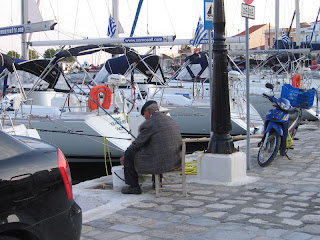 In the late afternoon, we arrived at Cape Sounion, about twenty-five miles southeast of Piraeus, and anchored within sight of the Temple of Poseidon. This was the first of our touchpoints with the Odyssey route, but we were coming at it from the wrong direction. Ulysses and his men stopped here on their way from Troy.
On Thursday morning, we set out early with the idea of making an overnight passage northeast to Turkey. By afternoon, the wind from the north had picked up dramatically and we were tightly pinched to make headway against it in eight-foot swells as we approached the Doro Channel. We were beginning to wonder if the meltemi, the strong northerly winds that occur every summer in the Aegean, had arrived early. John had purposely planned the trip early in the season to avoid the meltemi, but there was no getting around the fact that the wind was going to prevent us from getting to Turkey as planned. We steered toward the closest logical landfall at Gavrio, on the southern coast of Andros, but even the leeward harbor offered little protection as the winds continued building to gale force.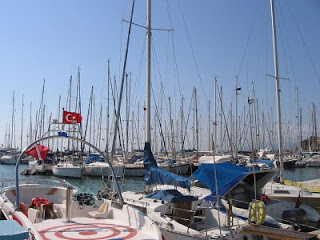 Our Med mooring put us perpendicular to the wind, requiring several lines from the boat to the quay just to hold us in place. Relieved to be safely ashore, we found a cozy taverna for dinner and a discussion of our options. We all agreed that if the strong winds continued, we would not be able to continue our northeastern tack. John proposed sailing east instead, staying in the lee of the Greek islands to temper the wind, and arriving in Turkey at Kusadasi, almost 200 miles south of Troy. The implication was clear: we would not be going to Troy. To ease the disappointment, John suggested we take an extra day in Turkey to visit Ephesus, the ancient Greek ruins located a short drive north of Kusadasi, perhaps figuring that some ruins were better than none.
 The wind was still howling on Friday morning, pinning us in place for the day. We wandered around Gavrio, shopped for provisions and killed time in an Internet café. Nan and I checked into a harborside hotel, hoping for a better night’s sleep and a decent shower. That evening we all watched as the local people celebrated Greek Orthodox Good Friday by parading through the streets carrying their church’s tabernacle and playing the funeral dirge on bugle and drums.
There was a small window of opportunity the following day, so we carefully exited the harbor and headed southeast along the protected coasts of Andros and Tinos. The wind picked up predictably as we crossed the gap to Mykonos, where we spent our fourth night at the new harbor north of town. It would have been worth the trip into town to see the distinctive “Greeky” architecture of white adobe buildings with bright blue trim for which Mykonos is known, but we lacked ground transportation and it was still off-season for most businesses.
 We awoke to rain on Sunday morning. The winds had moved on, replaced by dark clouds. We motored most of the distance east to the island of Ikaría, named for Icarus from Greek mythology, and arrived at Kirikos as the town was preparing to celebrate Greek Orthodox Easter. While we were tying up in the town’s small harbor, some local people were busy hanging Judas in effigy at the end of the dock. Later, when it was dark enough, we watched from a harborside taverna as they set the dummy on fire. The gathered crowd cheered as the fireworks stuffed inside were ignited, sending rockets in all directions. We had to admit we had never seen an Easter celebration to rival this one.
The clouds cleared but the wind didn’t return for the next leg of our trip east, to the island of Samos, just west of the Turkish coast. We moored at the new marina east of Pythagoria, the reputed birthplace of Pythagoras, the ancient mathematician credited with the theorem that bears his name. We made the muddy hike up and over the hill that separates the marina from town and were rewarded with a beautiful stroll along a stone boardwalk lined with tavernas on the one side and pastel-colored fishing boats on the other.
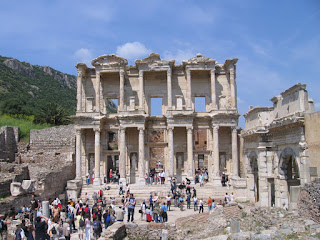 There was still no wind for our final push to Turkey on Tuesday morning, so we motored with limp sails while dodging the many cruise ships going to and coming from Kusadasi. We arrived in the early afternoon and were immediately captivated by the place. Turkey was very much like Greece in its terrain and climate, but everything about it was more pleasant. It was cleaner and better organized, the people were friendlier, and the food was better. There was a noticeable sense of pride and patriotism. All of this was clearly evident at a neighborhood street market we stumbled upon as we wandered the city streets. Despite the language and culture differences, and the fact that we were the only Americans in the crowded market, the merchants were happy to assist us in buying spices and souvenirs.
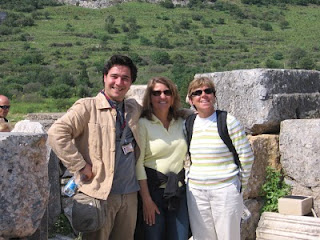
 Ephesus, our substitute Troy, was made memorable by Emre, our personal guide. He admitted at the beginning of our day trip the next day that he was hung over from drinking too much raki, but that didn’t prevent him from filling our heads with all the known history of the famous ruins, everything from the significance of the bull busts that topped one ancient wall to the fact that Marc Antony and Cleopatra had celebrated their honeymoon here.
Our couple of days in Turkey were the highlight of our trip, but it had taken us a full week to get there. We needed to be 500 miles to the west, all the way to Corfu, within another week to make our travel connections. We would need to hurry. Crete, the site of the most memorable Odyssey events, would need to be skipped. Not only that, we would need to make a series of overnight passages, with very few landfalls.
 Our first passage had us leaving Kusadasi before dawn and sailing continuously for more than 300 miles over two nights and three days to reach Methoni, at the southwest corner of the Peloponnese peninsula. We spent the night anchored offshore from the beach that draws summer crowds to this scenic town and its well-preserved Venetian-era castle.
Short on fuel from frequent light-air motoring, we were lucky to find a fuel truck willing to deliver on a Sunday morning when we pulled into the harbor at Pylos, just a few miles up the coast from Methoni. Then it was north to Ithaca on our second overnight passage.
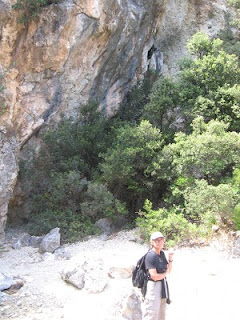 Early the next morning, we anchored in the beautiful harbor of Vathi on Ithaca. Not counting Methoni and Pylos, where Ulysses and his crew must have stopped on their way north, Ithaca was only the second touchpoint of our Odyssey trip after the Temple of Poseidon on Cape Sounion. We planned to make the most of it, renting cars to drive to the Cave of the Nymphs in the northern part of the island, where Ulysses hid his treasure after returning home. The cave had collapsed during the 1953 Kefalonia earthquake so there was not much to see, but standing at the shore below, it was easy to imagine Ulysses washing up in the crystalline waters of Polis Bay after twenty years away from home.
We headed north in the afternoon for the island of Corfu, our last overnight passage and the last leg of our trip. The capital city of Corfu, with its imposing Venetian citadel and Great Cross, were a welcome sight through the mist the next morning. We sailed past the city a few miles to the town of Gouvia, where Corfu’s primary marina is located, and Med moored for the final time.
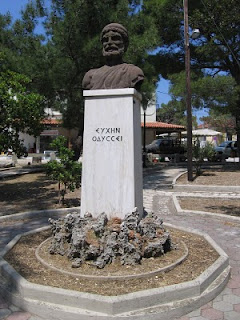 Nan and I went off in search of the hotel we had booked for the next three nights, and John went off to see if he could clear us in to Greece at the marina’s customs office. We had cleared in and out of Turkey at the Kusadasi marina, but since leaving Turkey, we had never been in one place long enough or during business hours on a weekday to clear back in to Greece. When Nan and I returned to the boat to pack up and move, John informed us that since it was off-season and the marina’s customs office was closed, we would all need to go into Corfu city to clear in. Tired, hungry and grubby, Nan and I stood with the others at the bus stop, regretting that we hadn’t made a detour to Samos or somewhere right after we left Turkey to take care of this necessary detail. Three hours later, after trudging through the rainy cobblestone streets, visiting first one office and then another and then yet another, and waiting interminable periods in sterile waiting rooms, we were cleared. Nan and I caught the first taxi we could find back to the marina, packed up and caught another taxi to the hotel.
 After showers, clean clothes, an excellent meal and a good night’s sleep, we felt human again. We ate breakfast at the hotel and then walked back to the marina. John was preparing the boat to be left on its own for a few weeks, and he and Kevin were packing up so they could catch a flight to Athens that afternoon. Harry and Velinda were going to stay on the boat for a few days to take in the sights of Corfu. We talked the nice owners of the Hinckley next to us into taking our picture, then we exchanged contact information, shook hands and hugged. Our Odyssey was over.
 While it is certainly true that we in no small way duplicated the voyage of Ulysses, I believe that our adventure in his part of the world more than lived up to Capt. John’s hope for it when he wrote in an email message before the trip: “I am searching for the spirit of Odysseus as much as anything.”
 The Odd-yssey
When Capt. John Kretschmer mentioned that he was thinking of re-creating the Odyssey by sailing from Troy to Ithaca, I couldn’t believe it. What a great idea! We were at the end of a successful passage from Fort Lauderdale to the Bahamas and back, and we were feeling that sense of accomplishment that makes you think you’re ready for whatever’s next. Follow in the footsteps of Ulysses, one of history’s greatest adventurers? Sure, why not? If he did it in a primitive galley, we could surely do it in a modern sailboat. And if it took him ten years, we could certainly do it in two weeks. These thoughts sustained me through the fifteen months of planning and preparation leading up to our voyage, which began on April 23 of 2008 and ended on May 7.
 There is much to be said in favor of spontaneity. Decide to do something and then go do it. No hesitation. No second-guessing. The fifteen months between the idea and the execution for the Odyssey trip gave us too much time to consider and then reconsider our plans. The original plan, based on the route detailed in Tim Severin’s The Ulysses Voyage: Sea Search for the Odyssey, called for us to fly into Izmir, on the west coast of Turkey, and then travel up the coast to the marina at Ayvalik, where we would meet up with Capt. John and his forty-seven foot 1987 Kaufman cutter, Quetzal. Our crew would consist of John, me, my wife Nan, and Harry and Velinda from the Bahamas trip. Since there are no marinas near the ancient ruins of Troy, in the furthest northwest corner of the Anatolian peninsula, we would travel overland to pay homage at the site of the Trojan War and its famous horse before retracing our route to begin our sail.
 From Ayvalik we would sail west along the north coast of the island of Lesbos and then roughly southwest toward the Doro Channel between the islands of Evvia and Andros. Ulysses (called Odysseus in Greek) had carefully worked his way counter-clockwise around the northern Aegean Sea, sailing during the day and camping on shore at night, but we wanted to get to the locations where the main events of Homer’s epic tale had reputedly taken place, starting with the Cyclops encounter on the southern coast of Crete. From there we would sail to the island of Gramvousa, off the northwest corner of Crete.
  Severin postulated that this was the place where Aeolus, the Ruler of the Winds, gave Ulysses the leather bag of wind he would need to cross back to the Greek mainland. After working our way west and north around the fingers of the Peloponnese peninsula, we would sail right past Ulysses’ home island of Ithaca, as he had also done, into the area where his encounters with Circe, the Clashing Rocks, the Sirens, Scylla and Charybdis had taken place. We would then retrace our route south to Ithaca before sailing north again to end our voyage in Corfu.
 By December the plans had changed. Instead of starting in Turkey, which would require greater travel expenses and the customs complication of arriving by plane but leaving by boat, it was decided that we would start in Athens and make a quick trip across the Aegean to Troy. John had worked a deal to have the Travel Channel film the voyage for a TV documentary, and they were counting on getting footage of us at Troy. John had also added another crewmember, Kevin.
 Nan and I arrived in Athens a few days before we were to set sail so we could tour the city and see the sights, including the Acropolis and the Parthenon. The evening before our Wednesday departure, we met up with everybody at the marina in Piraeus for dinner and a chart briefing. It was good to see John, Harry and Velinda again, and to meet Kevin. Nan was meeting them all for the first time. Over wine and authentic Greek food, we discussed the trip ahead. Everyone was excited to get going, even after John informed us that the deal with the Travel Channel had fallen through.
 After final fueling and provisioning, we were underway before noon the next day. Almost immediately, we experienced engine trouble. John had replaced the alternator the day before to correct a charging problem, and the belt slipped, filling the cockpit with burned-rubber smoke as it disintegrated. We sailed slowly along in the light winds as John worked in the engine compartment to replace the belt, but it was his last replacement so we agreed not to run the engine at more than 2,000 RPMs, the equivalent of five knots, for the rest of the trip.
 In the late afternoon, we arrived at Cape Sounion, about twenty-five miles southeast of Piraeus, and anchored within sight of the Temple of Poseidon. This was the first of our touchpoints with the Odyssey route, but we were coming at it from the wrong direction. Ulysses and his men stopped here on their way from Troy.
On Thursday morning, we set out early with the idea of making an overnight passage northeast to Turkey. By afternoon, the wind from the north had picked up dramatically and we were tightly pinched to make headway against it in eight-foot swells as we approached the Doro Channel. We were beginning to wonder if the meltemi, the strong northerly winds that occur every summer in the Aegean, had arrived early. John had purposely planned the trip early in the season to avoid the meltemi, but there was no getting around the fact that the wind was going to prevent us from getting to Turkey as planned. We steered toward the closest logical landfall at Gavrio, on the southern coast of Andros, but even the leeward harbor offered little protection as the winds continued building to gale force.
 Our Med mooring put us perpendicular to the wind, requiring several lines from the boat to the quay just to hold us in place. Relieved to be safely ashore, we found a cozy taverna for dinner and a discussion of our options. We all agreed that if the strong winds continued, we would not be able to continue our northeastern tack. John proposed sailing east instead, staying in the lee of the Greek islands to temper the wind, and arriving in Turkey at Kusadasi, almost 200 miles south of Troy. The implication was clear: we would not be going to Troy. To ease the disappointment, John suggested we take an extra day in Turkey to visit Ephesus, the ancient Greek ruins located a short drive north of Kusadasi, perhaps figuring that some ruins were better than none.
 The wind was still howling on Friday morning, pinning us in place for the day. We wandered around Gavrio, shopped for provisions and killed time in an Internet café. Nan and I checked into a harborside hotel, hoping for a better night’s sleep and a decent shower. That evening we all watched as the local people celebrated Greek Orthodox Good Friday by parading through the streets carrying their church’s tabernacle and playing the funeral dirge on bugle and drums.
There was a small window of opportunity the following day, so we carefully exited the harbor and headed southeast along the protected coasts of Andros and Tinos. The wind picked up predictably as we crossed the gap to Mykonos, where we spent our fourth night at the new harbor north of town. It would have been worth the trip into town to see the distinctive “Greeky” architecture of white adobe buildings with bright blue trim for which Mykonos is known, but we lacked ground transportation and it was still off-season for most businesses.
 We awoke to rain on Sunday morning. The winds had moved on, replaced by dark clouds. We motored most of the distance east to the island of Ikaría, named for Icarus from Greek mythology, and arrived at Kirikos as the town was preparing to celebrate Greek Orthodox Easter. While we were tying up in the town’s small harbor, some local people were busy hanging Judas in effigy at the end of the dock. Later, when it was dark enough, we watched from a harborside taverna as they set the dummy on fire. The gathered crowd cheered as the fireworks stuffed inside were ignited, sending rockets in all directions. We had to admit we had never seen an Easter celebration to rival this one.
The clouds cleared but the wind didn’t return for the next leg of our trip east, to the island of Samos, just west of the Turkish coast. We moored at the new marina east of Pythagoria, the reputed birthplace of Pythagoras, the ancient mathematician credited with the theorem that bears his name. We made the muddy hike up and over the hill that separates the marina from town and were rewarded with a beautiful stroll along a stone boardwalk lined with tavernas on the one side and pastel-colored fishing boats on the other.
 There was still no wind for our final push to Turkey on Tuesday morning, so we motored with limp sails while dodging the many cruise ships going to and coming from Kusadasi. We arrived in the early afternoon and were immediately captivated by the place. Turkey was very much like Greece in its terrain and climate, but everything about it was more pleasant. It was cleaner and better organized, the people were friendlier, and the food was better. There was a noticeable sense of pride and patriotism. All of this was clearly evident at a neighborhood street market we stumbled upon as we wandered the city streets. Despite the language and culture differences, and the fact that we were the only Americans in the crowded market, the merchants were happy to assist us in buying spices and souvenirs.
 Ephesus, our substitute Troy, was made memorable by Emre, our personal guide. He admitted at the beginning of our day trip the next day that he was hung over from drinking too much raki, but that didn’t prevent him from filling our heads with all the known history of the famous ruins, everything from the significance of the bull busts that topped one ancient wall to the fact that Marc Antony and Cleopatra had celebrated their honeymoon here.
Our couple of days in Turkey were the highlight of our trip, but it had taken us a full week to get there. We needed to be 500 miles to the west, all the way to Corfu, within another week to make our travel connections. We would need to hurry. Crete, the site of the most memorable Odyssey events, would need to be skipped. Not only that, we would need to make a series of overnight passages, with very few landfalls.
 Our first passage had us leaving Kusadasi before dawn and sailing continuously for more than 300 miles over two nights and three days to reach Methoni, at the southwest corner of the Peloponnese peninsula. We spent the night anchored offshore from the beach that draws summer crowds to this scenic town and its well-preserved Venetian-era castle.
Short on fuel from frequent light-air motoring, we were lucky to find a fuel truck willing to deliver on a Sunday morning when we pulled into the harbor at Pylos, just a few miles up the coast from Methoni. Then it was north to Ithaca on our second overnight passage.
 Early the next morning, we anchored in the beautiful harbor of Vathi on Ithaca. Not counting Methoni and Pylos, where Ulysses and his crew must have stopped on their way north, Ithaca was only the second touchpoint of our Odyssey trip after the Temple of Poseidon on Cape Sounion. We planned to make the most of it, renting cars to drive to the Cave of the Nymphs in the northern part of the island, where Ulysses hid his treasure after returning home. The cave had collapsed during the 1953 Kefalonia earthquake so there was not much to see, but standing at the shore below, it was easy to imagine Ulysses washing up in the crystalline waters of Polis Bay after twenty years away from home.
We headed north in the afternoon for the island of Corfu, our last overnight passage and the last leg of our trip. The capital city of Corfu, with its imposing Venetian citadel and Great Cross, were a welcome sight through the mist the next morning. We sailed past the city a few miles to the town of Gouvia, where Corfu’s primary marina is located, and Med moored for the final time.
 Nan and I went off in search of the hotel we had booked for the next three nights, and John went off to see if he could clear us in to Greece at the marina’s customs office. We had cleared in and out of Turkey at the Kusadasi marina, but since leaving Turkey, we had never been in one place long enough or during business hours on a weekday to clear back in to Greece. When Nan and I returned to the boat to pack up and move, John informed us that since it was off-season and the marina’s customs office was closed, we would all need to go into Corfu city to clear in. Tired, hungry and grubby, Nan and I stood with the others at the bus stop, regretting that we hadn’t made a detour to Samos or somewhere right after we left Turkey to take care of this necessary detail. Three hours later, after trudging through the rainy cobblestone streets, visiting first one office and then another and then yet another, and waiting interminable periods in sterile waiting rooms, we were cleared. Nan and I caught the first taxi we could find back to the marina, packed up and caught another taxi to the hotel.
 After showers, clean clothes, an excellent meal and a good night’s sleep, we felt human again. We ate breakfast at the hotel and then walked back to the marina. John was preparing the boat to be left on its own for a few weeks, and he and Kevin were packing up so they could catch a flight to Athens that afternoon. Harry and Velinda were going to stay on the boat for a few days to take in the sights of Corfu. We talked the nice owners of the Hinckley next to us into taking our picture, then we exchanged contact information, shook hands and hugged. Our Odyssey was over.
 While it is certainly true that we in no small way duplicated the voyage of Ulysses, I believe that our adventure in his part of the world more than lived up to Capt. John’s hope for it when he wrote in an email message before the trip: “I am searching for the spirit of Odysseus as much as anything.”
Thursday, May 29, 2008
The Odyssey: Slideshow
 Sorry for the delay in posting additional photos from our Odyssey trip. I took about 360 so it has taken some time to figure out which ones to share. While reviewing them, I came up with a novel idea: use the Windows DVD Maker to create the slideshow, then rip it to WMV and MOV formats and upload it to the Internet. It's less work than creating Flex/Flash slideshows like I did for our Italy trip last fall, and I was able to add music from a CD of classic Greek music that we picked up in Corfu. Take your pick:
- The Odyssey: Slideshow (Windows Media Player format)
- The Odyssey: Slideshow (QuickTime Player format)
Friday, May 9, 2008
The Odyssey: Early Photos
 Nan and I are checked into the Sofitel Hotel at the Athens airport, after our Aegean Airlines flight over from Corfu this morning. Early tomorrow morning we fly back to Colorado with Lufthansa by way of Munich. We are both ready to go home. The three weeks we have been traveling is starting to feel like three months.
 We have reliable high-speed Internet access here at the hotel, so I am trying to catch up on the blog. I have manually posted the few Spot updates that went through that Kevin has forwarded to me. If you view the Spot updates' Google Maps links in chronological order, they give you a rough idea of our voyage east to Kusadasi, Turkey and then west to Corfu, although the last Spot is from right outside of Methoni, our first landfall after leaving Kusadasi.
 Here are three photos from early in our voyage. The first shows Quetzal tied up at the marina in Piraeus before we set sail. That's Kevin in the white shirt, writing in his journal. The second is a group shot of Harry, Kevin, me and Nan in front of the Temple of Poseidon at Cape Sounion after our first day of sailing. And the third shows me at the helm on our second day, sailing to Andros, when the gale started to blow in. The camera is not tilted, as you can see by the level sea behind me; the boat is really heeling that much. What you can't see is that we were rocking and rolling through some massive swells that afternoon.
When we get home, I will try to put together the best photos into a slideshow and post them here. Thanks for following our voyage!
Update 5/15/08: Kevin sent me two more Spots, one from Ithaca dated May 5 and one from Corfu dated May 7. Both are posted now under their respective dates.
Wednesday, May 7, 2008
The Odyssey: Corfu
We arrived in Corfu yesterday morning after an overnight passage from Ithaca. After four nights of passages between Kusadasi and Corfu, Nan and I were ready to get off the boat. As soon as we tied up at the Gouvia marina, we set out in search of the Iliada beach hotel, where we had a reservation. We were a day early but it is still off-season here so it wasn't a problem.
Ithaca was beautiful. We rented two Fiats for the six of us and toured the northern end of the island. We stopped at an old monastery with a view of Vathi, where we had anchored Quetzal. Then we drove on to the Cave of the Nymphs, known locally as Louvias Cave. It was a disappointment. The 1953 earthquake which devastated Kefalonia, the large island to the west of Ithaca, also collapsed the cave. It was located right at the waterline and we were able to walk to it, but there wasn't much to see, just the grafitti and trash that are ever-present in Greece.
We couldn't clear into Greece at the marina, so we needed to go into Old Corfu. We all took a bus, which ended up taking longer than if we had just walked the three kilometers. We wandered through the narrow crowded streets, somewhat reminiscent of Florence, to reach the waterfront where the customs and immigration offices were located. After an endless wait, an official added a handstamp to our Turkey stamps and we were cleared. Nan and I caught a taxi back to the hotel and showered off the many days of sea travel, then ate a leisurely Greek dinner and settled into our first land-based sleep in almost two weeks.
We will be in Corfu until Friday morning, when we fly to Athens. On Saturday morning, we fly home. I think we will both be relieved to be home. This has been an interesting adventure, not at all how we imagined it. We had difficult weather at the beginning when we were sailing east and then almost no wind at all for the westward return. We needed to run the engine frequently to make headway, which meant we were going about five knots instead of the seven to eight that we would have been going under sail. We still managed to travel eight hundred nautical miles in fourteen days, but that meant that we spent more time on the boat than we did exploring the places where we made landfall. In retrospect, it was unrealistic to think we could re-create the Odyssey in that timeframe. Afterall, it took Ulysses ten whole years to make his similar voyage.
Ithaca was beautiful. We rented two Fiats for the six of us and toured the northern end of the island. We stopped at an old monastery with a view of Vathi, where we had anchored Quetzal. Then we drove on to the Cave of the Nymphs, known locally as Louvias Cave. It was a disappointment. The 1953 earthquake which devastated Kefalonia, the large island to the west of Ithaca, also collapsed the cave. It was located right at the waterline and we were able to walk to it, but there wasn't much to see, just the grafitti and trash that are ever-present in Greece.
We couldn't clear into Greece at the marina, so we needed to go into Old Corfu. We all took a bus, which ended up taking longer than if we had just walked the three kilometers. We wandered through the narrow crowded streets, somewhat reminiscent of Florence, to reach the waterfront where the customs and immigration offices were located. After an endless wait, an official added a handstamp to our Turkey stamps and we were cleared. Nan and I caught a taxi back to the hotel and showered off the many days of sea travel, then ate a leisurely Greek dinner and settled into our first land-based sleep in almost two weeks.
We will be in Corfu until Friday morning, when we fly to Athens. On Saturday morning, we fly home. I think we will both be relieved to be home. This has been an interesting adventure, not at all how we imagined it. We had difficult weather at the beginning when we were sailing east and then almost no wind at all for the westward return. We needed to run the engine frequently to make headway, which meant we were going about five knots instead of the seven to eight that we would have been going under sail. We still managed to travel eight hundred nautical miles in fourteen days, but that meant that we spent more time on the boat than we did exploring the places where we made landfall. In retrospect, it was unrealistic to think we could re-create the Odyssey in that timeframe. Afterall, it took Ulysses ten whole years to make his similar voyage.
OK ESN:0-7351773 (Corfu)
This is Quetzal, all is well. We'll be in touch when we can.
ESN:0-7351773
Latitude:39.6498
Longitude:19.8539
Nearest Location:not known
Distance:not known
Time:05/07/2008 00:01:24 (US/Eastern)
http://maps.google.com/maps?f=q&hl=en&geocode=&q=39.6498,19.8539&ie=UTF8&z=12&om=1
ESN:0-7351773
Latitude:39.6498
Longitude:19.8539
Nearest Location:not known
Distance:not known
Time:05/07/2008 00:01:24 (US/Eastern)
http://maps.google.com/maps?f=q&hl=en&geocode=&q=39.6498,19.8539&ie=UTF8&z=12&om=1
Monday, May 5, 2008
The Odyssey: Ithaca
We have arrived at Ithaca, Ulysses' home island, on the Ionian coast of Greece. Quetzal is currently anchored in the harbor of Vathi. We will be renting cars in a little while to drive up to the Cave of the Nymphs, where the only relics from Ulysses' presence on the island are located. Late this afternoon, we will be shoving off again on another overnight passage, this time to Corfu, our final destination.
We have been sailing almost continuously since leaving Kusadasi last Thursday. Our first landfall was on Saturday evening, in the little port of Methoni on the Peloponesse peninsula, a few miles short of our intended destination of Pylos. We had a well-deserved "taverna" dinner to celebrate our 300-mile passage. On Sunday morning, we sailed the short distance to Pylos and were able to buy diesel fuel, but all the markets were closed so we couldn't buy much in the way of provisions. Early in the afternoon, we set sail again for the overnight to Ithaca, where we are now.
Apparently, there is a limit to how many addresses we can have in the Spot system, and none of Nan's or mine made it into the list. Kevin has been nice enough to forward them all to me so I will post them manually when we get up to Corfu.
We have been sailing almost continuously since leaving Kusadasi last Thursday. Our first landfall was on Saturday evening, in the little port of Methoni on the Peloponesse peninsula, a few miles short of our intended destination of Pylos. We had a well-deserved "taverna" dinner to celebrate our 300-mile passage. On Sunday morning, we sailed the short distance to Pylos and were able to buy diesel fuel, but all the markets were closed so we couldn't buy much in the way of provisions. Early in the afternoon, we set sail again for the overnight to Ithaca, where we are now.
Apparently, there is a limit to how many addresses we can have in the Spot system, and none of Nan's or mine made it into the list. Kevin has been nice enough to forward them all to me so I will post them manually when we get up to Corfu.
OK ESN:0-7351773 (Ithaca)
This is Quetzal, all is well. We'll be in touch when we can.
ESN:0-7351773
Latitude:38.366
Longitude:20.7192
Nearest Location:not known
Distance:not known
Time:05/05/2008 09:53:30 (US/Eastern)
http://maps.google.com/maps?f=q&hl=en&geocode=&q=38.366,20.7192&ie=UTF8&z=12&om=1
ESN:0-7351773
Latitude:38.366
Longitude:20.7192
Nearest Location:not known
Distance:not known
Time:05/05/2008 09:53:30 (US/Eastern)
http://maps.google.com/maps?f=q&hl=en&geocode=&q=38.366,20.7192&ie=UTF8&z=12&om=1
Sunday, May 4, 2008
OK ESN:0-7351773 (Leaving Methoni)
This is Quetzal, all is well. We'll be in touch when we can.
ESN:0-7351773
Latitude:36.8183
Longitude:21.696
Nearest Location: Meth*ni, Greece
Distance: 1 km(s)
Time:05/04/2008 00:00:15 (US/Eastern)
http://maps.google.com/maps?f=q&hl=en&geocode=&q=36.8183,21.696&ie=UTF8&z=12&om=1
ESN:0-7351773
Latitude:36.8183
Longitude:21.696
Nearest Location: Meth*ni, Greece
Distance: 1 km(s)
Time:05/04/2008 00:00:15 (US/Eastern)
http://maps.google.com/maps?f=q&hl=en&geocode=&q=36.8183,21.696&ie=UTF8&z=12&om=1
Friday, May 2, 2008
OK ESN:0-7351773 (Between Serifos and Sifnos)
This is Quetzal, all is well. We'll be in touch when we can.
ESN:0-7351773
Latitude:37.0504
Longitude:24.6016
Nearest Location: *yioi An*ryiroi, Greece
Distance: 10 km(s)
Time:05/02/2008 01:34:02 (US/Eastern)
http://maps.google.com/maps?f=q&hl=en&geocode=&q=37.0504,24.6016&ie=UTF8&z=12&om=1
ESN:0-7351773
Latitude:37.0504
Longitude:24.6016
Nearest Location: *yioi An*ryiroi, Greece
Distance: 10 km(s)
Time:05/02/2008 01:34:02 (US/Eastern)
http://maps.google.com/maps?f=q&hl=en&geocode=&q=37.0504,24.6016&ie=UTF8&z=12&om=1
Thursday, May 1, 2008
OK ESN:0-7351773 (South of Mykonos)
This is Quetzal, all is well. We'll be in touch when we can.
ESN:0-7351773
Latitude:37.2854
Longitude:25.2541
Nearest Location:not known
Distance:not known
Time:05/01/2008 18:41:50 (US/Eastern)
http://maps.google.com/maps?f=q&hl=en&geocode=&q=37.2854,25.2541&ie=UTF8&z=12&om=1
ESN:0-7351773
Latitude:37.2854
Longitude:25.2541
Nearest Location:not known
Distance:not known
Time:05/01/2008 18:41:50 (US/Eastern)
http://maps.google.com/maps?f=q&hl=en&geocode=&q=37.2854,25.2541&ie=UTF8&z=12&om=1
OK ESN:0-7351773 (North of Samos)
This is Quetzal, all is well. We'll be in touch when we can.
ESN:0-7351773
Latitude:37.8494
Longitude:26.82
Nearest Location:not known
Distance:not known
Time:05/01/2008 02:32:18 (US/Eastern)
http://maps.google.com/maps?f=q&hl=en&geocode=&q=37.8494,26.82&ie=UTF8&z=12&om=1
ESN:0-7351773
Latitude:37.8494
Longitude:26.82
Nearest Location:not known
Distance:not known
Time:05/01/2008 02:32:18 (US/Eastern)
http://maps.google.com/maps?f=q&hl=en&geocode=&q=37.8494,26.82&ie=UTF8&z=12&om=1
The Odyssey: Passage to Pylos
Today was a shore day in Kusadasi. We took a guided tour of Ephesus in the morning and then bombed around town in the afternoon. Ephesus was amazing, like touring an entire city from the Greek and Roman eras. We have a new appreciation for the beauty and sophistication of Turkey.
Early tomorrow we're headed west to Pylos on the Peloponesse peninsula of Greece, about 300 miles away. Capt. John decided that we will need to skip Crete in order to stay on track to reach Corfu by next Wednesday, when we all have travel connections. So we will be sailing for about forty-eight straight hours without landfall. We'll try to send Spot updates, but they might show only here on the blog and not go out to the recipients list. Sorry that hasn't worked out better.
Early tomorrow we're headed west to Pylos on the Peloponesse peninsula of Greece, about 300 miles away. Capt. John decided that we will need to skip Crete in order to stay on track to reach Corfu by next Wednesday, when we all have travel connections. So we will be sailing for about forty-eight straight hours without landfall. We'll try to send Spot updates, but they might show only here on the blog and not go out to the recipients list. Sorry that hasn't worked out better.
Wednesday, April 30, 2008
OK ESN:0-7351773 (Kusadasi, Turkey)
This is Quetzal, all is well. We'll be in touch when we can.
ESN:0-7351773
Latitude:37.8729
Longitude:27.2627
Nearest Location:not known
Distance:not known
Time:04/30/2008 12:21:04 (US/Eastern)
http://maps.google.com/maps?f=q&hl=en&geocode=&q=37.8729,27.2627&ie=UTF8&z=12&om=1
ESN:0-7351773
Latitude:37.8729
Longitude:27.2627
Nearest Location:not known
Distance:not known
Time:04/30/2008 12:21:04 (US/Eastern)
http://maps.google.com/maps?f=q&hl=en&geocode=&q=37.8729,27.2627&ie=UTF8&z=12&om=1
The Odyssey: Kusadasi, Turkey
 Hello from the marina in Kusadasi. Yes, we have finally left Greece behind for Turkey after a full week of sailing. We arrived this afternoon after motoring over from Pythagoria on Samos, where we moored last night. Today was our best weather day so far, sunny and warm, but with almost no wind, thus the motoring.
Kusadasi has a different, much less European feel from any of our Greek landfalls. Turkey is a Muslim country and it shows in the cleanliness of its streets, the friendly nature of its people and the liveliness of its marketplaces. We spent the afternoon wandering around the area near the marina, buying spices and produce to boost our diminished provisions. We ate dinner at Mezget, a traditional Turkish restaurant with excellent seafood and grilled meats. The last prayer of the day just echoed out across the city about a half-hour ago, so it must be time to call it a night.
 Tomorrow we are taking a tour of Ephesus, the famous Roman ruins north of here. It will have to substitute for Troy, which is still too far away. On Thursday, we are planning on getting underway early and sailing continuously until we reach the northwest corner of Crete, about 120 nautical miles away. This will involve overnight sailing and two-person, three-hour watches.
Sorry again about the SPOT updates. Apparently, all of Nan's and my email addresses have been left out of the recipients list. The update from yesterday was forwarded to me by crewmate Kevin. It shows us on our way from Kirikos to Pythagoria. Capt. John says he will try to get the situation rectified by tomorrow. I will keep you posted.
Tuesday, April 29, 2008
OK ESN:0-7351773 (Between Samos and Turkey)
This is Quetzal, all is well. We'll be in touch when we can.
ESN:0-7351773
Latitude:37.7003
Longitude:27.047
Nearest Location: Kl*ma, Greece
Distance: 1 km(s)
Time:04/29/2008 04:21:11 (US/Eastern)
http://maps.google.com/maps?f=q&hl=en&geocode=&q=37.7003,27.047&ie=UTF8&z=12&om=1
ESN:0-7351773
Latitude:37.7003
Longitude:27.047
Nearest Location: Kl*ma, Greece
Distance: 1 km(s)
Time:04/29/2008 04:21:11 (US/Eastern)
http://maps.google.com/maps?f=q&hl=en&geocode=&q=37.7003,27.047&ie=UTF8&z=12&om=1
Monday, April 28, 2008
OK ESN:0-7351773 (South of Samos)
This is Quetzal, all is well. We'll be in touch when we can.
ESN:0-7351773
Latitude:37.637
Longitude:26.6852
Nearest Location:not known
Distance:not known
Time:04/28/2008 06:32:55 (US/Eastern)
http://maps.google.com/maps?f=q&hl=en&geocode=&q=37.637,26.6852&ie=UTF8&z=12&om=1
ESN:0-7351773
Latitude:37.637
Longitude:26.6852
Nearest Location:not known
Distance:not known
Time:04/28/2008 06:32:55 (US/Eastern)
http://maps.google.com/maps?f=q&hl=en&geocode=&q=37.637,26.6852&ie=UTF8&z=12&om=1
Sunday, April 27, 2008
The Odyssey: Kirikos on Ikaria
Not where you (or we) expected. The winds have been blowing hard out of the north so we have been unable to make much comfortable headway in that direction. Instead we have been heading east. So from Mykonos, where we spent last night, today we sailed further east and are now in Kirikos on the island of Ikaria, named after Icarus, the character from mythology who flew too close to the sun, melted the wax that held his wings together and fell into the sea.
I picked up a wireless connection from the harbor because the Internet cafes are closed. Today is Easter in the Greek Orthodox religion, and we just witnessed the local people hanging and burning Judas in effigy. They take Easter very seriously here.
Tomorrow we hope to clear out of Greece in Samos, the next island to the east and then clear in to Turkey in Kusadasi. We will be too far south of Troy to even attempt an overland journey to the ruins, which would probably be about twelve hours by car or bus, so we may go to one of Turkey's more famous sites, Ephesus.
By the way, the GPS satellite coverage in this area is weak, so we have been unable to send the SPOT beacon messages or to even secure our latitude and longitude using the GPS at times. We hope this will improve later in the voyage as we move toward Crete and Ithaca.
Next update: Kusadasi (if there's Internet access)
I picked up a wireless connection from the harbor because the Internet cafes are closed. Today is Easter in the Greek Orthodox religion, and we just witnessed the local people hanging and burning Judas in effigy. They take Easter very seriously here.
Tomorrow we hope to clear out of Greece in Samos, the next island to the east and then clear in to Turkey in Kusadasi. We will be too far south of Troy to even attempt an overland journey to the ruins, which would probably be about twelve hours by car or bus, so we may go to one of Turkey's more famous sites, Ephesus.
By the way, the GPS satellite coverage in this area is weak, so we have been unable to send the SPOT beacon messages or to even secure our latitude and longitude using the GPS at times. We hope this will improve later in the voyage as we move toward Crete and Ithaca.
Next update: Kusadasi (if there's Internet access)
Friday, April 25, 2008
The Odyssey: Gavrio
Greetings from Gavrio, on the island of Andros, about sixty miles east of Athens. We are pinned down here by a Force 7 to 8 gale that is blowing out of the north. We arrived here late yesterday afternoon on our way toward Turkey and have been here now about twenty-four hours. This morning we were thinking of heading southeast to Mykonos to avoid beating ourselves up fighting into the wind, but with gusts of close to fifty miles per hour, Capt. John decided we should stay put for the day.
I'm sorry about the SPOT beacon broadcasts. Capt. John put me in charge of them a couple of days ago and I have sent out two so far but they're not going anywhere. I will review the instructions with him and try again tomorrow. Of the two you missed, the first was from Cape Sounion, within sight of the Temple of Poseidon. I took some great late afternoon shots of the temple, but I am at an Internet cafe and will have to post them later. The second was from Gavrio, where we are now.
If the weather improves, we will probably head north tomorrow through the Doro Channel and then northeast to the island of Lesbos, where we will check out of Greece and check into Turkey, with landfall at Ayvalik on Sunday sometime.
Everyone here in Greece is getting set for Easter, one of their biggest holidays. They start celebrating at midnight on Saturday and continue for three weeks. The locals are telling us we should stick around for it but we're anxious to press on if we can. We're barely three days into our Odyssey and we haven't even made it to Troy yet.
Next update: Lesbos (hopefully)
I'm sorry about the SPOT beacon broadcasts. Capt. John put me in charge of them a couple of days ago and I have sent out two so far but they're not going anywhere. I will review the instructions with him and try again tomorrow. Of the two you missed, the first was from Cape Sounion, within sight of the Temple of Poseidon. I took some great late afternoon shots of the temple, but I am at an Internet cafe and will have to post them later. The second was from Gavrio, where we are now.
If the weather improves, we will probably head north tomorrow through the Doro Channel and then northeast to the island of Lesbos, where we will check out of Greece and check into Turkey, with landfall at Ayvalik on Sunday sometime.
Everyone here in Greece is getting set for Easter, one of their biggest holidays. They start celebrating at midnight on Saturday and continue for three weeks. The locals are telling us we should stick around for it but we're anxious to press on if we can. We're barely three days into our Odyssey and we haven't even made it to Troy yet.
Next update: Lesbos (hopefully)
Wednesday, April 23, 2008
The Odyssey: Acropolis
 On Tuesday morning, Nan and I caught some breakfast at an Everest Cafe ("It's cool!") and then took a taxi down to the Acropolis. We had hoped to meet Harry and Velinda there, but they were running behind due to electrical problems at the boat. Capt. John thought there was a problem with the alternator so they were going to go find a new one.
When we arrived at the entrance to the Acropolis, we were surprised to see thousands of people already there and trudging up the steep walkway to the top. Here's a photo of Nan on the walk with the Parthenon on the hill in the background.
 The Parthenon itself is an amazing architectural achievement considering that is about twenty-five centuries old. Its scale is based on the squares of the first three numbers, so it is four units tall and nine units wide, and the columns are nine units tall and four units between. To fool the eye and its tendency to curve perspectives, the base is curved slightly upward in the middle so that it appears to be a straight line when looked at straight on. In the same way, the columns bulge in their middles and tilt slightly inward to achieve the same effect.
 The entire area is in a condition of continuous renovation, so there are cranes and scaffolds everywhere. We're not sure if maybe they intend to put the Parthenon back into its original condition, which was badly damaged by the invading Venetians in 1687 as well as the ravages of time. The caryatids are well preserved and represent, I think, the oldest use of statues as support columns. They are smaller than I would have thought, maybe ten feet tall. Behind them but not visible is an olive tree planted in the location where Athena herself is supposed to have planted an original one.
In the evening, we took a taxi down to the Marina Zea in Piraeus to meet up with Capt. John, Harry and Velinda, and Kevin. We did a quick chart briefing and some last-minute provisioning and then went to dinner at a local taverna featuring, what else, authentic Greek food.
We are on our way down there again this morning to cast off on our sailing adventure. We expect to pass the Temple of Poseidon on our way to a marina around the corner from Cape Sounion before heading across the Aegean for Turkey tomorrow.
Subscribe to:
Posts (Atom)

