

Of course, as soon as I had given up hope of Latitudes & Attitudes ever publishing my article about our 2008 Odyssey sailing trip, they finally did publish it in their May 2010 issue, along with fourteen of the eighteen photos I submitted. If you missed it at the newstand or at the seafaring.com website, you can still read it in its published format at Capt. John Kretschmer's website: "The Odd-yssey" by John Lichty.
Editor Sue took a few liberties that I wasn't overly happy about, and there are some misspellings in the photo captions, but the article finally made it to print and that's what matters. She even mailed me a check, which went immediately into the "boat fund."
If you would like to read the original article, in its original format, with all eighteen photos, which I posted here back in March when I was sure it would never get published, here's a link to it: "The Odd-yssey".
About Me

- John Lichty
- Savannah,
Georgia, USA
"Go confidently in the direction of your dreams. Live the life you have imagined." --Henry David Thoreau
 Raising Charlie: The Lessons of a Perfect Dog by John Lichty
Subscribe To

 Posts
All Comments
Posts
All Comments

Showing posts with label Ithaca. Show all posts
Showing posts with label Ithaca. Show all posts
Sunday, June 6, 2010

Wednesday, March 17, 2010
The Odd-yssey
Despite assurances from Editor Sue at Latitudes & Attitudes magazine that she would publish it eventually, it has been almost two years since I submitted the following article from our somewhat ill-fated Odyssey trip. St. Patrick's Day seems as good a day as any to post it on the blog. Don't tell her you saw it here first!
 The Odd-yssey
When Capt. John Kretschmer mentioned that he was thinking of re-creating the Odyssey by sailing from Troy to Ithaca, I couldn’t believe it. What a great idea! We were at the end of a successful passage from Fort Lauderdale to the Bahamas and back, and we were feeling that sense of accomplishment that makes you think you’re ready for whatever’s next. Follow in the footsteps of Ulysses, one of history’s greatest adventurers? Sure, why not? If he did it in a primitive galley, we could surely do it in a modern sailboat. And if it took him ten years, we could certainly do it in two weeks. These thoughts sustained me through the fifteen months of planning and preparation leading up to our voyage, which began on April 23 of 2008 and ended on May 7.
 There is much to be said in favor of spontaneity. Decide to do something and then go do it. No hesitation. No second-guessing. The fifteen months between the idea and the execution for the Odyssey trip gave us too much time to consider and then reconsider our plans. The original plan, based on the route detailed in Tim Severin’s The Ulysses Voyage: Sea Search for the Odyssey, called for us to fly into Izmir, on the west coast of Turkey, and then travel up the coast to the marina at Ayvalik, where we would meet up with Capt. John and his forty-seven foot 1987 Kaufman cutter, Quetzal. Our crew would consist of John, me, my wife Nan, and Harry and Velinda from the Bahamas trip. Since there are no marinas near the ancient ruins of Troy, in the furthest northwest corner of the Anatolian peninsula, we would travel overland to pay homage at the site of the Trojan War and its famous horse before retracing our route to begin our sail.
 From Ayvalik we would sail west along the north coast of the island of Lesbos and then roughly southwest toward the Doro Channel between the islands of Evvia and Andros. Ulysses (called Odysseus in Greek) had carefully worked his way counter-clockwise around the northern Aegean Sea, sailing during the day and camping on shore at night, but we wanted to get to the locations where the main events of Homer’s epic tale had reputedly taken place, starting with the Cyclops encounter on the southern coast of Crete. From there we would sail to the island of Gramvousa, off the northwest corner of Crete.
  Severin postulated that this was the place where Aeolus, the Ruler of the Winds, gave Ulysses the leather bag of wind he would need to cross back to the Greek mainland. After working our way west and north around the fingers of the Peloponnese peninsula, we would sail right past Ulysses’ home island of Ithaca, as he had also done, into the area where his encounters with Circe, the Clashing Rocks, the Sirens, Scylla and Charybdis had taken place. We would then retrace our route south to Ithaca before sailing north again to end our voyage in Corfu.
 By December the plans had changed. Instead of starting in Turkey, which would require greater travel expenses and the customs complication of arriving by plane but leaving by boat, it was decided that we would start in Athens and make a quick trip across the Aegean to Troy. John had worked a deal to have the Travel Channel film the voyage for a TV documentary, and they were counting on getting footage of us at Troy. John had also added another crewmember, Kevin.
 Nan and I arrived in Athens a few days before we were to set sail so we could tour the city and see the sights, including the Acropolis and the Parthenon. The evening before our Wednesday departure, we met up with everybody at the marina in Piraeus for dinner and a chart briefing. It was good to see John, Harry and Velinda again, and to meet Kevin. Nan was meeting them all for the first time. Over wine and authentic Greek food, we discussed the trip ahead. Everyone was excited to get going, even after John informed us that the deal with the Travel Channel had fallen through.
 After final fueling and provisioning, we were underway before noon the next day. Almost immediately, we experienced engine trouble. John had replaced the alternator the day before to correct a charging problem, and the belt slipped, filling the cockpit with burned-rubber smoke as it disintegrated. We sailed slowly along in the light winds as John worked in the engine compartment to replace the belt, but it was his last replacement so we agreed not to run the engine at more than 2,000 RPMs, the equivalent of five knots, for the rest of the trip.
 In the late afternoon, we arrived at Cape Sounion, about twenty-five miles southeast of Piraeus, and anchored within sight of the Temple of Poseidon. This was the first of our touchpoints with the Odyssey route, but we were coming at it from the wrong direction. Ulysses and his men stopped here on their way from Troy.
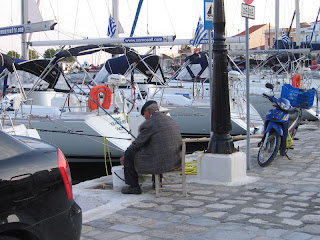
On Thursday morning, we set out early with the idea of making an overnight passage northeast to Turkey. By afternoon, the wind from the north had picked up dramatically and we were tightly pinched to make headway against it in eight-foot swells as we approached the Doro Channel. We were beginning to wonder if the meltemi, the strong northerly winds that occur every summer in the Aegean, had arrived early. John had purposely planned the trip early in the season to avoid the meltemi, but there was no getting around the fact that the wind was going to prevent us from getting to Turkey as planned. We steered toward the closest logical landfall at Gavrio, on the southern coast of Andros, but even the leeward harbor offered little protection as the winds continued building to gale force.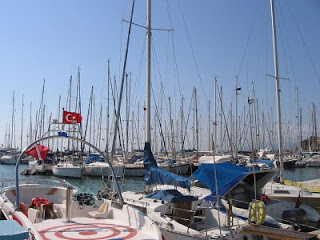 Our Med mooring put us perpendicular to the wind, requiring several lines from the boat to the quay just to hold us in place. Relieved to be safely ashore, we found a cozy taverna for dinner and a discussion of our options. We all agreed that if the strong winds continued, we would not be able to continue our northeastern tack. John proposed sailing east instead, staying in the lee of the Greek islands to temper the wind, and arriving in Turkey at Kusadasi, almost 200 miles south of Troy. The implication was clear: we would not be going to Troy. To ease the disappointment, John suggested we take an extra day in Turkey to visit Ephesus, the ancient Greek ruins located a short drive north of Kusadasi, perhaps figuring that some ruins were better than none.
 The wind was still howling on Friday morning, pinning us in place for the day. We wandered around Gavrio, shopped for provisions and killed time in an Internet café. Nan and I checked into a harborside hotel, hoping for a better night’s sleep and a decent shower. That evening we all watched as the local people celebrated Greek Orthodox Good Friday by parading through the streets carrying their church’s tabernacle and playing the funeral dirge on bugle and drums.
There was a small window of opportunity the following day, so we carefully exited the harbor and headed southeast along the protected coasts of Andros and Tinos. The wind picked up predictably as we crossed the gap to Mykonos, where we spent our fourth night at the new harbor north of town. It would have been worth the trip into town to see the distinctive “Greeky” architecture of white adobe buildings with bright blue trim for which Mykonos is known, but we lacked ground transportation and it was still off-season for most businesses.
 We awoke to rain on Sunday morning. The winds had moved on, replaced by dark clouds. We motored most of the distance east to the island of Ikaría, named for Icarus from Greek mythology, and arrived at Kirikos as the town was preparing to celebrate Greek Orthodox Easter. While we were tying up in the town’s small harbor, some local people were busy hanging Judas in effigy at the end of the dock. Later, when it was dark enough, we watched from a harborside taverna as they set the dummy on fire. The gathered crowd cheered as the fireworks stuffed inside were ignited, sending rockets in all directions. We had to admit we had never seen an Easter celebration to rival this one.
The clouds cleared but the wind didn’t return for the next leg of our trip east, to the island of Samos, just west of the Turkish coast. We moored at the new marina east of Pythagoria, the reputed birthplace of Pythagoras, the ancient mathematician credited with the theorem that bears his name. We made the muddy hike up and over the hill that separates the marina from town and were rewarded with a beautiful stroll along a stone boardwalk lined with tavernas on the one side and pastel-colored fishing boats on the other.
 There was still no wind for our final push to Turkey on Tuesday morning, so we motored with limp sails while dodging the many cruise ships going to and coming from Kusadasi. We arrived in the early afternoon and were immediately captivated by the place. Turkey was very much like Greece in its terrain and climate, but everything about it was more pleasant. It was cleaner and better organized, the people were friendlier, and the food was better. There was a noticeable sense of pride and patriotism. All of this was clearly evident at a neighborhood street market we stumbled upon as we wandered the city streets. Despite the language and culture differences, and the fact that we were the only Americans in the crowded market, the merchants were happy to assist us in buying spices and souvenirs.
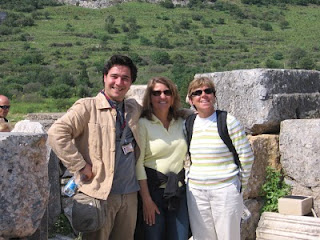
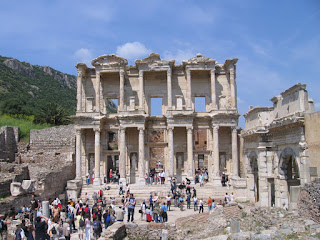
 Ephesus, our substitute Troy, was made memorable by Emre, our personal guide. He admitted at the beginning of our day trip the next day that he was hung over from drinking too much raki, but that didn’t prevent him from filling our heads with all the known history of the famous ruins, everything from the significance of the bull busts that topped one ancient wall to the fact that Marc Antony and Cleopatra had celebrated their honeymoon here.
Our couple of days in Turkey were the highlight of our trip, but it had taken us a full week to get there. We needed to be 500 miles to the west, all the way to Corfu, within another week to make our travel connections. We would need to hurry. Crete, the site of the most memorable Odyssey events, would need to be skipped. Not only that, we would need to make a series of overnight passages, with very few landfalls.
 Our first passage had us leaving Kusadasi before dawn and sailing continuously for more than 300 miles over two nights and three days to reach Methoni, at the southwest corner of the Peloponnese peninsula. We spent the night anchored offshore from the beach that draws summer crowds to this scenic town and its well-preserved Venetian-era castle.
Short on fuel from frequent light-air motoring, we were lucky to find a fuel truck willing to deliver on a Sunday morning when we pulled into the harbor at Pylos, just a few miles up the coast from Methoni. Then it was north to Ithaca on our second overnight passage.
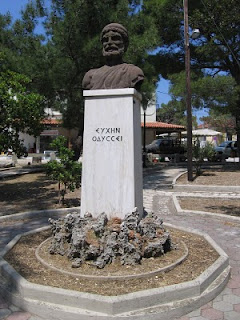
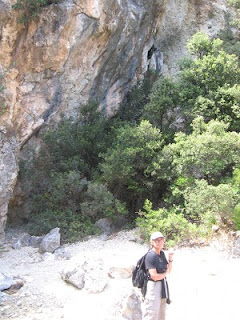 Early the next morning, we anchored in the beautiful harbor of Vathi on Ithaca. Not counting Methoni and Pylos, where Ulysses and his crew must have stopped on their way north, Ithaca was only the second touchpoint of our Odyssey trip after the Temple of Poseidon on Cape Sounion. We planned to make the most of it, renting cars to drive to the Cave of the Nymphs in the northern part of the island, where Ulysses hid his treasure after returning home. The cave had collapsed during the 1953 Kefalonia earthquake so there was not much to see, but standing at the shore below, it was easy to imagine Ulysses washing up in the crystalline waters of Polis Bay after twenty years away from home.
We headed north in the afternoon for the island of Corfu, our last overnight passage and the last leg of our trip. The capital city of Corfu, with its imposing Venetian citadel and Great Cross, were a welcome sight through the mist the next morning. We sailed past the city a few miles to the town of Gouvia, where Corfu’s primary marina is located, and Med moored for the final time.
 Nan and I went off in search of the hotel we had booked for the next three nights, and John went off to see if he could clear us in to Greece at the marina’s customs office. We had cleared in and out of Turkey at the Kusadasi marina, but since leaving Turkey, we had never been in one place long enough or during business hours on a weekday to clear back in to Greece. When Nan and I returned to the boat to pack up and move, John informed us that since it was off-season and the marina’s customs office was closed, we would all need to go into Corfu city to clear in. Tired, hungry and grubby, Nan and I stood with the others at the bus stop, regretting that we hadn’t made a detour to Samos or somewhere right after we left Turkey to take care of this necessary detail. Three hours later, after trudging through the rainy cobblestone streets, visiting first one office and then another and then yet another, and waiting interminable periods in sterile waiting rooms, we were cleared. Nan and I caught the first taxi we could find back to the marina, packed up and caught another taxi to the hotel.
 After showers, clean clothes, an excellent meal and a good night’s sleep, we felt human again. We ate breakfast at the hotel and then walked back to the marina. John was preparing the boat to be left on its own for a few weeks, and he and Kevin were packing up so they could catch a flight to Athens that afternoon. Harry and Velinda were going to stay on the boat for a few days to take in the sights of Corfu. We talked the nice owners of the Hinckley next to us into taking our picture, then we exchanged contact information, shook hands and hugged. Our Odyssey was over.
 While it is certainly true that we in no small way duplicated the voyage of Ulysses, I believe that our adventure in his part of the world more than lived up to Capt. John’s hope for it when he wrote in an email message before the trip: “I am searching for the spirit of Odysseus as much as anything.”
 The Odd-yssey
When Capt. John Kretschmer mentioned that he was thinking of re-creating the Odyssey by sailing from Troy to Ithaca, I couldn’t believe it. What a great idea! We were at the end of a successful passage from Fort Lauderdale to the Bahamas and back, and we were feeling that sense of accomplishment that makes you think you’re ready for whatever’s next. Follow in the footsteps of Ulysses, one of history’s greatest adventurers? Sure, why not? If he did it in a primitive galley, we could surely do it in a modern sailboat. And if it took him ten years, we could certainly do it in two weeks. These thoughts sustained me through the fifteen months of planning and preparation leading up to our voyage, which began on April 23 of 2008 and ended on May 7.
 There is much to be said in favor of spontaneity. Decide to do something and then go do it. No hesitation. No second-guessing. The fifteen months between the idea and the execution for the Odyssey trip gave us too much time to consider and then reconsider our plans. The original plan, based on the route detailed in Tim Severin’s The Ulysses Voyage: Sea Search for the Odyssey, called for us to fly into Izmir, on the west coast of Turkey, and then travel up the coast to the marina at Ayvalik, where we would meet up with Capt. John and his forty-seven foot 1987 Kaufman cutter, Quetzal. Our crew would consist of John, me, my wife Nan, and Harry and Velinda from the Bahamas trip. Since there are no marinas near the ancient ruins of Troy, in the furthest northwest corner of the Anatolian peninsula, we would travel overland to pay homage at the site of the Trojan War and its famous horse before retracing our route to begin our sail.
 From Ayvalik we would sail west along the north coast of the island of Lesbos and then roughly southwest toward the Doro Channel between the islands of Evvia and Andros. Ulysses (called Odysseus in Greek) had carefully worked his way counter-clockwise around the northern Aegean Sea, sailing during the day and camping on shore at night, but we wanted to get to the locations where the main events of Homer’s epic tale had reputedly taken place, starting with the Cyclops encounter on the southern coast of Crete. From there we would sail to the island of Gramvousa, off the northwest corner of Crete.
  Severin postulated that this was the place where Aeolus, the Ruler of the Winds, gave Ulysses the leather bag of wind he would need to cross back to the Greek mainland. After working our way west and north around the fingers of the Peloponnese peninsula, we would sail right past Ulysses’ home island of Ithaca, as he had also done, into the area where his encounters with Circe, the Clashing Rocks, the Sirens, Scylla and Charybdis had taken place. We would then retrace our route south to Ithaca before sailing north again to end our voyage in Corfu.
 By December the plans had changed. Instead of starting in Turkey, which would require greater travel expenses and the customs complication of arriving by plane but leaving by boat, it was decided that we would start in Athens and make a quick trip across the Aegean to Troy. John had worked a deal to have the Travel Channel film the voyage for a TV documentary, and they were counting on getting footage of us at Troy. John had also added another crewmember, Kevin.
 Nan and I arrived in Athens a few days before we were to set sail so we could tour the city and see the sights, including the Acropolis and the Parthenon. The evening before our Wednesday departure, we met up with everybody at the marina in Piraeus for dinner and a chart briefing. It was good to see John, Harry and Velinda again, and to meet Kevin. Nan was meeting them all for the first time. Over wine and authentic Greek food, we discussed the trip ahead. Everyone was excited to get going, even after John informed us that the deal with the Travel Channel had fallen through.
 After final fueling and provisioning, we were underway before noon the next day. Almost immediately, we experienced engine trouble. John had replaced the alternator the day before to correct a charging problem, and the belt slipped, filling the cockpit with burned-rubber smoke as it disintegrated. We sailed slowly along in the light winds as John worked in the engine compartment to replace the belt, but it was his last replacement so we agreed not to run the engine at more than 2,000 RPMs, the equivalent of five knots, for the rest of the trip.
 In the late afternoon, we arrived at Cape Sounion, about twenty-five miles southeast of Piraeus, and anchored within sight of the Temple of Poseidon. This was the first of our touchpoints with the Odyssey route, but we were coming at it from the wrong direction. Ulysses and his men stopped here on their way from Troy.
On Thursday morning, we set out early with the idea of making an overnight passage northeast to Turkey. By afternoon, the wind from the north had picked up dramatically and we were tightly pinched to make headway against it in eight-foot swells as we approached the Doro Channel. We were beginning to wonder if the meltemi, the strong northerly winds that occur every summer in the Aegean, had arrived early. John had purposely planned the trip early in the season to avoid the meltemi, but there was no getting around the fact that the wind was going to prevent us from getting to Turkey as planned. We steered toward the closest logical landfall at Gavrio, on the southern coast of Andros, but even the leeward harbor offered little protection as the winds continued building to gale force.
 Our Med mooring put us perpendicular to the wind, requiring several lines from the boat to the quay just to hold us in place. Relieved to be safely ashore, we found a cozy taverna for dinner and a discussion of our options. We all agreed that if the strong winds continued, we would not be able to continue our northeastern tack. John proposed sailing east instead, staying in the lee of the Greek islands to temper the wind, and arriving in Turkey at Kusadasi, almost 200 miles south of Troy. The implication was clear: we would not be going to Troy. To ease the disappointment, John suggested we take an extra day in Turkey to visit Ephesus, the ancient Greek ruins located a short drive north of Kusadasi, perhaps figuring that some ruins were better than none.
 The wind was still howling on Friday morning, pinning us in place for the day. We wandered around Gavrio, shopped for provisions and killed time in an Internet café. Nan and I checked into a harborside hotel, hoping for a better night’s sleep and a decent shower. That evening we all watched as the local people celebrated Greek Orthodox Good Friday by parading through the streets carrying their church’s tabernacle and playing the funeral dirge on bugle and drums.
There was a small window of opportunity the following day, so we carefully exited the harbor and headed southeast along the protected coasts of Andros and Tinos. The wind picked up predictably as we crossed the gap to Mykonos, where we spent our fourth night at the new harbor north of town. It would have been worth the trip into town to see the distinctive “Greeky” architecture of white adobe buildings with bright blue trim for which Mykonos is known, but we lacked ground transportation and it was still off-season for most businesses.
 We awoke to rain on Sunday morning. The winds had moved on, replaced by dark clouds. We motored most of the distance east to the island of Ikaría, named for Icarus from Greek mythology, and arrived at Kirikos as the town was preparing to celebrate Greek Orthodox Easter. While we were tying up in the town’s small harbor, some local people were busy hanging Judas in effigy at the end of the dock. Later, when it was dark enough, we watched from a harborside taverna as they set the dummy on fire. The gathered crowd cheered as the fireworks stuffed inside were ignited, sending rockets in all directions. We had to admit we had never seen an Easter celebration to rival this one.
The clouds cleared but the wind didn’t return for the next leg of our trip east, to the island of Samos, just west of the Turkish coast. We moored at the new marina east of Pythagoria, the reputed birthplace of Pythagoras, the ancient mathematician credited with the theorem that bears his name. We made the muddy hike up and over the hill that separates the marina from town and were rewarded with a beautiful stroll along a stone boardwalk lined with tavernas on the one side and pastel-colored fishing boats on the other.
 There was still no wind for our final push to Turkey on Tuesday morning, so we motored with limp sails while dodging the many cruise ships going to and coming from Kusadasi. We arrived in the early afternoon and were immediately captivated by the place. Turkey was very much like Greece in its terrain and climate, but everything about it was more pleasant. It was cleaner and better organized, the people were friendlier, and the food was better. There was a noticeable sense of pride and patriotism. All of this was clearly evident at a neighborhood street market we stumbled upon as we wandered the city streets. Despite the language and culture differences, and the fact that we were the only Americans in the crowded market, the merchants were happy to assist us in buying spices and souvenirs.
 Ephesus, our substitute Troy, was made memorable by Emre, our personal guide. He admitted at the beginning of our day trip the next day that he was hung over from drinking too much raki, but that didn’t prevent him from filling our heads with all the known history of the famous ruins, everything from the significance of the bull busts that topped one ancient wall to the fact that Marc Antony and Cleopatra had celebrated their honeymoon here.
Our couple of days in Turkey were the highlight of our trip, but it had taken us a full week to get there. We needed to be 500 miles to the west, all the way to Corfu, within another week to make our travel connections. We would need to hurry. Crete, the site of the most memorable Odyssey events, would need to be skipped. Not only that, we would need to make a series of overnight passages, with very few landfalls.
 Our first passage had us leaving Kusadasi before dawn and sailing continuously for more than 300 miles over two nights and three days to reach Methoni, at the southwest corner of the Peloponnese peninsula. We spent the night anchored offshore from the beach that draws summer crowds to this scenic town and its well-preserved Venetian-era castle.
Short on fuel from frequent light-air motoring, we were lucky to find a fuel truck willing to deliver on a Sunday morning when we pulled into the harbor at Pylos, just a few miles up the coast from Methoni. Then it was north to Ithaca on our second overnight passage.
 Early the next morning, we anchored in the beautiful harbor of Vathi on Ithaca. Not counting Methoni and Pylos, where Ulysses and his crew must have stopped on their way north, Ithaca was only the second touchpoint of our Odyssey trip after the Temple of Poseidon on Cape Sounion. We planned to make the most of it, renting cars to drive to the Cave of the Nymphs in the northern part of the island, where Ulysses hid his treasure after returning home. The cave had collapsed during the 1953 Kefalonia earthquake so there was not much to see, but standing at the shore below, it was easy to imagine Ulysses washing up in the crystalline waters of Polis Bay after twenty years away from home.
We headed north in the afternoon for the island of Corfu, our last overnight passage and the last leg of our trip. The capital city of Corfu, with its imposing Venetian citadel and Great Cross, were a welcome sight through the mist the next morning. We sailed past the city a few miles to the town of Gouvia, where Corfu’s primary marina is located, and Med moored for the final time.
 Nan and I went off in search of the hotel we had booked for the next three nights, and John went off to see if he could clear us in to Greece at the marina’s customs office. We had cleared in and out of Turkey at the Kusadasi marina, but since leaving Turkey, we had never been in one place long enough or during business hours on a weekday to clear back in to Greece. When Nan and I returned to the boat to pack up and move, John informed us that since it was off-season and the marina’s customs office was closed, we would all need to go into Corfu city to clear in. Tired, hungry and grubby, Nan and I stood with the others at the bus stop, regretting that we hadn’t made a detour to Samos or somewhere right after we left Turkey to take care of this necessary detail. Three hours later, after trudging through the rainy cobblestone streets, visiting first one office and then another and then yet another, and waiting interminable periods in sterile waiting rooms, we were cleared. Nan and I caught the first taxi we could find back to the marina, packed up and caught another taxi to the hotel.
 After showers, clean clothes, an excellent meal and a good night’s sleep, we felt human again. We ate breakfast at the hotel and then walked back to the marina. John was preparing the boat to be left on its own for a few weeks, and he and Kevin were packing up so they could catch a flight to Athens that afternoon. Harry and Velinda were going to stay on the boat for a few days to take in the sights of Corfu. We talked the nice owners of the Hinckley next to us into taking our picture, then we exchanged contact information, shook hands and hugged. Our Odyssey was over.
 While it is certainly true that we in no small way duplicated the voyage of Ulysses, I believe that our adventure in his part of the world more than lived up to Capt. John’s hope for it when he wrote in an email message before the trip: “I am searching for the spirit of Odysseus as much as anything.”
Tuesday, March 25, 2008
The Odyssey: Route
 In the earlier post The Odyssey: Preview, I outlined the route we would be sailing in general terms. Here is a map from Tim Severin's 1987 book, The Ulysses Voyage: Sea Search for the Odyssey, that shows it in detail. If you right-click on the image and choose "Open Link in New Window", you will be able to view the map in its full size while reading this post in a separate window.
Athens is not shown on the map but it is located at the shallow harbor immediately below the "H" in the caption that reads "Burial of Phrontis The Helmsman" near the center of the map. We will start the voyage near there, at the Alimos Marina in Kalamaki, about five miles south of the Acropolis. Capt. John Kretschmer will have his Kaufman 47 cutter-rigged sailboat, Quetzal, waiting there for us and the other crew members for our April 23 departure.
After rounding Cape Sounion and sailing through the Doro Channel, which is marked on the map with the caption "Several of Agamemnon's ships lost", we will continue northeast on an overnight passage to Turkey, landing in Ayvalik, on the mainland due east of the island of Lesbos. We will then sail north along Turkey's coast to the ruins of ancient Troy. At this point, our route should closely match the solid line on the map that depicts the route of Ulysses' squadron through the Aegean and Cretan Seas, until we reach the leg marked "Prolonged defensive drift". We will not be sailing to Africa to explore the Land of the Lotus Eaters. As Capt. John has said, "I am searching for the spirit of Odysseus as much as anything." So we will detour to the south coast of Crete, the large island between Greece and Africa, and pick up the route again there. We will explore the land of the Cyclops and then sail northwest to the Peloponnese peninsula of Greece, following it north into the Ionian Sea and on toward Ithaca, Ulysses' home. The voyage does not end there because Ulysses was unsuccessful in reaching Ithaca on his first attempt and was blown all the way to Circe's island of Aeaea, which we will also not be visiting. Instead we will explore the islands north of Ithaca, which figure into the Ionian Tales section of Homer's Odyssey, and finish the voyage at Corfu, the island below the "Phaeacia" caption on the map.
Captain John has installed a SPOT beacon on Quetzal which will relay our position every day to a service that sends out email notices with links to Google Maps. If you would like to receive those notices and follow our voyage as it happens, please send me a quick email message at johnlichty@bresnan.net and I will put you on the list. Thank you for sharing your interest.
Friday, February 29, 2008
The Odyssey: Research
 To prepare for our upcoming Odyssey sailing trip, I thought it would be a good idea to refamiliarize myself with Homer's epic tale. I already knew that the Odyssey was the second of Homer's two epic tales, the first being the Iliad, his story of the Trojan War, as symbolized by the Trojan horse.
Tim Severin's book The Ulysses Voyage: Sea Search for the Odyssey provided excellent background, much of it based on E. V. Rieu's translation of the Odyssey, which was first published by Penguin Books in 1946. But at 448 pages, I wasn't prepared to spend the time it would take to even muddle through what is considered the most accessible of the translations. Heck, it took me almost a year to read Moby-Dick. I gave the Cliff Notes version a thought, but that seemed like cheating, just like it did in high school and college.
Then I remembered that when we were growing up, my brother Stuart and I used to have a copy of the Classics Illustrated comic book The Odyssey by Homer. I jumped on eBay and there it was. Of course, it's a collector's item now, so I paid quite a bit more for it than its 15-cent cover price. I think the copy Stuart and I had dated from the mid-1960s. The version that arrived in the mail had a copyright of 1951. Fortunately, it was packaged in a cellophane envelope with a cardboard backing, which made me hesitant to take it out and actually read it. It seemed like it might crumble into dust if I dared to turn the pages.
 I sat down one evening a few weeks after the Odyssey comic book arrived and read it straight through, which only took about a half-hour. It was just the way I remembered it: rough artwork, primary colors, and stilted dialogue, but it touched on all the high points of the original story and held my interest to the end. To the right are the panels telling the story of Ulysses's encounter with the Sirens. Click the image for a larger view.
What became evident to me in reading the Odyssey story as an adult was how the mix of adventure and fantasy, real-life situations and purely imaginary ones, could be linked together in the context of a journey home from war to create a story that would hold up through the ages, from the time of Homer almost 2700 years ago to the present.
When I returned to reading the Severin book, it was with renewed interest, as I visualized the story as it may have taken place in the locations Tim Severin determined to be the most logical real-world landings for an actual sailing journey home from Troy to Ithaca.
Thursday, February 21, 2008
The Odyssey: Preview
 In a little over nine weeks, on April 23, Nan and I will begin the sailing adventure of a lifetime, a re-creation of The Odyssey, Homer's epic tale of Ulysses's journey from the Trojan War to his home in Ithaca, Greece. We will join John Kretschmer, with whom I sailed from Fort Lauderdale to the Bahamas in January 2007, and three other crew members, including Harry and Velinda from that same sailing trip, to sail John's boat Quetzal along the same route taken by author and explorer Tim Severin in his historic 1985 voyage in the replica Greek galley Argo. Mr. Severin documented the voyage in his 1987 book The Ulysses Voyage: Sea Search for the Odyssey, an excellent account filled with photographs, drawings and maps, which will serve as the guidebook for our own voyage.
The plan calls for us to rendez-vous in Athens, where John has kept Quetzal, a 47-foot Kaufman cutter, for the last few months getting her ready for the voyage. We will then sail across the Aegean Sea to the ruins of ancient Troy, on the northwest coast of Turkey, to begin our Odyssey. About two weeks later, we will arrive at Ithaca, a small island on Greece's west coast. Along the way, we will sail counter-clockwise around the Aegean, then south and east to the southern coast of Crete, and then back north and west to the west coast of Greece before returning to Athens, a round-trip voyage of almost a thousand nautical miles.
John has contracted with the Miami Herald and Cruising World to write articles about the trip, and he has graciously given me his permission to write an article for Latitudes & Attitudes magazine. I pitched the idea to Editor Sue a few months ago in an email message thanking her for publishing my water spout photo, and she was enthusiastic. In addition, the Travel Channel will have a film crew on board for much of the trip producing a documentary for broadcast on TV and elsewhere. It is all very exciting for both of us, and it offers me the opportunity to start a travel writing sideline.
Additional details will be posted here as they become available. And of course, I will have a laptop and a digital camera with me throughout the trip for posting updates as time and Internet access allow.
Correction 3/3/08: I received an email update from John Kretschmer. It turns out that our voyage will end in Corfu, an island off the west coast of Greece at its border with Albania. We will be flying back to Athens instead of sailing. This will knock about 250 nautical miles off the trip, making for a total of about 750 nautical miles.
Subscribe to:
Posts (Atom)

