Showing posts with label Writing. Show all posts

Sunday, March 3, 2019

Rubbernecking the world in decline

Following the news these days, especially after a truly tragic week, is like witnessing a fatal car accident. You are horrified to see it happening but you are helpless to look away.

Watching Meet the Press this morning, I felt a fluttering in my chest that was more than too much coffee. It was an adrenal fight-or-flight response. Should I stop reading the newspapers and watching the news in order to preserve my mental health? Or should I get more involved in political activism and defending the common good?

When I started this blog in 2005, my dream was to sail around the world. Now that seems hopelessly naïve. There are too many countries along the way that would be seriously dangerous to visit. Much of the world is in turmoil, and it will only get worse as the population continues to grow and the effects of climate change become more prevalent.

What to do? Scale back the dream, first of all. Try to lessen my personal impact and contribute to causes that promote positive change. But understand that my efforts are, to use an expression I just heard, like a fart on a garbage ship—not that significant. As I recently read, individual efforts will not slow climate change. Only legislative action, in the form of stringent emission restrictions and alternative energy promotion, will accomplish anything. And that action will need to be worldwide.

Fat chance. The countries of the world are embroiled in their people’s everyday struggles—trying to secure a decent life for their families, or are enriching the few over the needs of the many. The big picture, what is happening to the world and what the future will bring, is a distant concern.

I am helpless to look away.

Friday, May 19, 2017

Waiting for the Return

     Aturok stood at the western shore and gazed up at the night sky. The moon had not yet risen and the Pleiades shone brightly. He could clearly see each of the seven stars in the open cluster. It wasn't difficult for him to imagine his ancestors calling this star system home, though it was more than four hundred light years away.
     Aturok had been born on the planet where he now stood, the product of a coupling between a male ancestor and a female native. His mother had not survived his birth and so he was raised by the ancestors in the years before their departure. Bridging two worlds, two cultures, two life forms, Aturok was a being of both and neither.
     His creation had been no accident. The ancestors were ill-adapted to life on this planet and needed intermediaries to fulfill their purposes. Aturok was one of many they had created to serve them and then abandoned, with the promise of their eventual return. Now, many years later, Aturok still looked to the sky for some kind of sign.
     During his childhood, Aturok learned from the ancestors about their worlds and culture, with special emphasis on their technology, the technology he would use to control the native people and to mine the resources needed by the ancestors.
     The ancestors were believed to be gods by the native people. Aturok and the other hybrids were treated as the children of gods. The native people's creation myth foretold of a time when the gods would descend from the heavens, and the ancestors did nothing to dispel this belief. On the contrary, to ensure their cooperation, the ancestors applied their technology, which the native people considered pure magic, to build stone temples and monuments that reinforced native beliefs.
     When Aturok was of age, he took a native woman as his mate. As every hybrid was male, there was no other choice. But in common with the mule, a cross between a horse and a donkey, the hybrids were sterile and produced no offspring.
     Aturok's first mate was one of a succession of mates he had been paired with over the years. His ancestral genetic heritage gave him tremendous longevity, though not so long as the ancestors who had crossed the vast distances between stars.
     The natives who had been alive when the ancestors arrived were long dead, and the succeeding generations knew of them only through stories, temple ruins, and the persistent presence of the hybrids. Though Aturok and the other hybrids continued to exert control, there were grumblings from the native people and insubordinate questions. They wanted to know when the ancestors would return, and they believed the hybrids knew but would not tell them. If only it were so, thought Aturok, but the ancestors had taken their technology with them when they departed and there was no means for communication. Thus, he watched the night sky.
     Though doubts persisted among the native people, they still admired the hybrids for their knowledge and abilities. With no possible offspring, and with native people incapable of mastery, those advantages would ultimately die out. The native people, in deliberate attempts to prevent this eventuality, took to flattening the heads of their infants, believing that hybrid intelligence was contained within their unique head shapes.
     One of the infants thus affected grew to manhood as a leader of his people. He was confident, as were they, that he was the equal of the hybrids, and he sought to challenge them to prove it. What this leader lacked in hybrid-level intelligence he compensated for with guile and cunning. He would engage the hybrids in games and connivances, which the hybrids would purposely lose to preserve the peace. Instead of gloating over his small victories, the leader would seethe with anger over the knowledge that he was being manipulated. Finally, he called upon his people to rise up against the hybrids and force them to reveal the date of the ancestors' return.
     That event had taken place earlier in the day, as the sun was setting and the light was tinged with red. Now Aturok stood at the shore and awaited his fate. He turned at the sound of approaching footsteps and faced the leader holding a spear aimed at his heart. When will the ancestors return, the leader asked. Aturok gazed calmly at the leader and spoke the words he had come to know as truth: They will not return.
     With an anguished cry, the leader plunged the spear into Aturok's heart. Aturok did not cry out. He dropped to his knees and slid slowly to his side on the sand. With effort, he turned his head for a last look at the Pleiades and then closed his eyes and welcomed the starless darkness.

Aturok and the other murdered hybrids were buried among the stones of the temple ruins in graves befitting the children of gods. The native people abandoned their ancestral lands for new lands, where they could forget the past and resume living as they had before their creation myth had become their reality.


Monday, December 16, 2013

Remaking History at El Milagro Beach Hotel and Marina

by John Lichty

Julio knows the history better than anyone. He has been on the property for over thirty years, starting long before it became what it is today, a unique marina and resort in Isla Mujeres, Mexico. Back then, the hangar-like concrete building that is now the centerpiece of El Milagro Beach Hotel and Marina was a shrimp processing plant named Boca Iglesias and Julio was a shrimp boat captain. But in September 1988, Hurricane Gilbert ravaged Isla Mujeres and destroyed the local shrimp habitat. The once prosperous operation went into decline and languished for many years.
(Click any image for a full-size slideshow.)

Eric Schott, a high-end sales and leasing agent with Coldwell Banker in Santa Barbara, California, visited the property early in 2005 and met Julio, who was still piloting shrimp boats all those years later. Eric was impressed by the property’s location and potential, and he envisioned transforming it into a marina and resort, one that would offer the peace and tranquility not found in the noisy, crowded El Centro but still be located within easy walking distance.
In February 2005, Eric began the complicated process of purchasing the property, along with the adjoining Isla Blanca fishermen’s co-op, and closed the transaction early in the summer of 2006. He hired Julio to help him manage the project and later also hired Jaime, a young local man with excellent English skills acquired as a bartender. The three men had a daunting task ahead of them, as the early photos indicate. They began by removing tons of trash from the grounds and waterfront, selling off the old shrimp boats, and rebuilding the neglected pier.
Architects were hired to present plans for a combination marina and resort. Each proposed tearing down all the existing structures, including the signature concrete hangar, and starting from scratch. Eric’s intuition told him that this was the wrong approach, and his experience rehabbing concrete buildings in California gave him the confidence to undertake the design on his own. He would preserve the original structures and adapt them to their new purposes as lodging, work space, and community areas.
Late in the summer of 2006, just a few months after the project was begun, El Milagro Beach Hotel and Marina opened for business with the marina, the Cabaña unit, the Penthouse unit, and Villa 1 available for rental. The name “El Milagro” (The Miracle) was chosen by Eric because, as he explained, “it was a miracle that we were able to get the place open.” Accelerated development was possible because of Eric’s desire to keep it all as simple as possible. The humble origins of the buildings naturally lent themselves to this approach, and the interiors of the rooms reflect it: the wooden furniture is locally made, much of it by Julio, Jaime, and their talented crew in the on-site workshop; the doors and windows are natural, unfinished wood; the curtains are colorful Mexican tapestries; the floors and bathrooms feature locally made tile; and Talavera figurines adorn the pastel-colored walls. “What more do you need?” Eric asks with a smile. Just the air conditioners, flat-screen televisions, and kitchenettes that complete each room.
In keeping with the idea of simplicity, there is no bar, or restaurant, or large swimming pool at El Milagro. Eric believes that these amenities would only encourage nonguests to visit the grounds, and he prefers the quiet and serenity of his limited number of guests. Instead, he provides a well-equipped community kitchen, a dipping pool created by removing the top of an original concrete cistern, and an air-conditioned movie theater with a projector, DVD player, and comfortable couches. The kitchen, pool, and theater, as well as the large waterfront palapa, act as natural meeting places and encourage guests to interact with one another, enhancing the community feel of the place.
After the initial burst, the pace of development at El Milagro slowed to a stop for a few years while Eric worked out the details necessary for the next round of improvements. Starting in 2010, the push was on to add ten additional lodging units. A single-story wall was built separating the interior of the hangar and providing a location for a stairway and balcony to a second floor, where three villas and two studios were added above the villas on the ground floor. There is room for another villa on the second floor, but the space serves now as the furniture workshop, and Eric plans to leave it that way. Two new Ocean Garden units were created from the space below the Penthouse, and the entire grounds were elaborately landscaped with palm trees, native plants, and bubbling fountains.
El Milagro feels complete now. The view of the resort from the end of the sunset pier extending out from the manicured beach is tranquil and inviting. Hammocks hang between the shading palm trees, and lounge chairs line the sand below thatched palapas. For the energetic, there are kayaks and paddle boards to explore the bay and bicycles to tour the island. Signature blue Adirondack chairs are placed in strategic locations, perfect for watching a sunset mark the end of a another day in paradise. A just-completed tiling project, filling in the space from the community kitchen to the marina pier with terra cotta red, locally made tiles and Talavera borders, provides the finishing touch of authentic Mexico.
Julio and Jaime are still looking after things at El Milagro. Jaime is the official manager, and Julio is the assistant manager and dockmaster, licensed to conduct on-site immigration services. Eric says the staff of seven full-time local people has not changed in many months. “They like working here.” It shows in the effort they put forth for every guest and in the way they welcome new guests into the extended El Milagro family. The family feeling is regularly reinforced by the amazing seafood barbecues that Jaime and Julio organize every few weeks for guests and staff alike.
When Eric reflects back on what he has done to remake a struggling seafood operation into a first-class marina and resort, he says it took “perseverance, determination, and guts.” But he smiles when he says it because he is proud of the results. Asked what the future holds, Eric says he has no plans but to “keep on doing what he’s doing to make it better and better.”

For complete information about El Milagro Beach Hotel and Marina, including the availability of accommodations, please visit elmilagrobeachhotelandmarina.com or call Eric at 805-698-8165.

Monday, February 4, 2013

The Man in the Moon

The full moon rising over a distant Mt. Garfield
One of my oldest memories is one I revisit frequently, whenever I look up at the night sky and see a full moon. I was reminded of it again this past Monday, as I watched the full moon rise from the window of a jet flying to Cincinnati for a business training.

It must be the summer of 1961. I have just turned three. My little brother Stuart, my baby sister Jane and I are finishing bowls of ice cream at Grandpa and Grandma Lichty's house in Bloomfield, Iowa. My other sister, Susan, is not yet born. We kids are alone at the kitchen table with Grandpa, Jane in a high chair. Grandpa gets up from the table, collects our bowls and spoons, and walks them over to the sink. As he washes them, he looks out the kitchen window and sees the full moon. He calls me over and points. "Do you know what that is, John?" I follow his finger, raise one of my own, smile that I do know, and say, "The moon!" He smiles back. "Can you see the man in the moon?" I look hard at the bright, blue-gray shapes and try in my imagination to make them look like a face. I don't see it. I see a marble, like the ones Grandpa is teaching me to shoot, but I don't say so. He senses my frustration, puts his hand on my shoulder and pats it. "Keep trying. You'll see it."

All these years later, I still look hard at the full moon, willing the shapes to resemble a face, but they never do.

Saturday, July 28, 2012

JK University

Back in April, when I was out in Savannah getting work done on Whispering Jesse and spending time with family, I took a few days to drive down to Fort Lauderdale for a blue water sailing seminar led by John Kretschmer. I planned to write an article about it for Cruising World magazine, and I obtained John's permission ahead of time, along with his assurance that he would contact the magazine for their approval. The idea was that John would benefit from the free publicity and I would earn another publishing credit. So I was surprised and disappointed when I received a polite rejection indicating that the magazine was aware of John's seminars and planned to write its own article about an upcoming one. I had been scooped!

Since it's not going to be published, I might as well post it here:

Caribe, a Beneteau First 456, is pulled over to the pier by John Kretschmer
JK University’s Blue Water Passage Making Workshops

Suppose you’re an experienced coastal cruiser looking to take your sailing to the next level, to blue water passage making. Where do you turn for instruction and guidance? If you’re like most sailors, you get started by reading books by such noted sailing authors as Jimmy Cornell and John Vigor. But books will only provide you with theory. What about practical, hands-on experience? It used to come only from taking the risk on your own by making an actual passage, or by signing on as crew for an experienced captain. More recently, there have been instructional passage-making trips offered by outfits such as Mahina Expeditions.

Now there is a new offering, mixing classroom instruction with practical experience to fill in the knowledge gaps of potential ocean-going sailors: JK University, named in tongue-in-cheek fashion after its founder, Capt. John Kretschmer. John is best known for the book he wrote about his delivery captain days, Flirting with Mermaids, and for the passage-making trips he offers through his outfit, John Kretschmer Sailing. He has partnered with Bob Pingel, a contributing editor to Sailing magazine, and Rick Thompson, a marine electronics expert, to provide four-day workshops designed to answer all the big passage-making questions, with an emphasis on safety and self-sufficiency: What are the best methods for avoiding hurricanes? How do I splice a rope for an anchor snubber?

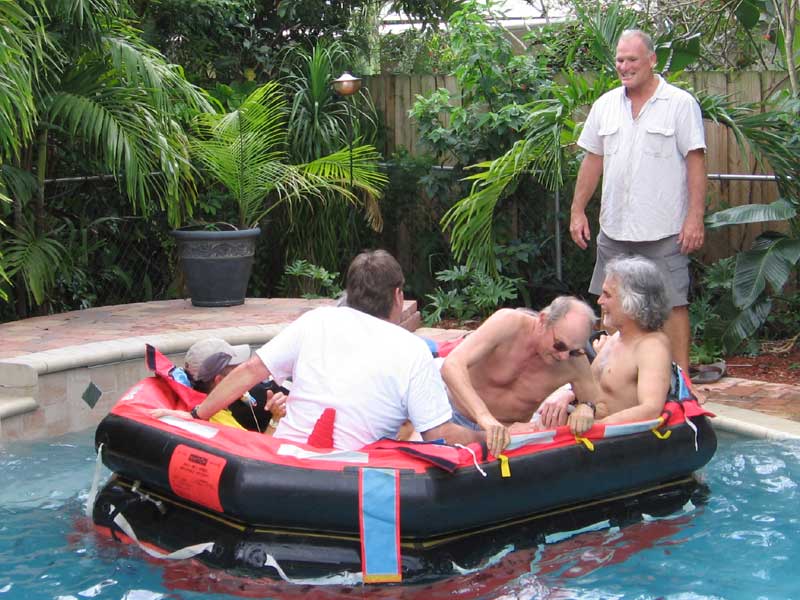
John Kretschmer supervises a life raft launch in a swimming pool
JK University’s Blue Water Passage Making Workshops are conducted three times a year in John’s hometown of Fort Lauderdale, Florida or in Solomons, Maryland. Both locations are close to water for easy access to ocean-going sailboats. Firsthand inspection of a well set-up vessel or two is one of the key components of “field trip Saturday,” along with the actual deployment of a Switlik life raft. Here is a typical workshop syllabus:

  • Introduction: Myths and realities about passage making
  • What makes a boat a blue water capable boat? Slideshow of 25 great boats
  • Outfitting: Necessary, nice, extravagant – 10 important items for a serious boat
  • Hands on – Rope
  • Inspecting boats: Caribe, a Beneteau First 456 performance cruiser and retrofit project, and Tioga, a brand-new Hylas 56
  • Hands on – The bullet-proof electrical system
  • Hands on – Standing rigging, discussion of rigging emergencies at sea
  • Passage planning, pilot charts, safety, weather, watch schedules, crew management, food preparation
  • Communications at sea: Satellite phones, wifi, SSB, VHF, AIS
  • Life raft launch
  • What’s new in cruising sails? A plan for optimizing “manageable” downwind performance; sail plans for storm sailing; how to spend money on cruising sails
  • Heavy weather: Dealing with storms, gales and squalls
  • Chart work and celestial navigation in the digital age: Thinking like a navigator

John Kretschmer discusses the merits of Tioga, a brand-new Hylas 56
Workshops run from early Thursday afternoon through late Sunday afternoon to help make scheduling as easy as booking a long weekend trip. The late start on Thursday and early finish on Sunday allow out-of-town attendees to arrive and depart without the expense of additional overnights.

To reserve your spot at the next JK University workshop, scheduled for February 7 to 10, 2013, please visit the John Krestschmer Sailing website at yayablues.com and click the Schedule link. In addition to a calendar of workshops, you’ll find all kinds of passage-making opportunities designed to help you build your confidence and broaden your experience.

Saturday, March 31, 2012

The Light in the Forest

     During the summer of 1979, I worked as a contract archeologist in Nicolet National Forest in northern Wisconsin. It was the responsibility of our group to conduct archeological surveys of areas that were under consideration for logging, road development and other purposes. We searched for signs of prehistoric human habitation and put our findings into environmental impact statements, as was required by the National Environmental Policy Act of 1969.
     Our work took us to extremely remote areas of the forest, places that hadn’t changed much since glaciers covered them fifteen thousand years ago. It was normally easy to tell if we would find any cultural remains based on the proximity of fresh water. Early Native Americans would not have hauled water any farther than was necessary, the same as any modern campers. In fact, the first question I would ask myself after getting out of our work van and looking around was, “Would I want to camp here?” If the answer was no, then chances were good that we wouldn’t find anything. I could confirm my hunch by sticking a shovel into the ground. If it made clanking contact with rocky glacial till within an inch or two of the surface, then the area was going to be a “write-off.” Native people wore soft-soled moccasins and would not have lived on rocky ground. To make things official, though, we needed to line up ten meters apart, try to dig holes that were a shovel blade square and a shovel blade deep, shake all that dirt and rock through half-inch mesh wooden-framed screens, examine what remained, refill the holes, march ahead ten meters, and do it all again, and again, until the entire area was surveyed. We would frequently dig over a hundred holes each in a single day.
     We so rarely found anything even remotely interesting that we developed a sense of gallows humor about our work. When Jodi would hand over yet another pulverized rock and ask for the umpteenth time if it was maybe a fire-cracked rock from a primitive hearth, Chris would examine the rock carefully, look her straight in the eye, and ask, “Which shoulder do you want me to throw it over?” A pebble with an interesting shape would be dubbed a “love stone” – just another effin’ rock.
     So our expectations were low when we set out early one morning to survey an old-growth maple forest. We followed the ghost of a leaf-covered double-track for a few miles to where it disappeared completely and parked the van. Getting out, I looked up at the forest canopy far above. It was so dense that only the dark green light filtering through the leaves would penetrate, like sunlight through stained glass. The cathedral effect was enhanced by the trees themselves, each trunk standing absolutely straight and extending more than thirty feet before branches appeared. The air was moist and cool, almost chilly, on what should have been a hot, sunny day.
     We noticed some old cans rusting into the ground near where we had parked and soon located other evidence of modern humans. Jack found what looked like a large silvered television tube, and it took us a moment to figure out that it was the remains of an old thermos bottle, its steel case long since rusted away. Our best guess was that the area had once been used as a maple sugaring camp, probably more than thirty years ago since there was no plastic to be found.
     We gathered our shovels and screens, assumed our ten-meter separations, and began digging the first of many holes, in a line perpendicular to the track. I was the farthest one out, which I didn’t mind because it gave me the added responsibility of charting our course with a compass and tying survey tape to shrubs in order to maintain the alignment of our grid for the return leg. When I stomped my shovel into the ground for the first time, I was pleasantly surprised to have the blade sink all the way in. Beneath the ancient layer of dead maple leaves, the soil was loamy. It went through the screen like water, leaving almost nothing but the leaves behind. I didn’t expect to find anything of interest, like a projectile point or a pot sherd; we were miles from any water source.
     The ease of the digging and the dark coolness of the forest lulled me into a comfortable rhythm. It must have been a couple of hours and many holes later that I noticed something strange up ahead. There was a column of white light shining down through a circular hole in the canopy. Our course would take me right to its edge. As I dug the remaining holes leading up to where the light shone down, I kept an eye on the hole in the canopy, wondering what had caused it. I was right at the edge of the light before I saw the depression in the ground. It was a circle about sixty feet across, the same size and shape as the hole in the canopy above it. In its center, mixed with dead maple leaves, was a large circular puddle of black mud. Was it an isolated sink hole? I didn’t think so. The local geology didn’t support that idea. I puzzled over it as I stomped the dirt into my most recent hole, and then I nearly jumped out of my skin. Just five feet to my right was a dead deer. I couldn’t believe I hadn’t noticed it, but I had been preoccupied with the light and the depression. The deer, a white-tailed doe, appeared to have died in the last few days. Its eyes were not fully sunken, and it was not yet bloated and stinking. There was no sign of violence. I stared at it for several seconds, half expecting it to get up and run away, and then my eyes were drawn back to the light. Whatever had killed the deer was somehow associated with this strange place. I was sure of it. Maybe it drank from the mud puddle and was poisoned somehow. No, there was no mud on the deer’s hooves. What was it then? And what had happened here in the first place to create the hole in the canopy and the mud-filled depression? A small meteorite falling to earth? A flying saucer landing?
     I was still staring back and forth between the dead deer and the depression, trying to figure it out, when I heard Bart calling my name. He had been ten meters to my left, but now he was way ahead of me. I skirted the edge of the depression – there was no way I was going to dig holes in it – and ran to take my position again next to Bart. “That was pretty weird back there, huh?” he said. “Yeah,” I responded. Weirder than you would believe, I thought.
     The next day, we surveyed a grassy meadow in the same vicinity as the maple forest. The meadow was dotted with large rounded boulders, known as erratics, which had been left behind by the last glacier. They looked like giant Easter eggs sitting in the tall grass. The work was difficult, shoveling through the dense turf, and we dug fewer holes than normal. As we slogged back down the dirt road we had worked our way up, feeling tired and dirty, and looking forward to a cold beer, I noticed a boulder a few feet off the side of the road. It was about the size of an oil drum and probably weighed at least a thousand pounds. It was lying on its side. It had been pushed over from its original position, leaving a depression where it had stood. The grass at the edges of the depression fanned out around a circle of dirt criss-crossed by worm holes. The worms were long gone, but the dirt was not yet dried out. The boulder had been tipped over in the last few days, maybe on the same day that the deer had died. Was there a connection? I didn’t know, but I did know that if a bear had pushed over the boulder looking for worms or grubs, there would have been scratches in the dirt, and there weren’t any.
     What else could explain it? I felt my face flush as I stared down at the depression, and sweat ran down my back. The others in my group had moved on down the road, not intrigued enough to delay that waiting beer. I looked up slowly. The woods surrounding the meadow felt as if they were closing in, like a dark wave cresting. I was in the presence of something I couldn’t understand, and it was frightening me. My skin tingled with electricity. I wouldn’t have been surprised to ride a beam of light up into the sky at that very moment. I scanned the sky to make sure there wasn’t something up there. It was blue and empty. I bent over to pick up my shovel and screen, and I walked slowly away down the road. I did not look back.

Wednesday, February 29, 2012

Running Away

     For as long as he could remember, Sam had wanted to run away. Many children go through a phase of trying to escape from their overbearing parents, sometimes making it only as far as the end of the driveway, but Sam was different: he wanted to escape from everybody.
     This desire of Sam’s may have been the result of a personality quirk from earliest childhood. Instead of developing from the stage of unconscious self to the stage of conscious self and then settling there, Sam continued on to a stage of self-conscious self. He was acutely aware not only of himself but also of how he was perceived by other people, and he was extremely sensitive to their acceptance or rejection.
     School was especially difficult for Sam. His self-consciousness made him appear meek, and his classmates often took advantage, teasing and bullying. Sam was baffled by this treatment because he did not see himself as being different from other children. If they could understand things as he did, why would they ever utter an unkind word or treat others poorly? So Sam dreamed of running away.
     In second grade, the alphabetical ordering of the desks put him at the back of his row and gave him his first escape opportunity. When his teacher wasn’t looking, Sam would slowly back his desk away from the one in front of his. Over the course of several days, he eventually reached the back wall of the classroom, next to a table on which an experiment with butterflies and cocoons was underway. From his new vantage point, he could see everything happening in the room, like a guard up in a tower, watchful and isolated. He believed his teacher either wasn’t paying attention or didn’t care. But then one day, out of the corner of his eye, he saw a giant moth emerge from one of the cocoons, and he let out a yelp of surprise. His teacher was more angry at him for disturbing the class than she was pleased that the experiment had been successful, and she made him keep his desk in line with the others from then on.
     Fourth grade, in a new school and in a new town, presented new challenges. Many of the other children had known each other since kindergarten, so Sam was even more of an outsider than usual. During one of his first recesses, some of his classmates decided that they would force him to kiss his classmate, Mary. A group of the boys grabbed his arms and dragged him kicking and screaming to where a group of the girls was holding Mary. When their lips were just inches apart, Sam broke free and ran toward an elevated corner of the playground. A classmate, Jim, grabbed his arm to stop him, and Sam wheeled around and punched him hard in the stomach, knocking the wind out of him. From the high corner, he turned to face his attackers, but the bell rang to end recess and everyone filed back inside. By the time Sam returned to his classroom, his teacher already knew about the punch, and she escorted him downstairs to the principal’s office. On the way, he tried to explain himself, but she would have none of it. At the principal’s office, he was told to phone home, but he explained that his mother and father were at work. He would have gone home anyway, to escape from school, but that was not an option. There was nothing to be done but to give Sam a stern talking-to and then escort him back to the classroom, where his classmates did not conceal the scorn they felt for him.
     Two years later, as Sam was entering sixth grade, he received an invitation in the mail to join a local Boy Scout troop. He saw it as an opportunity to go camping, an activity he had dreamed about as an escape into the wilderness but one in which his parents would never participate. The troop’s first camp-out took place within weeks of his joining, and he slept on the ground and cooked over a wood fire for the very first time. As he lay on his back in his tent, he knew that the camping life was the life for him.
     The following summer, he went with his troop to Boy Scout camp, a week-long stay at a permanent camp that offered merit badge classes, canoe trips and other advanced activities. He saw during sign-up that there would be an overnight survival trip and he signed up for it immediately, even though none of his troop mates did.
     On the morning of the trip, Sam arrived early and took a seat in the grass at the meeting place. He had only his pack, a sleeping bag, a ground cloth, a pocketknife and an empty peach can, as the rules for the trip specified, and his brand-new hiking boots, which kids called “waffle stompers.” The next boy to show up was Kevin, a tough kid with bad teeth and a beat-up felt hat. Sam tried to make friends, but Kevin would only say, “Nice shoes, Nimrod,” so he gave up trying. Butterfly, the trip’s instructor, showed up and Sam directed his attention toward learning as much as he could from him. After a brief orientation and equipment check, the scouts started out down a trail that Sam had not known existed. Along the way, Butterfly pointed out edible plants and had the boys sample them. Sam was pleasantly surprised that many of the plants he encountered in the woods could be eaten, but he imagined it would take an awful lot of them to make up a meal. They came to a small stream, and Butterfly amazed the boys by getting down on his hands and knees and drinking directly from it. He explained, as he stood up and wiped his mouth, that the waters that ran through these woods were very clean, clean enough even for trout to live in. Sam imagined catching a trout to round out his meal of edible plants. The thought made him hungry. They had not been allowed to pack any food, and it was now past lunch time.
     The trail followed the stream down to where it emptied into a swampy pond. Butterfly waded out into the muddy water and pulled up some cat tails by their roots. He brought them back to shore and had the boys sample the root shoots. They weren’t too bad, Sam thought, a little like tasteless carrots. Butterfly explained that the cat tails would make up a large portion of their dinner that night, so they should find and cut up enough shoots to fill their peach cans. So much for Sam’s new boots.
     The scouts continued down the trail, squishing in their muddy boots, until they reached an area at the far end of the pond that looked like it had been torn up by bulldozers. Butterfly explained that this would be their camp for the night. He arbitrarily broke the boys up into groups, and Sam was disappointed to see that he was grouped with Kevin and another boy. Each group was assigned a campsite, which was nothing more than a large excavated hole in the ground, with a fire pit at the bottom of it. There was also a puddle at the bottom of Sam’s group’s hole, and a frog was swimming in it. Kevin whipped off his pack, jumped into the hole and snagged the frog out of the puddle. Sam felt a little sick as he watched Kevin bend the frog’s head down until its neck snapped. “I’ll be eating good tonight,” Kevin exulted as he pulled out his pocketknife to butcher the frog. Sam looked to the other boy, who was smiling at Kevin’s antics but not saying anything.
     Sam found a flat spot above the hole and set down his gear. He plucked several fern fronds to make a mattress and then laid down his ground cloth and sleeping bag. He was proud of his little bed until Kevin came over. “Nice bed, Nimrod.” Other boys were wandering down to the pond to get water, so Sam joined them to get away from Kevin. Through the clear water, Sam could see that the pond’s bottom was covered with small snails. When he pointed them out, another boy reached into the water for one, crushed its shell with his fingers and sucked out the insides. The boy grimaced but swallowed. “They taste like muddy snot,” he said. Sam decided he would try to make do with his cat tail shoots and added water to his peach can full of them.
     Shortly after he returned to the campsite, Butterfly came by to help Sam’s group get a fire started. The boys had not been allowed to bring matches, but Butterfly had a flint stick, which he used to scrape sparks into some dry pine duff. It ignited immediately, and the boys raced around the edges of the campsite for sticks and logs to keep the fire burning. Before long, they had a regular bonfire burning at the bottom of their hole. Kevin insisted that they gather all the wood they could find before it got dark and that they set up a watch schedule to keep the fire burning all night long.
     Sam set his peach can full of water and cat tail shoots on a flat rock next to the fire to heat up. Kevin had skewered his frog on a stick and had it roasting at the edge of the flames. The other boy was heating up a can full of snails. Maybe they’ll taste better cooked, Sam thought, but he doubted it. As the water in his can heated up, it turned purple. Butterfly had told them that this was an indication that the shoots were ready to eat. Sam stabbed a piece with his pocketknife and put it in his mouth. The outside was warm and chewy, but the inside was still cool and crunchy and tasteless. Sam ate enough to fill his empty stomach and washed it down with the leftover water. He tried not to think of Kevin and the other boy eating their frog and snails.
     When it got dark, Kevin announced that he would take the first watch. He warned that the fire had better not go out later, while he was asleep. “I’m looking at you, Nimrod.” Sam crawled inside his sleeping bag and lay on his side watching the fire. The next thing he knew, the other boy was shaking him awake for his watch. Sam added more logs and poked at the fire for a while. Then he sat on his sleeping bag at the edge of the hole, watched the fire and tried to stay awake. He drifted off for a while and then woke up suddenly, still sitting upright. He had no idea what time it was. None of the boys had wristwatches, so the idea of a set watch schedule suddenly seemed completely stupid. Sam got up to stoke the fire back to Kevin’s standards and then went to wake him up. Kevin came awake thrashing like he was being attacked, but he settled down quickly and got up to tend the fire. Sam crawled back in his sleeping bag and rolled with his back to the fire. “Sleep tight, Nimrod.”
     He wasn’t sure if he was dreaming it at first, but Sam heard voices in the night, Kevin and another boy talking and laughing. He came awake enough to see a hulking kid from another campsite standing next to the fire with Kevin before he drifted off to sleep again. He dreamed that he was suffocating, unable to take a breath and unable to move. He awoke in disbelief to find the hulking kid standing on his chest with both feet. Sam let out a strangled yell and rolled out from under the boy’s weight. Kevin and the boy laughed as Sam coughed and tried to catch his breath. He couldn’t believe that someone would suffocate a person in his sleep as a joke. He wanted to run screaming into the woods to get away from them, but it was dark and he didn’t want to get lost. He curled up on his side in his sleeping bag and willed it to be morning. “That was a good one, Nimrod.”
     These childhood experiences did little to enamor Sam to the human race, and he grew more and more withdrawn. Instead of playing with friends after school, he would spend his late afternoons in the school library, where he befriended the librarian, Miss Angus. She supported his love of reading, not suspecting that Sam had grown to prefer books to people, and introduced him to many works he would never have discovered on his own.
     One afternoon in the library, Sam found a copy of My Side of the Mountain by Jean George. The cover featured a photo from the Walt Disney movie based on the book. It showed a boy hiding behind a boulder with a falcon perched on his gloved hand. Sam flipped through the book and noticed that it was illustrated with black-and-white line drawings of the boy and his falcon. He flipped back to the beginning and started reading. The story was about a boy named Sam Griggs who dreamed of running away to live in the woods. Sam was immediately awestruck. It was as if he were reading the story of his own life, or at least of the life he imagined. He and Sam Griggs even had the same first name. It must be some kind of a sign, he thought. He checked the book out of the library and raced home to read it.
     Sam Griggs ran away from New York City to live on his family’s ancestral farmstead in the Catskills. The farm had long since fallen into ruin, but Sam Griggs endeavored to live off the land, eating only what he could hunt or gather. He made his home in the hollow trunk of an enormous hemlock tree, and he captured a young peregrine falcon and trained it to hunt for him.
     To Sam, it seemed the perfect life, living alone in the wilderness, and he began to think about where he could live a similar life. He had read many of Jack London’s stories and so imagined the Canadian frontier as a likely place. He pored over detailed topographic maps at the library and decided that one of the small rivers that fed into James Bay, the small bay at the southern end of Hudson Bay, would be isolated enough without being so far north that the winters would be endless. Sam spent his free time daydreaming about what his life there would be like, building a canoe and using it to fish the rivers and lakes, hunting for game with an old flintlock rifle, maybe running a trap line and selling the furs to get needed supplies.
     Years passed, but the daydreams never materialized into an actual plan. Sam still thought about running away, especially when his self-consciousness interfered with his social relationships, but he was no longer sure that Canada was where he wanted to go. In the spring of his junior year in high school, Sam went on a group ski trip to Utah and was introduced to the Wasatch Mountains. The trip’s organizers had planned for a non-skiing day of horseback riding, and the group rode sturdy little winter-coated horses up into the mountains for a picnic lunch. Seeing the burbling brooks, the blooming aspen trees and the abundant wildlife of the mountains renewed Sam’s desire to run away to the wilderness and convinced him that the Utah mountains were where he wanted to be.
     When he returned home, Sam again pored over maps, this time looking for the perfect Utah location. He chanced upon the Uintah Mountains, to the east of the Wasatch Mountains, and discovered that they are the only east-west oriented mountain range in the whole of the Rocky Mountain region. He located the highest point in the Uintahs, Kings Peak, and noted that it was also the highest point in Utah. He had recently seen the movie Jeremiah Johnson, and he imagined himself living a mountain man’s existence on the warm, south-facing slopes of Kings Peak.
     Unlike his daydreams of Canada, Sam’s thoughts of Utah quickly formed into a plan. He wrote up elaborate equipment lists and started accumulating what he could afford. He read extensively on wilderness survival techniques and studied the flora and fauna of Utah. He mapped the best access points and plotted their routes. And when he felt he was as prepared as he could be, he couldn’t make himself go. It wasn’t that he was afraid. His desire to escape outweighed his fears, but still, there was something he couldn’t pin down holding him back. Was he anticipating a final catastrophic event in his life that would give him the necessary push? He wasn’t sure. And so he waited.
     A few years later, during the summer between his sophomore and junior years in college, Sam’s family took a road trip to Keystone, Colorado. Sam saw the trip as an opportunity to take a trip of his own, a solo overnight backpacking adventure. Despite all his dreams of being alone in the wilderness, he had never actually experienced it. So he put together a knapsack of his survival equipment and began checking his maps. Shortly after their arrival in Keystone, Sam noticed a mountain, Independence Peak, which overlooked the resort and could be reached from a trail that started at the base of the ski area. He had his parents drop him off there one sunny morning late in their trip.
     Sam felt a surge of adrenaline as he started out alone up the trail. It was really more of a summer access road that switched back and forth up the ski trails, but all that mattered to Sam was that he was alone in the Colorado wilderness. He hiked steadily, stopping only occasionally for a drink from his water bottle. He crested a rise and saw a mule deer only twenty yards away. The deer wasn’t startled by Sam’s presence, so he continued to watch it until it wandered away. By noon, he had reached tree line and found an old fire ring that marked a good place to camp. He took off his pack and sat down on a rock to eat his lunch. From his high vantage point, Sam could see the resort far below and the sky to the west. Clouds were forming, but they didn’t look threatening. He turned to look up at the summit of Independence Peak. It didn’t look too far away, maybe another hour or so of hiking. Since he planned to camp where he was that night, he didn’t see any reason to carry his pack up to the summit and back. He hung it in a tree and set out for the peak. Away from the shelter of the trees, the wind blew hard and cold. Sam put up the hood on his jacket and concentrated on hiking carefully up the rocks and trackless tundra to the final approach ridge. He looked up periodically to check his progress and was surprised each time to see that he seemed no closer to the summit.
     It started to snow, blowing sideways in the high wind and stinging Sam’s face. He stopped and held up his bare hand to catch some of it, and he saw that it was more like tiny pieces of hail than snow. No wonder it stung. He adjusted his hood and looked up to the peak. It was almost obscured by hail and scudding clouds. He turned and looked back down the way he had come and calculated that he was only halfway to the top from where he had left his pack. His reasons for climbing the peak were escaping him and with them, his desire to continue. He took one more long look at the summit he would not reach and then turned to go.
     Back below tree line, there was protection from the wind and hail. After locating his pack, Sam walked in widening circles around the fire ring, collecting sticks to make a campfire. When he had enough to last until bedtime, he went to work building a small fire. When it was going steadily, he unpacked his sleeping bag and ground cloth from his pack and made himself a bed a little ways upwind of the fire. He unpacked a small pot and the freeze-dried meal he had brought for dinner. He filled the pot with water from his water bottle, knocked the fire down to coals and then placed the pot on top of the coals to boil. When the water was boiling, he poured it into the aluminum pouch of his freeze-dried meal, stirred the contents with a spoon and set it aside to reconstitute. He stoked the fire back to flames, walked to the edge of his camp and looked to the west. The clouds had cleared and the sun was almost down. Far below, he could see lights twinkling in the resort. Sam felt very far removed from civilization for the first time in his life and very much alone. He wasn’t sure how it made him feel. He turned and looked at his camp, glowing in the firelight, and was heartened to see how the light of a campfire can define a small personal space in an otherwise vast wilderness.
     Sam checked on his dinner and found it ready to eat. He sat on a rock with the pouch on his knee and spooned the food into his mouth. It wasn’t bad tasting. And it was hot and plentiful. He ate until the pouch was empty and then set it aside. The fire had died down, and it was now fully dark. Sam looked up at the moonless night and saw so many stars that he couldn’t pick out familiar constellations. He watched the sky until a shooting star sliced past, then he got up, stoked the fire one last time to push back the dark, got into his sleeping bag and fell immediately to sleep.
     He wasn’t sure if he was dreaming it at first, but Sam heard a buzzing sound in the night. He came awake enough to see a hummingbird hovering above the smoldering remains of his campfire before he drifted off to sleep again. He dreamed that he was suffocating, unable to take a breath and unable to move. He awoke to find himself alone in the dark. There was no hulking kid standing on his chest this time. He lay on his back, coughing and trying to catch his breath. As his breathing returned to normal, he stared up at the stars and thought about his life. He thought about the cruel and senseless things that people had done to him. He thought about how much he hated those people in return. And he came to understand that despite all his feelings to the contrary, he was very much a member of the human race and he would never be able to escape it. His dreams of running away would only ever be realized through brief camping trips like this one he was on. He felt an old burden slowly lifting from his mind. He was resigned but at peace.
     Sam awoke at dawn the next morning, packed up his equipment, checked to make sure the campfire was out, and then hiked down the mountain to rejoin civilization.

Saturday, July 9, 2011

The Snowball Fight

     It may be just the way that everything seemed larger when I was younger, but I remember that it used to snow a lot more than it does now. Where we lived, a few miles west of Lake Michigan, it would start to snow right after Thanksgiving, and there would be snow on the ground until St. Patrick’s Day. During the holidays, there would be two feet or more in the front yard.
     As with the size of things, time seemed more drawn out then. Christmas breaks seemed almost endless, especially as I approached my teen years. With the excitement of Christmas Day behind us and the New Year looming, we would counter the boredom of being cooped up inside by going out to play in the snow. The proximity of Lake Michigan kept the climate humid and contributed to what we called the “packing” quality of the snow. It was excellent for making snowballs, and we obliged it by making and throwing snowballs all winter long. We would throw snowballs at each other, at street signs, and at passing cars and buses. We would make a game out of seeing how many times we could hit a bus as it passed, with extra points awarded for getting a snowball through an open window.
     On one of those Christmas break days, in 1970, I was wandering around the neighborhood with my friend John from across the street. It had snowed heavily the night before and there were at least three feet of heavy, wet snow on the ground. I knew it was wet and heavy because I had already shoveled it off our driveway and sidewalks. Up the street, John and I noticed that our friend Dave, who lived next to John, and another neighborhood kid, Robbie, were dragging Christmas trees toward us. This was back when everybody had live trees, which would dry out and become fire hazards if they were not taken down right after Christmas. It was the city’s practice to collect the trees from people’s curbs and mulch them into fertilizer, which they would then sell back to the people. It helped to ease the guilt over wasting all those evergreen trees.
     Dave and Robbie had decided they would have some fun with the Christmas trees before they were collected. They were dragging every tree in the neighborhood into Dave’s front yard. When we asked them why, Robbie said they were going to use them to build a fort, like a giant teepee made of trees. John and I thought this was the most ridiculous thing we had ever heard and said so. Robbie’s pale face turned crimson but I couldn’t tell if it was from embarrassment or anger. John was something of a bully in those days and he saw an opening. He walked over to the few trees that were leaning together and shoved them over. Now there was no question that Robbie was angry. He sputtered that we should leave him alone and seemed to be on the verge of crying. Dave looked like he was trying to work up the nerve to order us out of his yard. John kicked at the trees and teased Robbie: “What are you going to do about it, you cry baby?” This infuriated Robbie, and he started moving toward John through the deep snow, like he was going to try to hit him or wrestle him to the ground. John laughed mockingly as he dodged out of Robbie’s grasp. I had been packing a snowball during this entire exchange and it was now as hard as a rock. When Robbie made another lunge for John, I threw it with all my might. The snowball hit Robbie squarely in the back of the head with a sickening crack. He went facedown into the snow like he had been shot. He didn’t move for several seconds, and I worried that he was badly injured or possibly dead. But then he emitted a horrible wailing sound and struggled to his hands and knees. I was so relieved to see that I hadn’t killed him that I started laughing uncontrollably.
     Robbie got to his feet and turned to face me. He was covered in snow. It was melting off his bright red face and mixing with tears as he cried hysterically. I tried to sympathize with how much his head must have been hurting, but it didn’t stop my idiot laughing. Robbie lumbered toward me, and I was sure he intended to kill me. I backed away through the deep snow and then turned to run across the street to the safety of home. But Robbie was a big kid, and he had rage working for him. He caught me in my front yard and tackled me into the snow. Before I could struggle away, he sat on my back and shoved my face violently into the snow. I couldn’t breathe. I tried to get away but I couldn’t move. My vision was fading and I could feel myself losing consciousness. Adrenaline took over and my body did a super push-up, throwing Robbie off my back and bringing me back to my feet. Robbie looked astonished as I turned to face him, my arm fully cocked. He never saw the roundhouse punch that hit him squarely in the temple. Again, he went down like he had been shot, this time on his back. I stood over him, my hand on fire, not believing what had just happened. Robbie lay on his back, blubbering and in obvious pain, his arms and legs spread like he was making snow angels.
     I was overwhelmed by a terrible sense of shame at what I had done and turned to walk away. I went quietly into my house and downstairs to the basement rec room. I sat in the dark replaying the fight in my mind and trying to wish it away. The phone rang and I could feel the blood drain out of my body. I heard footsteps approaching upstairs. My mother stopped at the top of the stairs and said, “Are you down there? Robbie’s mother is on the phone, and she is very unhappy. What did you do?” I didn’t answer her right away. How could I explain that in the short time I had been outside playing in the snow, I had almost killed a person and then almost been killed by that same person? I opened my mouth to say something but heard her steps retreating back to the phone. I sat in the dark and watched the light fade from the day.

Wednesday, May 18, 2011

The Apple War

     A.J. Foyt had just won the Indianapolis 500, school had just let out for the summer, and my family was moving to a new home more than two hundred miles away from our old one. It was 1967 and the country was in turmoil. Bombs were falling in Viet Nam. Race riots were raging in major cities. And young people were pushing traditional boundaries. The sense that everything was changing all at once was palpable. Even I, a nine-year-old boy, could feel it.
     At that age, I was obsessed with building forts and forming clubs. My seven-year-old sister Jane and I thoroughly explored every inch of our new house, inside and out, looking for a place to locate a fort. What we finally settled on was the giant tree that grew behind our garage. Its trunk, almost five feet in diameter at its base, grew at an angle that allowed it to be climbed without nailing in planks for rungs. At the level of the garage roof's peak, the trunk split into three huge branches. The left branch extended horizontally for many feet before there were any smaller branches. It was only possible to reach those branches by either scooting along on the seat of one's pants or by walking across like a tightrope walker. A fall from that height would have meant a broken leg or worse. Because of the danger, we didn't venture out on that branch very often. The middle branch was the main trunk's extension but without the climbable angle. Its verticality and lack of branches made it too difficult and dangerous to climb.
     The right branch was where we established our fort. Like the left one, it extended horizontally a long ways, but it had numerous branches that served as handholds, making it a safer climb. Far out over our backyard neighbor's yard, more than thirty feet off the ground, the branch forked in such a way as to make a perfect bench, complete with foot and back rests. There was no need to build any kind of tree house; the tree was perfect as it was. I simply used my Cub Scout pocketknife to trim some of the smaller branches to make the bench more comfortable, and we had our fort.
     Next came the club. We were crazy about zoo animals, especially the big cats, so we called ourselves the Tiger Club. I wrote the word “Tigers” on an old piece of white bed sheet in big striped letters using Magic Markers and tied it to a bamboo pole that a new house rug had come rolled around. I stuck our new flag in the open end of a corner railing post on our second-floor back balcony, where it could be seen from the street and announce our presence. The bamboo pole served double duty as a makeshift spear when I rubber-banded a sharpened tongue depressor to one end, though it was never taken seriously.
     A two-person club is not much fun, so Jane and I went off in search of new members. We found Eileen, who was Jane's age, just a few houses away. Eileen knew the people who had lived in our house before us, and she was very familiar with the giant tree behind our garage. The three of us climbed up to the tree fort's bench and spent some time picking off leaves and watching them slowly circle to the ground. Eileen knew the neighborhood well and pointed out everything that could be seen from high up in the tree: the neighbors' houses, the public library, the sandlot baseball diamond, and in the far distance, an old apple orchard.
     Eileen said we should go take a look at the apple orchard, so we climbed down from the tree, climbed over the chain-link fence that separated our yard from the library parking lot, and set out for it. What we found was not so much a thriving apple orchard as an old sloping lot with a few ancient, untended apple trees growing in it. There were apples growing on the trees and the ground was covered with them, but they were wormy and not good to eat. Eileen picked up a rotten one and threw it hard against a tree trunk. It splattered in a satisfyingly messy way. We walked over to a dug-up area near the bottom of the lot. It looked like someone had been digging foxholes in the sandy soil, maybe to use for playing army, but there was no one around.
     Within a few days, Eileen had shown us around the entire neighborhood. She introduced us to most of the other kids and warned us about a few of them, including her eight-year-old brother John, who was in a club of his own called the Hanscotter Detective Agency. The name was an amalgam of the three principal members' last names. They were fans of the FBI television show and everything related to law enforcement. Eric, their eleven-year-old leader, even had a signed letter from J. Edgar Hoover appointing him an honorary G-man. Together with his friend Joe, also eleven years old, Eric was the law of the land as far as the kids in the neighborhood were concerned. The Hanscotters had converted Eileen's brother John's wagon into a tank by building a wooden turret that sat on top of it, like in the John Wayne movie War Wagon, and they used it to patrol the neighborhood with their squirt guns.
     The Hanscotters did not appreciate the Tigers' sudden appearance and immediately considered us the enemy. We didn't realize how serious they were until they captured Eileen and me one afternoon, plucking us off our bikes and carrying us into Eric's backyard. They chained us to a tree using bicycle locks and left us there to suffer, but it didn't take long for us to escape. I took Eric's brother Chris's squirt rifle in revenge and hid it under my bed, but my mother found out and made me give it back.
     The Tigers thought this would be the end of our conflict, now that adults had gotten involved, but we were wrong. The next day, as we rode our bikes down the street past the Hanscotters and their war wagon, they reached into it, pulled out apples from the orchard and opened fire, throwing as hard as they could to try and knock us off our bikes. Apples flew everywhere, splattering in the street and exploding through our bent spokes. Nobody was badly hurt, but we were shaken and angry. We managed to get home and regrouped at the tree fort. If they were going to throw apples, then we would too, we declared. We trooped off to the orchard with paper bags to arm ourselves.
     The Hanscotters had gathered up all but the most rotten apples from the ground, leaving just the ones still in the trees for us to gather. Eileen climbed up a tree to shake down some apples to Jane and me. We had gathered up only a few when the Hanscotters returned to rearm. They accused us of stealing their apples and said they were going to make us pay. Joe, the biggest and meanest of them, picked up a fresh apple and threw it hard at Eileen, knocking her out of the tree. She fell more than eight feet but landed on a mat of rotten apples and soft ground, uninjured except for a red welt on her chest. The shock of seeing her fall stopped everything for a few seconds, but then the Hanscotters recovered and launched a barrage of fresh apples at the three of us. Leaving our bags of apples behind, we ran for safety as they laughed and called us names.
     The apple war continued through the summer, with minor skirmishes occurring every few days. The Tigers did eventually arm themselves, and the battles became less one-sided but more fierce. Instead of one side or the other running away, both sides stood their ground and threw apples as hard as they could at each other, until there were no more apples left to throw. Bruises and welts were common. Black eyes were not unknown.
     One hot August day, I was helping my mother with some weeding in the front garden. Joe walked past and said something disrespectful. Without thinking, I picked up an apple and threw it at him, striking a glancing blow off his shoulder. He looked back with murder in his eyes and ran to get the apple I had thrown. He turned and threw it at me with all his might, but he missed me. In the midst of the commotion, my mother had stood up from her weeding and turned just in time to get hit square in the stomach by the apple. It knocked the wind out of her. She doubled over, gasping for breath. I started crying. Joe started crying. He yelled, "I'm sorry! I'm sorry!" And he turned and ran for home.
     No more apples were thrown that summer, but the differences between the Tiger Club and the Hanscotter Detective Agency were never resolved. The feud continued, but in a non-violent fashion, until my family moved to a new neighborhood two years later. In that time, Martin Luther King, Jr. and Robert F. Kennedy were assassinated, Richard M. Nixon was elected president, and man walked on the moon. The apple orchard was paved over to expand the library parking lot, and the giant tree behind our old garage was cut down after a kid fell out of it and broke his leg.

Tuesday, February 1, 2011

Cape Horn to Starboard

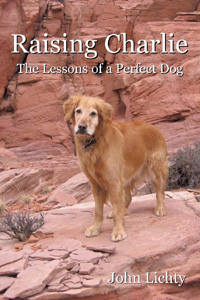
Cape Horn to Starboard by John KretschmerI recently finished reading my friend John Kretschmer's first book, Cape Horn to Starboard: The Classic Chronicle of Rounding the Horn in a 32-foot Sloop. It had been out of print for a few years, but it was republished last fall with a new introduction and afterword. I have enjoyed all of John's other books, so I was excited to read this one. It didn't disappoint.

In the fall of 1983, when he was only 25 years old, John and his crew sailed a Contessa 32 from New York to San Francisco by way of Cape Horn, replicating the route of the nineteenth-century clipper ships. His youth and relative lack of sailing experience proved to be an asset, as he didn't know what he didn't know, or he never would have considered such a crazy adventure. As John wrote to me in an email message last week, "Rereading the galleys I was amazed at my own audacity, what was I thinking?"

The feat gained him and his crew instant fame for sailing the smallest boat to date around the Horn. John states modestly in his afterword that their arrival in San Francisco must have occurred on "a slow news day" based on the grand reception they received from Mayor Dianne Feinstein and the local news media and later from Dan Rather and CBS News. When the commotion died down, John embarked on a career as a delivery captain, which is detailed in his second book, Flirting with Mermaids: The Unpredictable Life of a Sailboat Delivery Skipper.

John and I are the same age, so as I read his book I couldn't help but think about what I was doing with my life while John was sailing around the Horn. All I was doing was trying to get a second degree, in engineering this time, and working part-time at a Milwaukee hospital, where I met my future wife, Nan. My greatest ambitions revolved around planning annual backpacking trips with my friend, Dave Beckwith. It all seems so "small potatoes" compared to what John was doing. Maybe, at an unconscious level, that's why my ambitions now are so, well, ambitious.

Friday, December 24, 2010

Speak of the Devil

     Edward possessed an unusual talent. He could summon people at will—but not like a king could summon one of his subjects to the throne. Edward’s talent was more subtle than that. In fact, it was mostly unconscious. If Edward was daydreaming, as he did frequently, and happened to think of a person from his past, then within a few minutes, days or weeks, that person would make an appearance of some sort in his life. For instance, Edward would pick up the phone and hear a familiar voice: “I was just thinking of you,” he would say. Or he would wonder what an old acquaintance was up to and then open a newspaper to find an article about that person.
     For Edward, many of these incidents were happy coincidences, but not all of them were. Sometimes that article in the newspaper was an obituary. Edward had a dark side, and he would dwell on the bad experiences in his life more often than was normal. With his special talent, the results could be disturbing.
     Once, several years ago, he was on a backpacking trip with some friends, who were also business associates, in the Colorado mountains not far from his home. As they hiked up the trail, they discussed some of their worst business experiences, and Edward told them about the time his Christmas had been ruined by a client who refused to pay a very large overdue amount before closing his business for the holidays. A few minutes later, who should come walking down the trail past them but that very same client. Edward was thankful for his baseball cap and sunglasses, and for his friends reacting with waves and greetings but nothing more.
     When they were safely out of earshot, the friends stopped and confronted Edward. “How did you do that?” one asked.
     “Do what?” Edward replied.
     “How did you get that terrible client of yours to show up on cue like that? Did you know he would be out here?”
     “No,” said Edward, looking down at his boots. “Things like that happen to me all the time. I think about somebody and there they are.”
     “Speak of the devil!”
     “You mean that old expression, ‘Speak of the devil and the devil appears’?” asked Edward.
     “Exactly! You’d better be careful who you think about if you want to keep things like what just happened from happening all the time.”
     The friends saw the look of concern on Edward’s face and started laughing to lighten the mood. One said, “Don’t worry about it! It’s not like you know any axe murderers!” They drank from their water bottles, adjusted their packs, and continued up the trail, with Edward bringing up the rear.
     As he hiked, Edward thought about what had happened and replayed in his mind all the similar occurrences that he could remember. There were many. And the bad feelings about them far outweighed the good. He resolved that he would try to prevent the devil from appearing ever again by living as fully as possible in the present and not thinking about the past.

     Edward’s strategy worked well for him while he was awake, but he could not control his thoughts as he slept. His brain, deprived of its normal daydreaming, would work overtime at night, creating vivid dreams and horrific nightmares. Edward would breathe a sigh of relief on mornings when he awoke with no memories of his dreams. When he did wake up remembering them, he would jump out of bed and busy himself with his morning routines to put them quickly out of mind.
     Early one morning, when it was still dark, Edward awoke suddenly from a dream so intense that his ears were ringing and his heart was thumping in his chest. He rolled over and tried to fall back to sleep, but there was no hope of that. He rolled onto his back and stared up at the dark ceiling, replaying the dream in his mind:

     A classmate from childhood had somehow gotten in touch and invited him to her home for Christmas Eve dinner. It was snowing as he walked up the sidewalk to the address she had given him. Her adult son was bent over shoveling the front walk. When he saw Edward approach, he stood up and introduced himself. They entered the house together and removed their coats and boots in the front hall. The rooms were decorated for the holidays, but there was no one in them. Sounds of cooking and young children came from the back of the house, behind a swinging door at the rear of the dining room to their right. The son gestured to the living room on the left and told Edward to make himself at home. He said he would let his mother know that Edward had arrived and pushed through the swinging door into the kitchen, giving Edward a glimpse of a young woman that he guessed was the son’s wife, seated at a table with their children.
     Edward walked through the arch leading to the living room and looked around. The room was comfortably furnished, and the walls were lined with built-in bookcases full of books and music CDs. He walked over to a shelf of CDs to see if he shared her taste in music. He was noticing the abundance of classical music when he saw her enter the room from the corner of his eye. He turned to face her and she stopped, still a few feet away. She was just as he remembered her, but her hair was shorter and more auburn in color. She wore a sparkling silver gown and matching shoes that made her glow in the room’s soft light.
     At a loss for words, Edward asked, “Do you still play cello?”
     “No,” she said. “I play the piano now.” She gestured through a door off the living room, where Edward could see a grand piano with its top open. “I’ve been looking for a guitarist to play duets with.”
     “I play guitar,” Edward said.
     She stepped closer and took his shoulders in her hands. She leaned in and kissed him on the cheek. As she turned to pull away, Edward took her by the shoulders and kissed her softly on the mouth. “I love you,” he said. “I’ve always loved you.”

     That was the moment when Edward woke up. Somewhere in his subconscious mind, he still harbored feelings for this woman he had not seen since their twentieth class reunion, almost fifteen years ago. He also knew that given the intensity of his dream about her, she would soon appear in his life. His special talent would see to it. But he had been suppressing it for so long, he was no longer confident that it still worked. He needed to find her and tell her how he felt. He couldn’t wait for the talent to make it happen.
     Edward rolled out of bed and went into his office to turn on his computer. He tried every search engine and every networking site, but there was no mention of her. Finally, he found an address that might be hers. He wrote a quick letter saying that he had been thinking about her and asking her to get in touch with him. He put the letter in an envelope and hurried to the post office to mail it before he lost his nerve.
     Days passed and turned into weeks and months. The letter went unanswered. And the devil did not appear.

Sunday, October 31, 2010

The Bogeymen

     When John and his brother Stuart were very young, their father and mother gave them classic stories on vinyl records to encourage the development of their imaginations. The brothers played the stories over and over again on an old record player. Their favorites were The Knights of the Round Table and Robinson Crusoe, which they loved for their heroic characters, even though the Robinson Crusoe record skipped in the same place every time they played it: "… and knocked down one of his pursuers."
     Imaginations are impressionable, and the brothers listened to two of the stories only rarely, when they could work up the nerve: The Telltale Heart by Edgar Allan Poe and The Legend of Sleepy Hollow by Washington Irving. The Poe story was so frightening, with its rhythmic narration matching the imagined beat of the heart beneath the floorboards, that they could listen to it only during daylight hours or it would cause terrible dreams. By comparison, the Irving story was all-consuming. The image of a headless horseman charging his red-eyed stallion down upon the helpless Ichabod Crane and hurling his flaming jack-o-lantern caused frequent nightmares. John would awaken in a cold sweat, imagining himself knocked off his horse by the vengeful horseman. As he lay awake, waiting for his own telltale heart to stop beating in his chest, he would listen to the silence. On summer nights, when the windows were open, he imagined he could hear the headless horseman breathing outside the ground-floor window of the bedroom he shared with his brother. On particularly bad nights, he imagined he could hear the headless horseman scratching at the window screen.
     One rainy Saturday afternoon, when John and Stuart were racing their slot cars around the track in their bedroom, their friends from up the street, Gary and Dean, who were also brothers, knocked at the door. John and Stuart’s father answered the door and invited the brothers in out of the rain. Dean was holding a small white jewelry box in his hand. He announced that he had found the mummy’s finger and lifted off the lid. Inside was a ghostly pale finger surrounded by cotton batting. As everyone leaned in to get a closer look, the finger wiggled, eliciting shrieks of fright from everyone but the jokers, Dean and Gary, who laughed uncontrollably. Dean had powdered his finger and put it through a hole in the bottom of the box. He said that he and Gary played jokes all the time, like wandering the sleeping neighborhood and making noises outside windows. John’s gut tightened. He suddenly had an explanation for the sounds he heard at night.
     The next time John had the headless horseman nightmare and awoke in the middle of the night, he listened more intently than ever. He was so sure he could hear the breathing and scratching that he said as quietly as he could, “Dean?” The imagined sounds ceased immediately, replaced by the noise of crickets and the hum of distant cars on the highway. Then there was a new sound, a whispering. John strained to hear, not believing his ears. The silence that followed made him doubt he had heard the whispering at all. But then there was an answering whisper. Now there was no doubt. “Gary?” John pleaded in a soft, hoarse voice. There was no response. Blood pounded in John’s ears. He lay on his back, frozen in fear, until he lost consciousness.
     A few weeks later, John and Stuart’s family drove the brothers a couple of hours away, to their grandmother’s house, to spend a week with her, just the three of them. Grandma’s house had only two bedrooms, so John and Stuart shared a double bed in the front bedroom. It was hot enough that the ground-floor bedroom window was wide open every night. John slept peacefully, with the confidence that the headless horseman could not possibly have followed him to Grandma’s house.
     On the last night of their stay, Grandma made some popcorn, and they stayed up late to watch an old movie. It was after ten o’clock when the movie ended and they went to bed, more than an hour past John and Stuart’s regular bedtime. Stuart fell immediately into a deep sleep, but John lay awake, playing the movie over in his mind. As he lost control of his thoughts and drifted into sleep, the movie scenes melded into his recurrent nightmare of the headless horseman. At the moment when he expected to be struck by the flaming jack-o-lantern, he snapped awake. Nightglow flooded the room through the open window. There should have been cricket noise, but the room was quiet. He could hear Stuart’s soft breathing next to him, and beyond that, from the window, a second set of quiet breaths. His explanation that Dean and Gary were outside the window was suddenly so implausible that it was like a trapdoor dropping out from under him. He held his own breath and strained his ears, expecting to hear scratching at the screen. Instead, he heard a muffled tearing sound, like someone slowly cutting the screen, thin wire by thin wire, with a sharp pocketknife. He wanted to scream, but he couldn’t release his breath. He wanted to flee, but he couldn’t move. He lay trembling, tears squeezing out of the corners of his tightly closed eyes.
     The cutting noise stopped. John expected to hear the sound of someone crawling through the window, but there was only silence. Then he heard the sound of breathing, and it was coming from right next to the bed. He could almost feel the breath on his face. There was a strange smell. As he tried to make sense of it, the rhythm of the breathing changed, and he realized that there was a second breather. The one closer to his face started whispering. It was the same voice from home! They couldn’t have followed him to Grandma’s house. They must have found him somehow. The other one responded, and John realized that he could not understand a word but that they understood each other clearly. He recoiled as he felt hands lightly touch his chest and legs. His body lifted slowly off the bed, floated through the slit in the screen, and drifted up into the night sky.