

These days it is difficult to escape the constant barrage from the Christian right. From the fish symbols and "Real Men Love Jesus" bumper stickers to Bush advocating the teaching of "intelligent design" in our public schools, there is a radical retrenching of progressive thought going on in this country. Instead of living in the moment, taking our cues for what is right and what is wrong from how we are received by our fellow human beings, an increasing number have opted to put their faith in the Bible and its ancient teachings, which profess an otherworldly origin for life and mankind's place in it. Instead of looking outward for the answers to questions like, "What is our purpose?", I look inward. I look at who I am and what I have to offer others to make this world a better place, because I believe that what we see, you and I, is all there is. We don't answer to a higher God, we answer to each other. There is no heaven and there is no hell. There is only this life and what we make of it. And we are all in this life together, so the greatest good is to do the best we can for each other--Christ's message but without Christ in it--because the reward is not in heaven, it is here in this life.
To this end, the greatest virtue becomes personal freedom. This country declared its independence for the purposes of "life, liberty and the pursuit of happiness." One of the most disturbing trends in government today is the legislation of morality, which runs counter to everything the founding fathers had in mind. If what I do does not affect you, then why should you be able to tell me whether or not I may do it? Whatever happened to "live and let live"? If issues such as drug use, abortion and gay marriage make people uncomfortable enough that they press their legislators to pass laws against them, then the problem is with these people, not with the behavior. They need to understand that the world is made up of different people with different values, and that it is not up to them to make everyone the same. What advantage does it serve? Does it ease the conscience to know our prisons are full of drug law offenders? It would be more advantageous to society if we understood that most people are doing the best they can and that if that requires behavior other people do not agree with, then so be it.
More than anything, this resurgence of Christian fundamentalism amounts to the dumbing down of modern society. It has become acceptable to display bumper stickers with slogans like "Let go! Let God do it!" and "God is my co-pilot!" To me, this is the same thing as saying, "The universe is a complicated place and I don't understand it, so I'm going to throw up my hands in frustration and give my destiny over to God and his mystical ways, even though I don't understand them, because I have faith." Wouldn't it be more productive to think that our concept of God is a stepping stone to free thought? In simpler times, before we understood that we're all riding a small rock around a small star at the edge of a galaxy full of mostly bigger stars--some of which probably have life similar to our own circling them--in a universe that has no bounds, we needed God to explain the unexplainable. And the God concepts of heaven and hell helped to keep the masses under control, in a state of servitude toward a reward in the afterlife. We are way past that now. We know our place in the universe, at least geographically, and we know more about the workings of this planet and its inhabitants than would have been thought possible just a hundred years ago. We have invented technology and medicine that have made our lives longer, healthier and more comfortable than they even need to be. But instead of looking ahead to what new discoveries we might make, many in society have chosen to look backward, almost in nostalgia, to the simpler times. If we believe the Bible, Christ lived and died as an example to us of how we should live. It is time for us to take his example and apply it to our modern situation: Don't live in fear of spiritual retribution for perceived sins. Rather live for each other, in trust and empathy, that we all may prosper in this life. Think for yourself!
About Me

- John Lichty
- Savannah,
Georgia, USA
"Go confidently in the direction of your dreams. Live the life you have imagined." --Henry David Thoreau
 Raising Charlie: The Lessons of a Perfect Dog by John Lichty
Subscribe To

 Posts
All Comments
Posts
All Comments

Wednesday, September 21, 2005

Monday, May 30, 2005
Humanist Manifesto II (1973)
Humanist Manifesto II followed Humanist Manifesto I forty years later:
Humanist Manifesto II (1973)
It is forty years since Humanist Manifesto I (1933) appeared. Events since then make that earlier statement seem far too optimistic. Nazism has shown the depths of brutality of which humanity is capable. Other totalitarian regimes have suppressed human rights without ending poverty. Science has sometimes brought evil as well as good. Recent decades have shown that inhuman wars can be made in the name of peace. The beginnings of police states, even in democratic societies, widespread government espionage, and other abuses of power by military, political, and industrial elites, and the continuance of unyielding racism, all present a different and difficult social outlook. In various societies, the demands of women and minority groups for equal rights effectively challenge our generation.
As we approach the twenty-first century, however, an affirmative and hopeful vision is needed. Faith, commensurate with advancing knowledge, is also necessary. In the choice between despair and hope, humanists respond in this Humanist Manifesto II with a positive declaration for times of uncertainty.
As in 1933, humanists still believe that traditional theism, especially faith in the prayer-hearing God, assumed to love and care for persons, to hear and understand their prayers, and to be able to do something about them, is an unproved and outmoded faith. Salvationism, based on mere affirmation still appears as harmful, diverting people with false hopes of heaven hereafter. Reasonable minds look to other means for survival.
Those who signed Humanist Manifesto II disclaim that they are setting forth a binding credo; their individual views would be stated in widely varying ways. The statement is, however, reaching for vision in a time that needs direction. It is social analysis in an effort at consensus. New statements should be developed to supersede this, but for today it is our conviction that humanism offers an alternative that can serve present-day needs and guide humankind toward the future.
The next century can be and should be the humanistic century. Dramatic scientific, technological, and ever-accelerating social and political changes crowd our awareness. We have virtually conquered the planet, explored the moon, overcome the natural limits of travel and communication; we stand at the dawn of a new age, ready to move farther into space and perhaps inhabit other planets. Using technology wisely, we can control our environment, conquer poverty, markedly reduce disease, extend our life-span, significantly modify our behavior, alter the course of human evolution and cultural development, unlock vast new powers, and provide humankind with unparalleled opportunity for achieving an abundant and meaningful life.
The future is, however, filled with dangers. In learning to apply the scientific method to nature and human life, we have opened the door to ecological damage, overpopulation, dehumanizing institutions, totalitarian repression, and nuclear and biochemical disaster. Faced with apocalyptic prophesies and doomsday scenarios, many flee in despair from reason and embrace irrational cults and theologies of withdrawal and retreat.
Traditional moral codes and newer irrational cults both fail to meet the pressing needs of today and tomorrow. False "theologies of hope" and messianic ideologies, substituting new dogmas for old, cannot cope with existing world realities. They separate rather than unite peoples.
Humanity, to survive, requires bold and daring measures. We need to extend the uses of scientific method, not renounce them, to fuse reason with compassion in order to build constructive social and moral values. Confronted by many possible futures, we must decide which to pursue. The ultimate goal should be the fulfillment of the potential for growth in each human personality--not for the favored few, but for all of humankind. Only a shared world and global measures will suffice.
A humanist outlook will tap the creativity of each human being and provide the vision and courage for us to work together. This outlook emphasizes the role human beings can play in their own spheres of action. The decades ahead call for dedicated, clear-minded men and women able to marshal the will, intelligence, and cooperative skills for shaping a desirable future. Humanism can provide the purpose and inspiration that so many seek; it can give personal meaning and significance to human life.
Many kinds of humanism exist in the contemporary world. The varieties and emphases of naturalistic humanism include "scientific," "ethical," "democratic," "religious," and "Marxist" humanism. Free thought, theism, agnosticism, skepticism, deism, rationalism, ethical culture, and liberal religion all claim to be heir to the humanist tradition. Humanism traces its roots from ancient China, classical Greece and Rome, through the Renaissance and the Enlightenment, to the scientific revolution of the modern world. But views that merely reject theism are not equivalent to humanism. They lack commitment to the positive belief in the possibilities of human progress and to the values central to it. Many within religious groups, believing in the future of humanism, now claim humanist credential. Humanism is an ethical process through which we all can move, above and beyond the divisive particulars, heroic personalities, dogmatic creeds, and ritual customs of past religions or their mere negation.
We affirm a set of common principles that can serve as a basis for united action--positive principles relevant to the present human condition. They are a design for a secular society on a planetary scale.
For these reasons, we submit this new Humanist Manifesto for the future of humankind; for us, it is a vision of hope, a direction for satisfying survival.
Religion
First: In the best sense, religion may inspire dedication to the highest ethical ideals. The cultivation of moral devotion and creative imagination is an expression of genuine "spiritual" experience and aspiration.
We believe, however, that traditional dogmatic or authoritarian religions that place revelation, God, ritual, or creed above human needs and experience do a disservice to the human species. Any account of nature should pass the tests of scientific evidence; in our judgment, the dogmas and myths of traditional religions do not do so. Even at this late date in human history, certain elementary facts based upon the critical use of scientific reason have to be restated. We find insufficient evidence for belief in the existence of a supernatural; it is either meaningless or irrelevant to the question of the survival and fulfillment of the human race. As non-theists, we begin with humans not God, nature not deity. Nature may indeed be broader and deeper than we now know; any new discoveries, however, will but enlarge our knowledge of the natural.
Some humanists believe we should reinterpret traditional religions and reinvest them with meanings appropriate to the current situation. Such redefinitions, however, often perpetuate old dependencies and escapism; they easily become obscurantist, impeding the free use of the intellect. We need instead, radically new human purposes and goals.
We appreciate the need to preserve the best ethical teachings in the religious traditions of humankind, many of which we share in common. But we reject those features of traditional religious morality that deny humans a full appreciation of their own potentialities and responsibilities. Traditional religions often offer solace to humans, but, as often they inhibit humans from helping themselves or experiencing their full potentialities. Such institutions, creeds, and rituals often impede the will to serve others. Too often traditional faiths encourage dependence rather than independence, obedience rather than affirmation, fear rather than courage. More recently they have generated concerned social action, with many signs of relevance appearing in the wake of the "God is Dead" theologies. But we can discover no divine purpose or providence for the human species. While there is much that we do not know, humans are responsible for what we are or will become. No deity will save us; we must save ourselves.
Second: Promises of immortal salvation or fear of eternal damnation are both illusory and harmful. They distract humans from present concerns, from self-actualization, and from rectifying social injustices. Modern science discredits such historic concepts as the "ghost in the machine" and the "separable soul." Rather, science affirms that the human species is an emergence from natural evolutionary forces. As far as we know, the total personality is a function of the biological organism transacting in a social and cultural context. There is no credible evidence that life survives the death of the body. We continue to exist in our progeny and in the way that our lives have influenced others in our culture.
Traditional religions are surely not the only obstacles to human progress. Other ideologies also impede human advance. Some forms of political doctrine, for instance, function religiously, reflecting the worst features of orthodoxy and authoritarianism, especially when they sacrifice individuals on the altar of Utopian promises. Purely economic and political viewpoints, whether capitalist or communist, often function as religious and ideological dogma. Although humans undoubtedly need economic and political goals, they also need creative values by which to live.
Ethics
Third: We affirm that moral values derive their source from human experience. Ethics is autonomous and situational, needing no theological or ideological sanction. Ethics stems from human need and interest. To deny this distorts the whole basis of life. Human life has meaning because we create and develop our futures. Happiness and the creative realization of human needs and desires, individually and in shared enjoyment, are continuous themes of humanism. We strive for the good life here and now. The goal is to pursue life's enrichment despite debasing forces of vulgarization, commercialization, bureaucratization, and dehumanization.
Fourth: Reason and intelligence are the most effective instruments that humankind possesses. There is no substitute: neither faith nor passion suffices in itself. The controlled use of scientific methods, which have transformed the natural and social sciences since the Renaissance, must be extended further in the solution of human problems. But reason must be tempered by humility, since no group has a monopoly of wisdom or virtue. Nor is there any guarantee that all problems can be solved or all questions answered. Yet critical intelligence, infused by a sense of human caring, is the best method that humanity has for resolving problems. Reason should be balanced with compassion and empathy and the whole person fulfilled. Thus, we are not advocating the use of emotion, for we believe in the cultivation of feeling love. As science pushes back the boundary of the known, one's sense of wonder is continually renewed, and art, poetry, and music find their places, along with religion and ethics.
The Individual
Fifth: The preciousness and dignity of the individual person is a central humanist value. Individuals should be encouraged to realize their own creative talents and desires. We reject all religious, ideological, or moral codes that denigrate the individual, suppress freedom, dull intellect, dehumanize personality. We believe in maximum individual autonomy consonant with social responsibility. Although science can account for the causes of behavior, the possibilities of individual freedom of choice exist in human life and should be increased.
Sixth: In the area of sexuality, we believe that intolerant attitudes, often cultivated by orthodox religions and puritanical cultures, unduly repress sexual conduct. The right to birth control, abortion, and divorce should be recognized. While we do not approve of exploitive, denigrating forms of sexual expression, neither do we wish to prohibit, by law or social sanction, sexual behavior between consenting adults. The many varieties of sexual exploration should not in themselves be considered "evil." Without countenancing mindless permissiveness or unbridled promiscuity, a civilized society should be a tolerant one. Short of harming others or compelling them to do likewise, individuals should be permitted to express their sexual proclivities and pursue their life-styles as they desire. We wish to cultivate the development of a responsible attitude toward sexuality, in which humans are not exploited as sexual objects, and in which intimacy, sensitivity, respect, and honesty in interpersonal relations are encouraged. Moral education for children and adults is an important way of developing awareness and sexual maturity.
Democratic Society
Seventh: To enhance freedom and dignity the individual must experience a full range of civil liberties in all societies. This includes freedom of speech and the press, political democracy, the legal right of opposition to governmental policies, fair judicial process, religious liberty, freedom of association, and artistic, scientific, and cultural freedom. It also includes a recognition of an individual's right to die with dignity, euthanasia, and the right to suicide. We oppose the increasing invasion of privacy, by whatever means, in both totalitarian and democratic societies. We would safeguard, extend, and implement the principles of human freedom evolved from the Magna Carta to the Bill of Rights, the Rights of Man, and Universal Declaration of Human Rights.
Eighth: We are committed to an open and democratic society. We must extend participatory democracy in its true sense to the economy, the school, the family, the workplace, and the voluntary associations. Decision-making must be decentralized to include widespread involvement of people at all levels--social, political, and economic. All persons should have a voice in developing the values and goals that determine their lives. Institutions should be responsive to express desires and needs. The conditions of work, education, devotion and play should be humanized. Alienating forces should be modified or eradicated and bureaucratic structures should be held to a minimum. People are more important than decalogues, rules, proscriptions, or regulations.
Ninth: The separation of church and state and the separation of ideology and state are imperatives. The state should encourage maximum freedom for different moral, political, religious, and social values in society. It should not favor any particular religious bodies through the use of public monies, nor espouse a single ideology and function thereby as an instrument of propaganda or oppression, particularly against dissenters.
Tenth: Humane societies should evaluate economic systems not by rhetoric or ideology, but by whether or not they increase economic well-being for all individuals and groups, minimize poverty and hardship, increase the sum of human satisfaction, and enhance the quality of life. Hence the door is open to alternative economic systems. We need to democratize the economy and judge it by its responsiveness to human needs, testing results in terms of the common good.
Eleventh: The principle of moral equality must be furthered through elimination of all discrimination based upon race, religion, sex, age, or national origin. This means equality of opportunity and recognition of talent and merit. Individuals should be encouraged to contribute to their own betterment. If unable, then society should provide means to satisfy their basic economic, health, and cultural needs, including wherever resources make possible, a minimum guaranteed annual income. We are concerned for the welfare of the aged, the infirm, the disadvantaged, and also for the outcasts--the mentally retarded, abandoned or abused children, the handicapped, prisoners, and addicts--for all who are neglected or ignored by society. Practicing humanists should make it their vocation to humanize personal relations.
We believe in the right to universal education. Everyone has a right to the cultural opportunity to fulfill his or her unique capacities and talents. The schools should foster satisfying productive living. They should be open at all levels to any and all; the achievement of excellence should be encouraged. Innovative and experimental forms of education are to be welcomed. The energy and idealism of the young deserve to be appreciated and channeled to constructive purposes.
We deplore racial, religious, ethnic, or class antagonisms. Although we believe in cultural diversity and encourage racial and ethnic pride, we reject separations which promote alienation and set people and groups against each other; we envision an integrated community where people have a maximum opportunity for free and voluntary association.
We are critical of sexism or sexual chauvinism--male or female. We believe in equal rights for both women and men to fulfill their unique careers and potentialities as they see fit, free of invidious discrimination.
World Community
Twelfth: We deplore the division of humankind on nationalistic grounds. We have reached a turning point in human history where the best option is to transcend the limits of national sovereignty and to move toward the building of a world community in which all sectors of the human family can participate. Thus we look to the development of a system of world law and a world order based upon transnational federal government. This would appreciate cultural pluralism and diversity. It would no exclude pride in national origins and accomplishments nor the handling of regional problems on a regional basis. Human progress, however, can no longer be achieved by focusing on one section of the world, Western of Eastern, developed or underdeveloped. For the first time in human history, no part of humankind can be isolated from any other. Each person's future is in some way linked to all. We thus affirm a commitment to the building of world community, at the same time recognizing that this commits us to some hard choices.
Thirteenth: This world community must renounce the resort to violence and force as a method of solving international disputes. We believe in the peaceful adjudication of differences of negotiation and compromise. War is obsolete. So is the use of nuclear, biological, and chemical weapons. It is a planetary imperative to reduce the level of military expenditures and turn these savings to peaceful and people-oriented uses.
Fourteenth: The world community must engage in cooperative planning concerning the use of rapidly depleting resources. The planet earth must be considered a single ecosystem. Ecological damage, resource depletion, and excessive population growth must be checked by international concord. The cultivation and conservation of nature is a moral value; we should perceive ourselves as integral to the sources of our being in nature. We must free our world from needless pollution and waste, responsibly guarding and creating wealth, both natural and human. Exploitation of natural resources, uncurbed by social conscience, must end.
Fifteenth: The problems of economic growth and development can no longer be resolved by one nation alone; they are worldwide in scope. It is the moral obligation of the developed nations to provide--through an international authority that safeguards human rights--massive technical, agricultural, medical, and economic assistance, including birth control techniques, to the developing portions of the globe. World poverty must cease. Hence extreme disproportions in wealth, income, and economic growth should be reduced on a worldwide basis.
Sixteenth: Technology is a vital key to human progress and development. We deplore any neo-romantic efforts to condemn indiscriminately all technology and science or to counsel retreat from its further extension and use for the good of humankind. We would resist any moves to censor basic scientific research on moral, political, or social grounds. Technology must, however, be carefully judged by the consequences of its use; harmful and destructive changes should be avoided. We are particularly disturbed when technology and bureaucracy control, manipulate, or modify human beings without their consent. Technological feasibility does not imply social or cultural desirability.
Seventeenth: We must expand communication and transportation across frontiers. Travel restrictions must cease. The world must be open to diverse political, ideological, and moral viewpoints and evolve a worldwide system of television and radio for information and education. We thus call for full international cooperation in culture, science, the arts, and technology across ideological borders. We must learn to live openly together or we shall perish together.
Humanity As A Whole
In closing: The world cannot wait for a reconciliation of competing political or economic systems to solve its problems. These are the times for men and women of good will to further the building of a peaceful and prosperous world. We urge that parochial loyalties and inflexible moral and religious ideologies be transcended. We urge recognition of the common humanity of all people. We further urge the use of reason and compassion to produce the kind of world we want--a world in which peace, prosperity, freedom, and happiness are widely shared. Let us not abandon that vision in despair or cowardice. We are responsible for what we are or will be. Let us work together for a humane world by means commensurate with humane ends. Destructive ideological differences among communism, capitalism, socialism, conservatism, liberalism, and radicalism should be overcome. Let us call for an end to terror and hatred. We will survive and prosper only in a world of shared humane values. We can initiate new directions for humankind; ancient rivalries can be superseded by broad-based cooperative efforts. The commitment to tolerance, understanding, and peaceful negotiation does not necessitate acquiescence to the status quo nor the damming up of dynamic and revolutionary forces. The true revolution is occurring and can continue in countless non-violent adjustments. But this entails the willingness to step forward onto new and expanding plateaus. At the present juncture of history, commitment to all humankind is the highest commitment of which we are capable; it transcends the narrow allegiances of church, state, party, class or race in moving toward a wider vision of human potentiality. What more daring a goal for humankind than for each person to become, in ideal as well as practice, a citizen of a world community. It is a classical vision; we can now give it new vitality. Humanism thus interpreted is a moral force that has time on its side. We believe that humankind has the potential intelligence, goodwill, and cooperative skill to implement this commitment in the decades ahead.
We, the undersigned, while not necessarily endorsing every detail of the above, pledge our general support to Humanist Manifesto II for the future of humankind. These affirmations are not a final credo or dogma but an expression of a living and growing faith. We invite others in all lands to join us in further developing and working for these goals.
(Those signing Humanist Manifesto II include Isaac Asimov, science fiction writer; Edd Doerr, Americans United for Separation of Church and State; Bette Chambers, President of American Humanist Association; Alan F. Guttmacher, President of Planned Parenthood Federation of America; Paul Kurtz, Editor of The Humanist; Lester Mondale, former President, Fellowship of Religious Humanists and brother of Walter Mondale; B.F. Skinner, Professor of Psychology, Harvard University; Norman Fleishman, Executive Vice President, Planned Parenthood World Population; and Betty Friedan, Founder, National Organization of Women.)
Humanist Manifesto II (1973)
It is forty years since Humanist Manifesto I (1933) appeared. Events since then make that earlier statement seem far too optimistic. Nazism has shown the depths of brutality of which humanity is capable. Other totalitarian regimes have suppressed human rights without ending poverty. Science has sometimes brought evil as well as good. Recent decades have shown that inhuman wars can be made in the name of peace. The beginnings of police states, even in democratic societies, widespread government espionage, and other abuses of power by military, political, and industrial elites, and the continuance of unyielding racism, all present a different and difficult social outlook. In various societies, the demands of women and minority groups for equal rights effectively challenge our generation.
As we approach the twenty-first century, however, an affirmative and hopeful vision is needed. Faith, commensurate with advancing knowledge, is also necessary. In the choice between despair and hope, humanists respond in this Humanist Manifesto II with a positive declaration for times of uncertainty.
As in 1933, humanists still believe that traditional theism, especially faith in the prayer-hearing God, assumed to love and care for persons, to hear and understand their prayers, and to be able to do something about them, is an unproved and outmoded faith. Salvationism, based on mere affirmation still appears as harmful, diverting people with false hopes of heaven hereafter. Reasonable minds look to other means for survival.
Those who signed Humanist Manifesto II disclaim that they are setting forth a binding credo; their individual views would be stated in widely varying ways. The statement is, however, reaching for vision in a time that needs direction. It is social analysis in an effort at consensus. New statements should be developed to supersede this, but for today it is our conviction that humanism offers an alternative that can serve present-day needs and guide humankind toward the future.
The next century can be and should be the humanistic century. Dramatic scientific, technological, and ever-accelerating social and political changes crowd our awareness. We have virtually conquered the planet, explored the moon, overcome the natural limits of travel and communication; we stand at the dawn of a new age, ready to move farther into space and perhaps inhabit other planets. Using technology wisely, we can control our environment, conquer poverty, markedly reduce disease, extend our life-span, significantly modify our behavior, alter the course of human evolution and cultural development, unlock vast new powers, and provide humankind with unparalleled opportunity for achieving an abundant and meaningful life.
The future is, however, filled with dangers. In learning to apply the scientific method to nature and human life, we have opened the door to ecological damage, overpopulation, dehumanizing institutions, totalitarian repression, and nuclear and biochemical disaster. Faced with apocalyptic prophesies and doomsday scenarios, many flee in despair from reason and embrace irrational cults and theologies of withdrawal and retreat.
Traditional moral codes and newer irrational cults both fail to meet the pressing needs of today and tomorrow. False "theologies of hope" and messianic ideologies, substituting new dogmas for old, cannot cope with existing world realities. They separate rather than unite peoples.
Humanity, to survive, requires bold and daring measures. We need to extend the uses of scientific method, not renounce them, to fuse reason with compassion in order to build constructive social and moral values. Confronted by many possible futures, we must decide which to pursue. The ultimate goal should be the fulfillment of the potential for growth in each human personality--not for the favored few, but for all of humankind. Only a shared world and global measures will suffice.
A humanist outlook will tap the creativity of each human being and provide the vision and courage for us to work together. This outlook emphasizes the role human beings can play in their own spheres of action. The decades ahead call for dedicated, clear-minded men and women able to marshal the will, intelligence, and cooperative skills for shaping a desirable future. Humanism can provide the purpose and inspiration that so many seek; it can give personal meaning and significance to human life.
Many kinds of humanism exist in the contemporary world. The varieties and emphases of naturalistic humanism include "scientific," "ethical," "democratic," "religious," and "Marxist" humanism. Free thought, theism, agnosticism, skepticism, deism, rationalism, ethical culture, and liberal religion all claim to be heir to the humanist tradition. Humanism traces its roots from ancient China, classical Greece and Rome, through the Renaissance and the Enlightenment, to the scientific revolution of the modern world. But views that merely reject theism are not equivalent to humanism. They lack commitment to the positive belief in the possibilities of human progress and to the values central to it. Many within religious groups, believing in the future of humanism, now claim humanist credential. Humanism is an ethical process through which we all can move, above and beyond the divisive particulars, heroic personalities, dogmatic creeds, and ritual customs of past religions or their mere negation.
We affirm a set of common principles that can serve as a basis for united action--positive principles relevant to the present human condition. They are a design for a secular society on a planetary scale.
For these reasons, we submit this new Humanist Manifesto for the future of humankind; for us, it is a vision of hope, a direction for satisfying survival.
Religion
First: In the best sense, religion may inspire dedication to the highest ethical ideals. The cultivation of moral devotion and creative imagination is an expression of genuine "spiritual" experience and aspiration.
We believe, however, that traditional dogmatic or authoritarian religions that place revelation, God, ritual, or creed above human needs and experience do a disservice to the human species. Any account of nature should pass the tests of scientific evidence; in our judgment, the dogmas and myths of traditional religions do not do so. Even at this late date in human history, certain elementary facts based upon the critical use of scientific reason have to be restated. We find insufficient evidence for belief in the existence of a supernatural; it is either meaningless or irrelevant to the question of the survival and fulfillment of the human race. As non-theists, we begin with humans not God, nature not deity. Nature may indeed be broader and deeper than we now know; any new discoveries, however, will but enlarge our knowledge of the natural.
Some humanists believe we should reinterpret traditional religions and reinvest them with meanings appropriate to the current situation. Such redefinitions, however, often perpetuate old dependencies and escapism; they easily become obscurantist, impeding the free use of the intellect. We need instead, radically new human purposes and goals.
We appreciate the need to preserve the best ethical teachings in the religious traditions of humankind, many of which we share in common. But we reject those features of traditional religious morality that deny humans a full appreciation of their own potentialities and responsibilities. Traditional religions often offer solace to humans, but, as often they inhibit humans from helping themselves or experiencing their full potentialities. Such institutions, creeds, and rituals often impede the will to serve others. Too often traditional faiths encourage dependence rather than independence, obedience rather than affirmation, fear rather than courage. More recently they have generated concerned social action, with many signs of relevance appearing in the wake of the "God is Dead" theologies. But we can discover no divine purpose or providence for the human species. While there is much that we do not know, humans are responsible for what we are or will become. No deity will save us; we must save ourselves.
Second: Promises of immortal salvation or fear of eternal damnation are both illusory and harmful. They distract humans from present concerns, from self-actualization, and from rectifying social injustices. Modern science discredits such historic concepts as the "ghost in the machine" and the "separable soul." Rather, science affirms that the human species is an emergence from natural evolutionary forces. As far as we know, the total personality is a function of the biological organism transacting in a social and cultural context. There is no credible evidence that life survives the death of the body. We continue to exist in our progeny and in the way that our lives have influenced others in our culture.
Traditional religions are surely not the only obstacles to human progress. Other ideologies also impede human advance. Some forms of political doctrine, for instance, function religiously, reflecting the worst features of orthodoxy and authoritarianism, especially when they sacrifice individuals on the altar of Utopian promises. Purely economic and political viewpoints, whether capitalist or communist, often function as religious and ideological dogma. Although humans undoubtedly need economic and political goals, they also need creative values by which to live.
Ethics
Third: We affirm that moral values derive their source from human experience. Ethics is autonomous and situational, needing no theological or ideological sanction. Ethics stems from human need and interest. To deny this distorts the whole basis of life. Human life has meaning because we create and develop our futures. Happiness and the creative realization of human needs and desires, individually and in shared enjoyment, are continuous themes of humanism. We strive for the good life here and now. The goal is to pursue life's enrichment despite debasing forces of vulgarization, commercialization, bureaucratization, and dehumanization.
Fourth: Reason and intelligence are the most effective instruments that humankind possesses. There is no substitute: neither faith nor passion suffices in itself. The controlled use of scientific methods, which have transformed the natural and social sciences since the Renaissance, must be extended further in the solution of human problems. But reason must be tempered by humility, since no group has a monopoly of wisdom or virtue. Nor is there any guarantee that all problems can be solved or all questions answered. Yet critical intelligence, infused by a sense of human caring, is the best method that humanity has for resolving problems. Reason should be balanced with compassion and empathy and the whole person fulfilled. Thus, we are not advocating the use of emotion, for we believe in the cultivation of feeling love. As science pushes back the boundary of the known, one's sense of wonder is continually renewed, and art, poetry, and music find their places, along with religion and ethics.
The Individual
Fifth: The preciousness and dignity of the individual person is a central humanist value. Individuals should be encouraged to realize their own creative talents and desires. We reject all religious, ideological, or moral codes that denigrate the individual, suppress freedom, dull intellect, dehumanize personality. We believe in maximum individual autonomy consonant with social responsibility. Although science can account for the causes of behavior, the possibilities of individual freedom of choice exist in human life and should be increased.
Sixth: In the area of sexuality, we believe that intolerant attitudes, often cultivated by orthodox religions and puritanical cultures, unduly repress sexual conduct. The right to birth control, abortion, and divorce should be recognized. While we do not approve of exploitive, denigrating forms of sexual expression, neither do we wish to prohibit, by law or social sanction, sexual behavior between consenting adults. The many varieties of sexual exploration should not in themselves be considered "evil." Without countenancing mindless permissiveness or unbridled promiscuity, a civilized society should be a tolerant one. Short of harming others or compelling them to do likewise, individuals should be permitted to express their sexual proclivities and pursue their life-styles as they desire. We wish to cultivate the development of a responsible attitude toward sexuality, in which humans are not exploited as sexual objects, and in which intimacy, sensitivity, respect, and honesty in interpersonal relations are encouraged. Moral education for children and adults is an important way of developing awareness and sexual maturity.
Democratic Society
Seventh: To enhance freedom and dignity the individual must experience a full range of civil liberties in all societies. This includes freedom of speech and the press, political democracy, the legal right of opposition to governmental policies, fair judicial process, religious liberty, freedom of association, and artistic, scientific, and cultural freedom. It also includes a recognition of an individual's right to die with dignity, euthanasia, and the right to suicide. We oppose the increasing invasion of privacy, by whatever means, in both totalitarian and democratic societies. We would safeguard, extend, and implement the principles of human freedom evolved from the Magna Carta to the Bill of Rights, the Rights of Man, and Universal Declaration of Human Rights.
Eighth: We are committed to an open and democratic society. We must extend participatory democracy in its true sense to the economy, the school, the family, the workplace, and the voluntary associations. Decision-making must be decentralized to include widespread involvement of people at all levels--social, political, and economic. All persons should have a voice in developing the values and goals that determine their lives. Institutions should be responsive to express desires and needs. The conditions of work, education, devotion and play should be humanized. Alienating forces should be modified or eradicated and bureaucratic structures should be held to a minimum. People are more important than decalogues, rules, proscriptions, or regulations.
Ninth: The separation of church and state and the separation of ideology and state are imperatives. The state should encourage maximum freedom for different moral, political, religious, and social values in society. It should not favor any particular religious bodies through the use of public monies, nor espouse a single ideology and function thereby as an instrument of propaganda or oppression, particularly against dissenters.
Tenth: Humane societies should evaluate economic systems not by rhetoric or ideology, but by whether or not they increase economic well-being for all individuals and groups, minimize poverty and hardship, increase the sum of human satisfaction, and enhance the quality of life. Hence the door is open to alternative economic systems. We need to democratize the economy and judge it by its responsiveness to human needs, testing results in terms of the common good.
Eleventh: The principle of moral equality must be furthered through elimination of all discrimination based upon race, religion, sex, age, or national origin. This means equality of opportunity and recognition of talent and merit. Individuals should be encouraged to contribute to their own betterment. If unable, then society should provide means to satisfy their basic economic, health, and cultural needs, including wherever resources make possible, a minimum guaranteed annual income. We are concerned for the welfare of the aged, the infirm, the disadvantaged, and also for the outcasts--the mentally retarded, abandoned or abused children, the handicapped, prisoners, and addicts--for all who are neglected or ignored by society. Practicing humanists should make it their vocation to humanize personal relations.
We believe in the right to universal education. Everyone has a right to the cultural opportunity to fulfill his or her unique capacities and talents. The schools should foster satisfying productive living. They should be open at all levels to any and all; the achievement of excellence should be encouraged. Innovative and experimental forms of education are to be welcomed. The energy and idealism of the young deserve to be appreciated and channeled to constructive purposes.
We deplore racial, religious, ethnic, or class antagonisms. Although we believe in cultural diversity and encourage racial and ethnic pride, we reject separations which promote alienation and set people and groups against each other; we envision an integrated community where people have a maximum opportunity for free and voluntary association.
We are critical of sexism or sexual chauvinism--male or female. We believe in equal rights for both women and men to fulfill their unique careers and potentialities as they see fit, free of invidious discrimination.
World Community
Twelfth: We deplore the division of humankind on nationalistic grounds. We have reached a turning point in human history where the best option is to transcend the limits of national sovereignty and to move toward the building of a world community in which all sectors of the human family can participate. Thus we look to the development of a system of world law and a world order based upon transnational federal government. This would appreciate cultural pluralism and diversity. It would no exclude pride in national origins and accomplishments nor the handling of regional problems on a regional basis. Human progress, however, can no longer be achieved by focusing on one section of the world, Western of Eastern, developed or underdeveloped. For the first time in human history, no part of humankind can be isolated from any other. Each person's future is in some way linked to all. We thus affirm a commitment to the building of world community, at the same time recognizing that this commits us to some hard choices.
Thirteenth: This world community must renounce the resort to violence and force as a method of solving international disputes. We believe in the peaceful adjudication of differences of negotiation and compromise. War is obsolete. So is the use of nuclear, biological, and chemical weapons. It is a planetary imperative to reduce the level of military expenditures and turn these savings to peaceful and people-oriented uses.
Fourteenth: The world community must engage in cooperative planning concerning the use of rapidly depleting resources. The planet earth must be considered a single ecosystem. Ecological damage, resource depletion, and excessive population growth must be checked by international concord. The cultivation and conservation of nature is a moral value; we should perceive ourselves as integral to the sources of our being in nature. We must free our world from needless pollution and waste, responsibly guarding and creating wealth, both natural and human. Exploitation of natural resources, uncurbed by social conscience, must end.
Fifteenth: The problems of economic growth and development can no longer be resolved by one nation alone; they are worldwide in scope. It is the moral obligation of the developed nations to provide--through an international authority that safeguards human rights--massive technical, agricultural, medical, and economic assistance, including birth control techniques, to the developing portions of the globe. World poverty must cease. Hence extreme disproportions in wealth, income, and economic growth should be reduced on a worldwide basis.
Sixteenth: Technology is a vital key to human progress and development. We deplore any neo-romantic efforts to condemn indiscriminately all technology and science or to counsel retreat from its further extension and use for the good of humankind. We would resist any moves to censor basic scientific research on moral, political, or social grounds. Technology must, however, be carefully judged by the consequences of its use; harmful and destructive changes should be avoided. We are particularly disturbed when technology and bureaucracy control, manipulate, or modify human beings without their consent. Technological feasibility does not imply social or cultural desirability.
Seventeenth: We must expand communication and transportation across frontiers. Travel restrictions must cease. The world must be open to diverse political, ideological, and moral viewpoints and evolve a worldwide system of television and radio for information and education. We thus call for full international cooperation in culture, science, the arts, and technology across ideological borders. We must learn to live openly together or we shall perish together.
Humanity As A Whole
In closing: The world cannot wait for a reconciliation of competing political or economic systems to solve its problems. These are the times for men and women of good will to further the building of a peaceful and prosperous world. We urge that parochial loyalties and inflexible moral and religious ideologies be transcended. We urge recognition of the common humanity of all people. We further urge the use of reason and compassion to produce the kind of world we want--a world in which peace, prosperity, freedom, and happiness are widely shared. Let us not abandon that vision in despair or cowardice. We are responsible for what we are or will be. Let us work together for a humane world by means commensurate with humane ends. Destructive ideological differences among communism, capitalism, socialism, conservatism, liberalism, and radicalism should be overcome. Let us call for an end to terror and hatred. We will survive and prosper only in a world of shared humane values. We can initiate new directions for humankind; ancient rivalries can be superseded by broad-based cooperative efforts. The commitment to tolerance, understanding, and peaceful negotiation does not necessitate acquiescence to the status quo nor the damming up of dynamic and revolutionary forces. The true revolution is occurring and can continue in countless non-violent adjustments. But this entails the willingness to step forward onto new and expanding plateaus. At the present juncture of history, commitment to all humankind is the highest commitment of which we are capable; it transcends the narrow allegiances of church, state, party, class or race in moving toward a wider vision of human potentiality. What more daring a goal for humankind than for each person to become, in ideal as well as practice, a citizen of a world community. It is a classical vision; we can now give it new vitality. Humanism thus interpreted is a moral force that has time on its side. We believe that humankind has the potential intelligence, goodwill, and cooperative skill to implement this commitment in the decades ahead.
We, the undersigned, while not necessarily endorsing every detail of the above, pledge our general support to Humanist Manifesto II for the future of humankind. These affirmations are not a final credo or dogma but an expression of a living and growing faith. We invite others in all lands to join us in further developing and working for these goals.
(Those signing Humanist Manifesto II include Isaac Asimov, science fiction writer; Edd Doerr, Americans United for Separation of Church and State; Bette Chambers, President of American Humanist Association; Alan F. Guttmacher, President of Planned Parenthood Federation of America; Paul Kurtz, Editor of The Humanist; Lester Mondale, former President, Fellowship of Religious Humanists and brother of Walter Mondale; B.F. Skinner, Professor of Psychology, Harvard University; Norman Fleishman, Executive Vice President, Planned Parenthood World Population; and Betty Friedan, Founder, National Organization of Women.)
Humanist Manifesto I (1933)
When Christian fundamentalists refer to those who do not believe as they do as secular humanists, many people have no idea what they are talking about. Here is the document that is the basis for humanism: Humanist Manifesto I (1933)
The time has come for widespread recognition of the radical changes in religious beliefs throughout the modern world. The time is past for mere revision of traditional attitudes. Science and economic change have disrupted the old beliefs. Religions the world over are under the necessity of coming to terms with new conditions created by a vastly increased knowledge and experience. In every field of human activity, the vital movement is now in the direction of a candid and explicit humanism. In order that religious humanism may be better understood we, the undersigned, desire to make certain affirmations which we believe the facts of our contemporary life demonstrate.
There is great danger of a final, and we believe fatal, identification of the word religion with doctrines and methods which have lost their significance and which are powerless to solve the problem of human living in the Twentieth Century. Religions have always been means for realizing the highest values of life. Their end has been means for realizing the highest values of life. Their end has been accomplished through the interpretation of the total environing situation (theology or world view), the sense of values resulting therefrom (goal or ideal), and the technique (cult) established for realizing the satisfactory life. A change in any of these factors results in alteration of the outward forms of religion. This fact explains the changefulness of religions through the centuries. But through all changes religion itself remains constant in its quest for abiding values, an inseparable feature of human life.
Today man's larger understanding of the universe, his scientific achievements, and his deeper appreciation of brotherhood, have created a situation which requires a new statement of the means and purposes of religion. Such a vital, fearless, and frank religion capable of furnishing adequate social goals and personal satisfactions may appear to many people as a complete break with the past. While this age does owe a vast debt to traditional religions, it is none the less obvious that any religion that can hope to be a synthesizing and dynamic force for today must be shaped for the needs of this age. To establish such a religion is a major necessity of the present. It is a responsibility which rests upon this generation. We therefore affirm the following:
First: Religious humanists regard the universe as self-existing and not created.
Second: Humanism believes that man is a part of nature and that he has emerged as the result of a continuous process.
Third: Holding an organic view of life, humanists find that the traditional dualism of mind and body must be rejected.
Fourth: Humanism recognizes that man's religious culture and civilization, as clearly depicted by anthropology and history, are the product of a gradual development due to his interaction with his natural environment and with his social heritage. The individual born into a particular culture is largely molded to that culture.
Fifth: Humanism asserts that the nature of the universe depicted by modern science makes unacceptable any supernatural or cosmic guarantees of human values. Obviously humanism does not deny the possibility of realities as yet undiscovered, but it does insist that the way to determine the existence and value of any and all realities is by means of intelligent inquiry and by the assessment of their relation to human needs. Religion must formulate its hopes and plans in the light of the scientific spirit and method.
Sixth: We are convinced that the time has passed for theism, deism, modernism, and the several varieties of "new thought."
Seventh: Religion consists of those actions, purposes, and experiences which are humanly significant. Nothing human is alien to the religious. It includes labor, art, science, philosophy, love, friendship, recreation--all that is in its degree expressive of intelligently satisfying human living. The distinction between the sacred and the secular can no longer be maintained.
Eighth: Religious humanism considers the complete realization of human personality to be the end of man's life and seeks its development and fulfillment in the here and now. This is the explanation of the humanist's social passion.
Ninth: In place of the old attitudes involved in worship and prayer the humanist finds his religious emotions expressed in a heightened sense of personal life and in a cooperative effort to promote social well being.
Tenth: It follows that there will be no uniquely religious emotions and attitudes of the kind hitherto associated with belief in the supernatural.
Eleventh: Man will learn to face the crises of life in terms of his knowledge of their naturalness and probability. Reasonable and manly attitudes will be fostered by education and supported by custom. We assume that humanism will take the path of social and mental hygiene and discourage sentimental and unreal hopes and wishful thinking.
Twelfth: Believing that religion must work increasingly for joy in living, religious humanists aim to foster the creative in man and to encourage achievements that add to the satisfactions of life.
Thirteenth: Religious humanism maintains that all associations and institutions exist for the fulfillment of human life. The intelligent evaluation, transformation, control, and direction of such associations and institutions with a view of the enhancement of human life is the purpose and program of humanism. Certainly religious institutions, their ritualistic forms, ecclesiastical methods, and communal activities must be reconstituted as rapidly as experience allows, in order to function effectively in the modern world.
Fourteenth: The humanists are firmly convinced that existing acquisitive and profit-motivated society has shown itself to be inadequate and that a radical change in methods, controls, and motives must be instituted. A socialized and cooperative economic order must be established to the end that the equitable distribution of the means of life be possible. The goal of humanism is a free and universal society in which people voluntarily and intelligently cooperate for the common good. Humanists demand a shared life in a shared world.
Fifteenth and last: We assert that humanism will: (a) affirm life rather than deny it; (b) seek to elicit the possibilities of life, not flee from it; and (c) endeavor to establish the conditions of a satisfactory life for all, not merely for the few. By this positive morale and intention humanism will be guided, and from this perspective and alignment the techniques and efforts of humanism will flow.
So stand the theses of religious humanism. Though we consider the religious form and ideas of our fathers no longer adequate the quest for the good life is still the central task for mankind. Man is at last becoming aware that he alone is responsible for the realization of the world of his dreams, that he has within himself the power for its achievement. He must set intelligence and will to the task.
(Those signing Humanist Manifesto I included John Dewey, the father of modern education.)
The time has come for widespread recognition of the radical changes in religious beliefs throughout the modern world. The time is past for mere revision of traditional attitudes. Science and economic change have disrupted the old beliefs. Religions the world over are under the necessity of coming to terms with new conditions created by a vastly increased knowledge and experience. In every field of human activity, the vital movement is now in the direction of a candid and explicit humanism. In order that religious humanism may be better understood we, the undersigned, desire to make certain affirmations which we believe the facts of our contemporary life demonstrate.
There is great danger of a final, and we believe fatal, identification of the word religion with doctrines and methods which have lost their significance and which are powerless to solve the problem of human living in the Twentieth Century. Religions have always been means for realizing the highest values of life. Their end has been means for realizing the highest values of life. Their end has been accomplished through the interpretation of the total environing situation (theology or world view), the sense of values resulting therefrom (goal or ideal), and the technique (cult) established for realizing the satisfactory life. A change in any of these factors results in alteration of the outward forms of religion. This fact explains the changefulness of religions through the centuries. But through all changes religion itself remains constant in its quest for abiding values, an inseparable feature of human life.
Today man's larger understanding of the universe, his scientific achievements, and his deeper appreciation of brotherhood, have created a situation which requires a new statement of the means and purposes of religion. Such a vital, fearless, and frank religion capable of furnishing adequate social goals and personal satisfactions may appear to many people as a complete break with the past. While this age does owe a vast debt to traditional religions, it is none the less obvious that any religion that can hope to be a synthesizing and dynamic force for today must be shaped for the needs of this age. To establish such a religion is a major necessity of the present. It is a responsibility which rests upon this generation. We therefore affirm the following:
First: Religious humanists regard the universe as self-existing and not created.
Second: Humanism believes that man is a part of nature and that he has emerged as the result of a continuous process.
Third: Holding an organic view of life, humanists find that the traditional dualism of mind and body must be rejected.
Fourth: Humanism recognizes that man's religious culture and civilization, as clearly depicted by anthropology and history, are the product of a gradual development due to his interaction with his natural environment and with his social heritage. The individual born into a particular culture is largely molded to that culture.
Fifth: Humanism asserts that the nature of the universe depicted by modern science makes unacceptable any supernatural or cosmic guarantees of human values. Obviously humanism does not deny the possibility of realities as yet undiscovered, but it does insist that the way to determine the existence and value of any and all realities is by means of intelligent inquiry and by the assessment of their relation to human needs. Religion must formulate its hopes and plans in the light of the scientific spirit and method.
Sixth: We are convinced that the time has passed for theism, deism, modernism, and the several varieties of "new thought."
Seventh: Religion consists of those actions, purposes, and experiences which are humanly significant. Nothing human is alien to the religious. It includes labor, art, science, philosophy, love, friendship, recreation--all that is in its degree expressive of intelligently satisfying human living. The distinction between the sacred and the secular can no longer be maintained.
Eighth: Religious humanism considers the complete realization of human personality to be the end of man's life and seeks its development and fulfillment in the here and now. This is the explanation of the humanist's social passion.
Ninth: In place of the old attitudes involved in worship and prayer the humanist finds his religious emotions expressed in a heightened sense of personal life and in a cooperative effort to promote social well being.
Tenth: It follows that there will be no uniquely religious emotions and attitudes of the kind hitherto associated with belief in the supernatural.
Eleventh: Man will learn to face the crises of life in terms of his knowledge of their naturalness and probability. Reasonable and manly attitudes will be fostered by education and supported by custom. We assume that humanism will take the path of social and mental hygiene and discourage sentimental and unreal hopes and wishful thinking.
Twelfth: Believing that religion must work increasingly for joy in living, religious humanists aim to foster the creative in man and to encourage achievements that add to the satisfactions of life.
Thirteenth: Religious humanism maintains that all associations and institutions exist for the fulfillment of human life. The intelligent evaluation, transformation, control, and direction of such associations and institutions with a view of the enhancement of human life is the purpose and program of humanism. Certainly religious institutions, their ritualistic forms, ecclesiastical methods, and communal activities must be reconstituted as rapidly as experience allows, in order to function effectively in the modern world.
Fourteenth: The humanists are firmly convinced that existing acquisitive and profit-motivated society has shown itself to be inadequate and that a radical change in methods, controls, and motives must be instituted. A socialized and cooperative economic order must be established to the end that the equitable distribution of the means of life be possible. The goal of humanism is a free and universal society in which people voluntarily and intelligently cooperate for the common good. Humanists demand a shared life in a shared world.
Fifteenth and last: We assert that humanism will: (a) affirm life rather than deny it; (b) seek to elicit the possibilities of life, not flee from it; and (c) endeavor to establish the conditions of a satisfactory life for all, not merely for the few. By this positive morale and intention humanism will be guided, and from this perspective and alignment the techniques and efforts of humanism will flow.
So stand the theses of religious humanism. Though we consider the religious form and ideas of our fathers no longer adequate the quest for the good life is still the central task for mankind. Man is at last becoming aware that he alone is responsible for the realization of the world of his dreams, that he has within himself the power for its achievement. He must set intelligence and will to the task.
(Those signing Humanist Manifesto I included John Dewey, the father of modern education.)
Sunday, May 22, 2005
Isla Mujeres
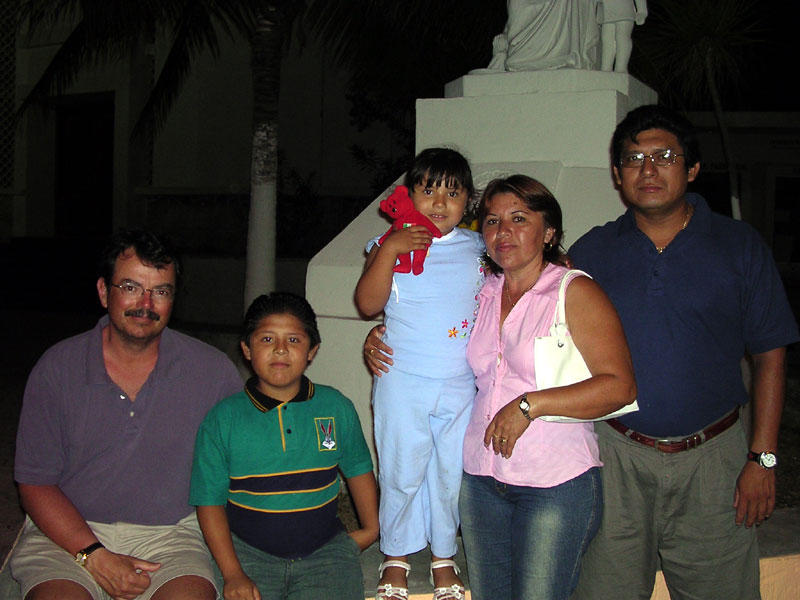 |
| Juan, su esposa Paola, sus niños Manolo y Paolina, y el autor delante de la iglesia donde Juan y Paola se casaron en 1987 |
| Juan, his wife Paola, his children Manolo and Paolina, and the author in front of the church where Juan and Paola were married in 1987 |
Our daily routine quickly evolved into an early morning walk on the beach followed by perfect cappuccinos and muffins at the café while we checked our email messages using the café's free Internet access. Then it was off to the beach to read and relax, or bombing around the island on scooters to see the sights too far away to walk to. The island is only five miles long and a half-mile wide, so exploring it is easy. There are several places of interest along the west coast. This time out, we stopped at Playa Indios, a beach club that caters to visitors catching a ferry over from Cancún, but it was crowded so we just sat in the shade and drank Cokes to avoid the mid-90s heat of mid-day. Then is was off to Punta Sur.
 |
| Paolina travieso en Amigos después que metiendo accidentalmente a su hermano en el ojo |
| Mischievous Paolina at Amigos after accidentally poking her brother in the eye |
The best part of our visits to Isla Mujeres is the people we have befriended there. Many of them are Mayan and most are from the mainland. The story we've heard is that when the island was being developed for tourism, the developers recruited masons from the Yucatan peninsula to build the hotels. Many of them liked the island so much that they stayed on after the work was completed, taking jobs in the hotels and restaurants they had built. Our friend Juan was not one of these early arrivals, but he came to Isla Mujeres from a town south of Tulum on the east coast of the peninsula and has made a good life for himself and his family working as a waiter at the Na Balam's restaurants. Juan was the first person we met on our first visit to the island, and although his English was not great and our Spanish was considerably worse, we were able to communicate well enough to make each other laugh and form a friendship. During our third visit, Juan invited us to his home to meet his wife Paola, his sons Juan Jr. and Manolo, and his baby daughter Paolina. They live in what is locally known as a "colonial," one of several tiny villages scattered around the island to the south of the main town, which is not normally referred to as anything but "downtown." Juan's family lives with his wife's family in a shared house. Their accommodations are simple--they sleep in hammocks they put up at night--but they have every modern appliance plus a good computer with Internet access. Juan typically rides a scooter to work, but he also owns a car that his family uses for trips to their hometowns on the mainland, taking the car ferries that make the passage several times a day.
 |
| Nan con Juan en el restaurante de Na Balam balcón romántico de primer piso |
| Nan with Juan on the Na Balam restaurant's romantic second-floor balcony |
We promised Juan that we would put some pictures of our visit on the Internet for his family to see, so here they are with the captions in both Spanish and English. Juan, we hope you enjoy them as much as we enjoyed spending time with you and your family. Readers, if you ever get a chance to vacation in the Cancún area, be sure to take the ferry across to Isla Mujeres, Mexico's best-kept secret.
Wednesday, May 4, 2005
Lin and Larry Pardey
The Pardeys are one of the most recognized couples in the sailing world. They have written several books on cruising, including the indispensable "Self-Sufficient Sailor". Nan and I attended a two-day seminar they gave in Denver in January, 2004 at the Marriott Inn in West Denver. We were surprised to see more than two hundred people in attendance when we entered the lecture room that Saturday evening. I guess this sailing bug is contagious.
The Pardeys started things out with a slideshow of their adventures on their sailboats, Seraffyn and Taleisin, which Larry the master boat builder had built himself. Their images were so enticing that everyone in attendance was soon longing for the open sea and faraway tropical islands. During intermission both Lin and Larry were available for questions as well as signings of their books, which were on sale in the lobby.
The following day was spent in lectures and question-and-answer sessions on topics important to anyone considering the cruising lifestyle. Larry and Lin said they had been sailing pretty much continuously since 1968 and that during that time they had been around the world four times, twice in each direction. Much of their experience is condensed in their many excellent books, in which the overriding principle is to keep it simple. To that end, they sail without a motor and have just the bare minimum of electronics on board, figuring that these are things upon which it would be too easy to become dependent, only to have them fail when most needed.
For me the most important topics were how to survive a storm and how to handle the paperwork of international boat travel. Larry handled the first topic and Lin the second. Larry said that with the proper equipment and techniques, any storm at sea is survivable. He showed us slides demonstrating heave-to procedures and the use of storm sails and sea anchors. Some of the slides were truly frightening: fifty- to sixty-foot waves towering over their little thirty-foot boat. Lin’s talk was a little more calming. She assured us that with the proper documents it was possible to travel the world, stopping at every place of interest, and never run into trouble with foreign authorities. She also touched on important topics like outfitting a serious first aid kit, getting the necessary immunizations and how to keep life back home manageable in terms of mail, banking and bill paying.
By the end of the day, you could see the dreamy look in many people’s eyes starting to turn alert and calculating as they began to think in concrete terms about giving up their workaday lives for ones of high adventure cruising the world’s oceans. I know I was one of them.
The Pardeys started things out with a slideshow of their adventures on their sailboats, Seraffyn and Taleisin, which Larry the master boat builder had built himself. Their images were so enticing that everyone in attendance was soon longing for the open sea and faraway tropical islands. During intermission both Lin and Larry were available for questions as well as signings of their books, which were on sale in the lobby.
The following day was spent in lectures and question-and-answer sessions on topics important to anyone considering the cruising lifestyle. Larry and Lin said they had been sailing pretty much continuously since 1968 and that during that time they had been around the world four times, twice in each direction. Much of their experience is condensed in their many excellent books, in which the overriding principle is to keep it simple. To that end, they sail without a motor and have just the bare minimum of electronics on board, figuring that these are things upon which it would be too easy to become dependent, only to have them fail when most needed.
For me the most important topics were how to survive a storm and how to handle the paperwork of international boat travel. Larry handled the first topic and Lin the second. Larry said that with the proper equipment and techniques, any storm at sea is survivable. He showed us slides demonstrating heave-to procedures and the use of storm sails and sea anchors. Some of the slides were truly frightening: fifty- to sixty-foot waves towering over their little thirty-foot boat. Lin’s talk was a little more calming. She assured us that with the proper documents it was possible to travel the world, stopping at every place of interest, and never run into trouble with foreign authorities. She also touched on important topics like outfitting a serious first aid kit, getting the necessary immunizations and how to keep life back home manageable in terms of mail, banking and bill paying.
By the end of the day, you could see the dreamy look in many people’s eyes starting to turn alert and calculating as they began to think in concrete terms about giving up their workaday lives for ones of high adventure cruising the world’s oceans. I know I was one of them.
Saturday, April 23, 2005
U2 Concert in Denver
Nan and I were lucky enough to get tickets to see U2 perform on Thursday night in Denver. It was one of the best concerts we've ever experienced. The stage set-up and light show were absolutely incredible, and the full house of fans stood and sang through the entire 2.5 hour set of songs. Bono commented on how well-received they always feel when they come to Colorado. Afterall, this is where U2 recorded their live album "Under a Blood Red Sky" back in 1983 at the Red Rocks Amphitheatre just outside of Denver, in Morrison.
Bono used portions of the concert as a platform for his message of world-wide love and compassion, especially for the people of Africa. He asked people to use their cell phones to "text" their names in support of The ONE Campaign. There were also booths out in the lobby where people could sign The ONE Campaign's petition, so Nan and I signed it again even though we had both already signed it online at the ONE website (see my Monday, April 18, 2005 post). To learn more about the concert, including the set list and photos, please click here: U2 Concert in Denver.
Bono used portions of the concert as a platform for his message of world-wide love and compassion, especially for the people of Africa. He asked people to use their cell phones to "text" their names in support of The ONE Campaign. There were also booths out in the lobby where people could sign The ONE Campaign's petition, so Nan and I signed it again even though we had both already signed it online at the ONE website (see my Monday, April 18, 2005 post). To learn more about the concert, including the set list and photos, please click here: U2 Concert in Denver.
Monday, April 18, 2005
The ONE Campaign
 This weblog is devoted to sailing, but once in a while, it will address other issues. Last week, I saw a TV commercial for a new non-profit organization called The ONE Campaign, whose message is simply this:
"WE BELIEVE that in the best American tradition of helping others help themselves, now is the time to join with other countries in a historic pact for compassion and justice to help the poorest people of the world overcome AIDS and extreme poverty. WE RECOGNIZE that a pact including such measures as fair trade, debt relief, fighting corruption and directing additional resources for basic needs – education, health, clean water, food, and care for orphans – would transform the futures and hopes of an entire generation in the poorest countries, at a cost equal to just one percent more of the US budget. WE COMMIT ourselves - one person, one voice, one vote at a time - to make a better, safer world for all."
If you believe as I do that the time is right for Americans to voice their concern for the welfare of all the world's people, then please click the ONE image in this post to go to the ONE website and sign the ONE declaration. Together we will make a difference!
Saturday, April 16, 2005
Where's the Dinghy? Day 8
or, How We Learned Most of Cruising's Lessons in Just One Week
Day 8 (Saturday, May 8, 2004)
The next morning, we both awoke feeling hungover from the previous night’s wine. The only thing on our immediate agenda was to get the boat back to Conch Charters before noon. All we had to do was negotiate the six miles back across Sir Francis Drake Channel to Road Town, and our trip would be over. Partly because I wasn’t feeling well and partly because it was such a short distance, I didn’t bother to put up the sails. We just motored across the channel and circled around near the Conch Charters dock until someone responded to our call and came out in a dinghy to guide us into our boat’s slip. We worked on packing up our stuff and moving it to the dock until Miles came along to check us out. Miraculously, the only damage was to the boat hook, which was a little crumpled from being bent and straightened, but Miles didn’t notice and we didn’t mention it. He was more concerned with explaining to me the intricacies of our previous day’s impellor problem, which I already understood thoroughly from having experienced it firsthand. He gave us an exit survey to fill out while he poked around the boat. One of the questions was, “Did you circumnavigate Tortola?” I hadn’t really thought about it much before I read the question, but that was exactly what we had done. We didn’t do it very directly, and we certainly didn’t do it very gracefully, but we had managed to make our way around the island and return to our point of origin, safely and on time. We had faced many trials, and we had learned from each of them. I don’t know if Nan would agree, but I felt confident that we could handle almost anything at this point. I was already thinking ahead to our next trip, and ultimately to my dream of sailing around the world.
Epilogue
When people ask about our sailing trip, I tell them that we had quite a bit of trouble, everything from bad weather to mechanical problems. But I also tell them that I never said to Nan, “We’re screwed.” Everything, even the completely unexpected, was manageable in the end. In fact, at one point during the trip, what I said to Nan instead was, “Despite all the problems we’ve been having, I’m having the greatest time of my life.”
Day 8 (Saturday, May 8, 2004)
The next morning, we both awoke feeling hungover from the previous night’s wine. The only thing on our immediate agenda was to get the boat back to Conch Charters before noon. All we had to do was negotiate the six miles back across Sir Francis Drake Channel to Road Town, and our trip would be over. Partly because I wasn’t feeling well and partly because it was such a short distance, I didn’t bother to put up the sails. We just motored across the channel and circled around near the Conch Charters dock until someone responded to our call and came out in a dinghy to guide us into our boat’s slip. We worked on packing up our stuff and moving it to the dock until Miles came along to check us out. Miraculously, the only damage was to the boat hook, which was a little crumpled from being bent and straightened, but Miles didn’t notice and we didn’t mention it. He was more concerned with explaining to me the intricacies of our previous day’s impellor problem, which I already understood thoroughly from having experienced it firsthand. He gave us an exit survey to fill out while he poked around the boat. One of the questions was, “Did you circumnavigate Tortola?” I hadn’t really thought about it much before I read the question, but that was exactly what we had done. We didn’t do it very directly, and we certainly didn’t do it very gracefully, but we had managed to make our way around the island and return to our point of origin, safely and on time. We had faced many trials, and we had learned from each of them. I don’t know if Nan would agree, but I felt confident that we could handle almost anything at this point. I was already thinking ahead to our next trip, and ultimately to my dream of sailing around the world.
Epilogue
When people ask about our sailing trip, I tell them that we had quite a bit of trouble, everything from bad weather to mechanical problems. But I also tell them that I never said to Nan, “We’re screwed.” Everything, even the completely unexpected, was manageable in the end. In fact, at one point during the trip, what I said to Nan instead was, “Despite all the problems we’ve been having, I’m having the greatest time of my life.”
Thursday, April 14, 2005
Where's the Dinghy? Day 7
or, How We Learned Most of Cruising's Lessons in Just One Week
Day 7 (Friday, May 7, 2004)
Friday morning we awoke rested despite the previous night’s interruption. We took a quick dip off the stern, then fired up the engine and started motoring out the way we should have come in the day before, through the gap between Prickly Pear Island and Mosquito Island. There was absolutely no wind and the water in Gorda Sound was like glass, a huge difference from previous days. As we approached the west end of Prickly Pear, the engine alarm suddenly sounded. I quickly turned off the engine and then went below to check on it. I had been doing all the morning engine checks that the Conch Charters people had instructed me to do, and everything had been fine. Now as I removed the cover, something was obviously wrong. Heat poured out of the engine compartment. I set the cover aside to let the engine cool and then climbed back out to the helm. I told Nan that the engine was overheating and that we should put up the sails even though there was no wind. In the short time I was below, the boat had drifted closer to Prickly Pear so we were facing an imminent lee shore problem. Just then, the Salty Kat crew, who had spent the night at Saba Rock, passed us at a good clip under engine power. We thought they might notice us floating aimlessly and ask if we needed help, but nobody even glanced our way. I put the mainsail all the way up and unfurled the jib. Both sails started luffing like lazy flags. We weren’t making any noticeable headway and shore was getting closer. I said to hell with it and started the engine. We motored away from shore for about two minutes before the alarm went off again. I turned off the engine again but started to figure that we could go along like this, using the engine for a few minutes at a time until we reached open water and hopefully some sort of breeze. Several starts and stops later, we were floating aimlessly again, in open water with no wind.
It was time to call Conch Charters. I got Miles on the phone and explained our situation. He asked me to start the engine and check to see if water was coming out with the exhaust. Since the exhaust pipe was underwater, I had to go under the boat, for the third time in six days, to check it. Sure enough, there was only stinky diesel exhaust coming out, no water from the cooling system. I called Miles back and he said it was probably a problem with the impellor, the little spinning device that circulated cool sea water through the engine to keep it from overheating. He said he would have to have his mechanic Tom come out and fix it for us. About an hour later, Tom showed up in a big speed boat.
Tom was a laid-back mechanic from Canada, and very different from the intense all-English crew at Conch Charters headquarters. He tossed me a line so I could tie his boat to our stern, then came aboard with his toolbox. He went below, carefully spread a protective cloth, and went to work on the engine. Sure enough, the impellor was the problem. The rubber part with the little fins on it had spun loose from its brass core. Tom replaced it with a new one, put everything back together, and came back up to the cockpit to test the engine. He started it and looked over the stern. It was now pretty obvious that water was coming out with the exhaust. Big smiles all around. Tom was sweating hard from working on the hot engine, so we all sipped Cokes in the cockpit while he chatted about his split existence between the British Virgin Islands and Canada, and also about hockey, of course.
After Tom took off, we decided to keep the engine running for a while to charge up the batteries and keep the refrigerator cool, plus there still wasn’t much wind. The combination of the engine and the sails kept us moving along at about four knots, which was good because we had lost a lot of time already and were hoping to make it the remaining ten miles to Manchioneel Bay, on the west side of Cooper Island, before dark. It would be our last night on the boat, so we were hoping for something special. We were not disappointed. The little bay and its tiny facilities—a beach bar and restaurant, and a few modest rooms—are a magical place. We arrived late in the afternoon, tied up to a mooring, and took Squishy over to the dinghy dock. We toured the area, which took all of five minutes, then headed to the bar for what felt like a well-deserved margarita. On our way out, we made dinner reservations for later, then headed back to the boat for a swim and a shower.
When we returned, it was dusk. The sun was setting over Salt Island to the west and the wait staff were lighting the candles on the small tables overlooking the bay. We ordered a good bottle of red wine and sipped it while we reflected back on the week. Nan asked if I was ready for the trip to be over. I smiled and said I could keep going forever. I could tell by the look on her face that she was ready to be back on dry ground for a while. She started talking about the great week we would have at Round Hill Villa on Tortola’s Cane Garden Bay starting the next day. Dinner arrived and we ate fresh seafood prepared in an Italian style that was so good we bought drinks for the kitchen staff. We ordered a second bottle of wine, then dessert and coffee. By the time we stumbled back to the dinghy dock, it was apparent that we had had enough to drink. The dock was pretty high, so when I turned around and started to climb down to the dinghy, the step was further than I thought it would be. Combined with the night-time squishy condition of Squishy, I lost my balance and tumbled backward into the water. Whatever wine buzz I had was lost immediately as I thrashed my way back into the dinghy. Nan was still on the dock, looking concerned. I’m fine, I said, just very wet. I hadn’t lost anything, but my watch, wallet and shoes were soaked. We motored slowly back to the boat, where I toweled off and spread my stuff out to dry.
Day 7 (Friday, May 7, 2004)
Friday morning we awoke rested despite the previous night’s interruption. We took a quick dip off the stern, then fired up the engine and started motoring out the way we should have come in the day before, through the gap between Prickly Pear Island and Mosquito Island. There was absolutely no wind and the water in Gorda Sound was like glass, a huge difference from previous days. As we approached the west end of Prickly Pear, the engine alarm suddenly sounded. I quickly turned off the engine and then went below to check on it. I had been doing all the morning engine checks that the Conch Charters people had instructed me to do, and everything had been fine. Now as I removed the cover, something was obviously wrong. Heat poured out of the engine compartment. I set the cover aside to let the engine cool and then climbed back out to the helm. I told Nan that the engine was overheating and that we should put up the sails even though there was no wind. In the short time I was below, the boat had drifted closer to Prickly Pear so we were facing an imminent lee shore problem. Just then, the Salty Kat crew, who had spent the night at Saba Rock, passed us at a good clip under engine power. We thought they might notice us floating aimlessly and ask if we needed help, but nobody even glanced our way. I put the mainsail all the way up and unfurled the jib. Both sails started luffing like lazy flags. We weren’t making any noticeable headway and shore was getting closer. I said to hell with it and started the engine. We motored away from shore for about two minutes before the alarm went off again. I turned off the engine again but started to figure that we could go along like this, using the engine for a few minutes at a time until we reached open water and hopefully some sort of breeze. Several starts and stops later, we were floating aimlessly again, in open water with no wind.
It was time to call Conch Charters. I got Miles on the phone and explained our situation. He asked me to start the engine and check to see if water was coming out with the exhaust. Since the exhaust pipe was underwater, I had to go under the boat, for the third time in six days, to check it. Sure enough, there was only stinky diesel exhaust coming out, no water from the cooling system. I called Miles back and he said it was probably a problem with the impellor, the little spinning device that circulated cool sea water through the engine to keep it from overheating. He said he would have to have his mechanic Tom come out and fix it for us. About an hour later, Tom showed up in a big speed boat.
Tom was a laid-back mechanic from Canada, and very different from the intense all-English crew at Conch Charters headquarters. He tossed me a line so I could tie his boat to our stern, then came aboard with his toolbox. He went below, carefully spread a protective cloth, and went to work on the engine. Sure enough, the impellor was the problem. The rubber part with the little fins on it had spun loose from its brass core. Tom replaced it with a new one, put everything back together, and came back up to the cockpit to test the engine. He started it and looked over the stern. It was now pretty obvious that water was coming out with the exhaust. Big smiles all around. Tom was sweating hard from working on the hot engine, so we all sipped Cokes in the cockpit while he chatted about his split existence between the British Virgin Islands and Canada, and also about hockey, of course.
After Tom took off, we decided to keep the engine running for a while to charge up the batteries and keep the refrigerator cool, plus there still wasn’t much wind. The combination of the engine and the sails kept us moving along at about four knots, which was good because we had lost a lot of time already and were hoping to make it the remaining ten miles to Manchioneel Bay, on the west side of Cooper Island, before dark. It would be our last night on the boat, so we were hoping for something special. We were not disappointed. The little bay and its tiny facilities—a beach bar and restaurant, and a few modest rooms—are a magical place. We arrived late in the afternoon, tied up to a mooring, and took Squishy over to the dinghy dock. We toured the area, which took all of five minutes, then headed to the bar for what felt like a well-deserved margarita. On our way out, we made dinner reservations for later, then headed back to the boat for a swim and a shower.
When we returned, it was dusk. The sun was setting over Salt Island to the west and the wait staff were lighting the candles on the small tables overlooking the bay. We ordered a good bottle of red wine and sipped it while we reflected back on the week. Nan asked if I was ready for the trip to be over. I smiled and said I could keep going forever. I could tell by the look on her face that she was ready to be back on dry ground for a while. She started talking about the great week we would have at Round Hill Villa on Tortola’s Cane Garden Bay starting the next day. Dinner arrived and we ate fresh seafood prepared in an Italian style that was so good we bought drinks for the kitchen staff. We ordered a second bottle of wine, then dessert and coffee. By the time we stumbled back to the dinghy dock, it was apparent that we had had enough to drink. The dock was pretty high, so when I turned around and started to climb down to the dinghy, the step was further than I thought it would be. Combined with the night-time squishy condition of Squishy, I lost my balance and tumbled backward into the water. Whatever wine buzz I had was lost immediately as I thrashed my way back into the dinghy. Nan was still on the dock, looking concerned. I’m fine, I said, just very wet. I hadn’t lost anything, but my watch, wallet and shoes were soaked. We motored slowly back to the boat, where I toweled off and spread my stuff out to dry.
Tuesday, April 12, 2005
Where's the Dinghy? Day 6
or, How We Learned Most of Cruising's Lessons in Just One Week
Day 6 (Thursday, May 6, 2004)
We wanted to get an early start for the Baths that Thursday morning because we had heard that the day moorings filled up quickly and that anchoring was not allowed. We motored over to the Salty Kat catamaran at about 8:00 to pick up Shannon, who told us that with four gung-ho guys on board her boat, she wasn’t getting any real sailing time. We changed that quickly, having Shannon jump around on top of the cabin and down in the cockpit to rig the mainsail with a single reef while I steered us into the wind. We were well protected from the high wind and swells by the mass of Virgin Gorda to our east, so it was finally time to sail! We bore off to port and watched with delight as the mainsail filled with wind for the first time this trip. We put out the jib as well and soon were flying along at a respectable six knots. With easy teamwork, we smoothly came about and were now on a starboard tack. Shannon snapped a picture of Nan and me sitting together at the helm, and Nan was actually smiling. This was the most fun we had had all week. The Salty Kat soon motored past us mid-tack, on a straight run to the Baths. Those guys don’t know what they’re missing, we commented. Several tacks later we arrived at the Baths ourselves to find that all the day moorings were already filled. We dropped the sails and motored in lazy loops, enjoying the rock formations and waiting for something to open up, but nothing ever did. Shannon decided she should rejoin her group instead of staying with us all the way to the Bitter End Yacht Club, where we planned to spend the night. So as we passed the bow of the moored Salty Kat, Shannon heaved her backpack onto the trampoline and then jumped into the water. We waved good-bye and promised to meet up with her later.
In the shelter of shore, we put the sails back up and headed north in an effortless beam reach past Spanish Town and Collision Point to starboard and then the Dogs islands to port. In almost no time, we passed an inlet where other boats were pulling in. It’s too soon, I thought. The inlet we want is the next one. As we rounded to the east, following the contour of shore, we saw nothing ahead of us but a massive reef, open ocean and big swells. This can’t be right, I thought. I checked the chart and saw that we were north and east of where I had thought we were, in Virgin Sound between Necker Island and Prickly Pear Island. Add “lost” to our list of problems for the week. We dropped the sails and steered for what appeared to be a break between the reef and shore, then watched as the water went from dark blue to the brilliant aquamarine of shallow water. The depth finder indicated that we were in about only six feet of water. Nan thought for sure that we would run aground at any moment. But I suggested that as long as we were in the sheltered water behind the reef and could clearly see the bottom and any obstacles, we might as well go exploring. The water was so beautiful she couldn’t help but agree. We followed a line of small buoys to a tiny bay at the easternmost end of Virgin Gorda. This could have been a private island paradise for the night but there were already a couple of boats anchored there and we really had our hearts set on spending the night at the Bitter End. We turned around and headed toward Saba Rock, which marks the northeastern entrance to Gorda Sound.
We rounded east after entering the sound and there was the Bitter End Yacht Club, perhaps the most famous sailing destination in the Caribbean. It looked like a country club set at water’s edge. We moored about a hundred yards from the dinghy dock and then piloted Squishy over to it. We explored the little theme park-like village and then ducked into the bar to escape the heat and drink a cold beer. Everything was pretty expensive, like the $50 per person prix fixe dinner (wine extra) advertised outside the restaurant, so we decided to buy some steaks at the grocery store and try out the little stern rail barbecue grill that came with the boat. I installed the grill and got the coals going while Nan worked her magic on some salads, vegetables and garlic bread down in the galley. As dusk turned to twilight, we ate like royalty in the cockpit while gazing across the water at the series of pyramid-roofed huts that are the primary land-based accommodation at the Bitter End. I was able to pick out the original three that Robin Graham, of Dove fame, had helped to build when he sailed through the area in the late 1960s, near the end of his epic solo, around-the-world sailing adventure. A couple of glasses of wine later, it was time for bed. Nan roused me just a few hours later. A boatload of drunks from the bar was having difficulty locating their boat. They were in the process of boarding ours when Nan yelled out, “Wrong boat!” Slurred apologies and the sound of an outboard motor disappearing into the distance lulled us back to sleep.
Day 6 (Thursday, May 6, 2004)
 |
| Sailing to The Baths |
In the shelter of shore, we put the sails back up and headed north in an effortless beam reach past Spanish Town and Collision Point to starboard and then the Dogs islands to port. In almost no time, we passed an inlet where other boats were pulling in. It’s too soon, I thought. The inlet we want is the next one. As we rounded to the east, following the contour of shore, we saw nothing ahead of us but a massive reef, open ocean and big swells. This can’t be right, I thought. I checked the chart and saw that we were north and east of where I had thought we were, in Virgin Sound between Necker Island and Prickly Pear Island. Add “lost” to our list of problems for the week. We dropped the sails and steered for what appeared to be a break between the reef and shore, then watched as the water went from dark blue to the brilliant aquamarine of shallow water. The depth finder indicated that we were in about only six feet of water. Nan thought for sure that we would run aground at any moment. But I suggested that as long as we were in the sheltered water behind the reef and could clearly see the bottom and any obstacles, we might as well go exploring. The water was so beautiful she couldn’t help but agree. We followed a line of small buoys to a tiny bay at the easternmost end of Virgin Gorda. This could have been a private island paradise for the night but there were already a couple of boats anchored there and we really had our hearts set on spending the night at the Bitter End. We turned around and headed toward Saba Rock, which marks the northeastern entrance to Gorda Sound.
We rounded east after entering the sound and there was the Bitter End Yacht Club, perhaps the most famous sailing destination in the Caribbean. It looked like a country club set at water’s edge. We moored about a hundred yards from the dinghy dock and then piloted Squishy over to it. We explored the little theme park-like village and then ducked into the bar to escape the heat and drink a cold beer. Everything was pretty expensive, like the $50 per person prix fixe dinner (wine extra) advertised outside the restaurant, so we decided to buy some steaks at the grocery store and try out the little stern rail barbecue grill that came with the boat. I installed the grill and got the coals going while Nan worked her magic on some salads, vegetables and garlic bread down in the galley. As dusk turned to twilight, we ate like royalty in the cockpit while gazing across the water at the series of pyramid-roofed huts that are the primary land-based accommodation at the Bitter End. I was able to pick out the original three that Robin Graham, of Dove fame, had helped to build when he sailed through the area in the late 1960s, near the end of his epic solo, around-the-world sailing adventure. A couple of glasses of wine later, it was time for bed. Nan roused me just a few hours later. A boatload of drunks from the bar was having difficulty locating their boat. They were in the process of boarding ours when Nan yelled out, “Wrong boat!” Slurred apologies and the sound of an outboard motor disappearing into the distance lulled us back to sleep.
Subscribe to:
Posts (Atom)
