

On Saturday night, Nan and I went to our local Red Robin for an inexpensive dinner out. It was a nice evening, cooler than it has been, so we opted for a table outside on the patio. We chatted about our upcoming vacation, sipped our wine, ate our burgers, and watched the sun slowly sink behind the Chick-fil-A across the street. Just a typical dining experience. But then it got weird.
The eleven- or twelve-year-old girl sitting with her mother at a table near ours stood up suddenly, went to the table across from us, where a family of five were seated, and yelled at the mother, "Stop staring at me!" Everyone on the patio stopped eating. It got very quiet. The girl returned to her table and sat looking at her mother. Neither said anything.
People looked around at one another with expressions of "What was that all about?!" on their faces. We made eye contact with the man of the family, who said, "She wasn't staring. She was just talking to her son and that girl was behind him." The mother looked shaken and close to tears.
The girl and her mother paid their bill quickly and stood up to leave. The man stood up and intercepted them. He asked why the mother would let her daughter speak to an adult with such disrespect. The mother said, "I don't f--king care." The man stared in disbelief as the girl and her mother walked quickly away.
As he returned to his table, the man announced to everyone within earshot that if he had ever spoken to someone in that way, his father would have whipped his ass right there in the restaurant. There were murmurs of agreement all around. Seated again, the man said, "Did you smell that woman's perfume? It was enough to make me gag! I had to go out and smoke a cigarette just to get away from it. If they thought we were staring at them, then that's why!" He took off his camouflage baseball cap, brushed his hair back with his hand, replaced the cap, and sat back in his chair with a deep sigh.
The man and his family paid their bill and stood to leave. At the exit, he turned and said loudly enough for all to hear, "Y'know, I don't vote Republican!" He paused. "I may be a redneck, but I'm not stupid!" He paused again. "I'm a union member!" He threw up his hands for dramatic effect and then turned to go. Nan and I cheered and clapped, joined by several others.
About Me

- John Lichty
- Savannah,
Georgia, USA
"Go confidently in the direction of your dreams. Live the life you have imagined." --Henry David Thoreau
 Raising Charlie: The Lessons of a Perfect Dog by John Lichty
Subscribe To

 Posts
All Comments
Posts
All Comments

Monday, August 20, 2012

Tuesday, August 14, 2012
Storm King Mountain Memorial Trail


Saturday, July 28, 2012
JK University
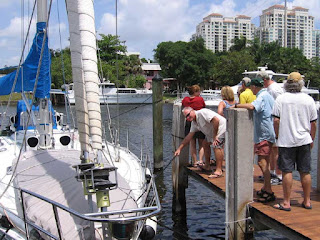
Back in April, when I was out in Savannah getting work done on Whispering Jesse and spending time with family, I took a few days to drive down to Fort Lauderdale for a blue water sailing seminar led by John Kretschmer. I planned to write an article about it for Cruising World magazine, and I obtained John's permission ahead of time, along with his assurance that he would contact the magazine for their approval. The idea was that John would benefit from the free publicity and I would earn another publishing credit. So I was surprised and disappointed when I received a polite rejection indicating that the magazine was aware of John's seminars and planned to write its own article about an upcoming one. I had been scooped!
Since it's not going to be published, I might as well post it here:
 JK University’s Blue Water Passage Making Workshops
Suppose you’re an experienced coastal cruiser looking to take your sailing to the next level, to blue water passage making. Where do you turn for instruction and guidance? If you’re like most sailors, you get started by reading books by such noted sailing authors as Jimmy Cornell and John Vigor. But books will only provide you with theory. What about practical, hands-on experience? It used to come only from taking the risk on your own by making an actual passage, or by signing on as crew for an experienced captain. More recently, there have been instructional passage-making trips offered by outfits such as Mahina Expeditions.
Now there is a new offering, mixing classroom instruction with practical experience to fill in the knowledge gaps of potential ocean-going sailors: JK University, named in tongue-in-cheek fashion after its founder, Capt. John Kretschmer. John is best known for the book he wrote about his delivery captain days, Flirting with Mermaids, and for the passage-making trips he offers through his outfit, John Kretschmer Sailing. He has partnered with Bob Pingel, a contributing editor to Sailing magazine, and Rick Thompson, a marine electronics expert, to provide four-day workshops designed to answer all the big passage-making questions, with an emphasis on safety and self-sufficiency: What are the best methods for avoiding hurricanes? How do I splice a rope for an anchor snubber?
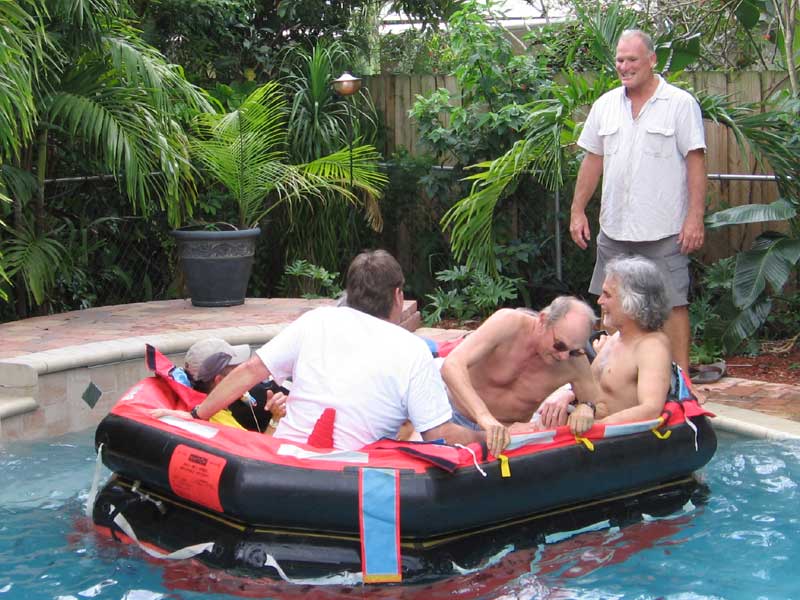
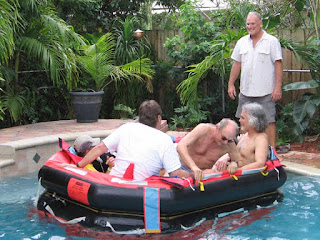 JK University’s Blue Water Passage Making Workshops are conducted three times a year in John’s hometown of Fort Lauderdale, Florida or in Solomons, Maryland. Both locations are close to water for easy access to ocean-going sailboats. Firsthand inspection of a well set-up vessel or two is one of the key components of “field trip Saturday,” along with the actual deployment of a Switlik life raft. Here is a typical workshop syllabus:
 Workshops run from early Thursday afternoon through late Sunday afternoon to help make scheduling as easy as booking a long weekend trip. The late start on Thursday and early finish on Sunday allow out-of-town attendees to arrive and depart without the expense of additional overnights.
To reserve your spot at the next JK University workshop, scheduled for February 7 to 10, 2013, please visit the John Krestschmer Sailing website at yayablues.com and click the Schedule link. In addition to a calendar of workshops, you’ll find all kinds of passage-making opportunities designed to help you build your confidence and broaden your experience.
Since it's not going to be published, I might as well post it here:

Suppose you’re an experienced coastal cruiser looking to take your sailing to the next level, to blue water passage making. Where do you turn for instruction and guidance? If you’re like most sailors, you get started by reading books by such noted sailing authors as Jimmy Cornell and John Vigor. But books will only provide you with theory. What about practical, hands-on experience? It used to come only from taking the risk on your own by making an actual passage, or by signing on as crew for an experienced captain. More recently, there have been instructional passage-making trips offered by outfits such as Mahina Expeditions.
Now there is a new offering, mixing classroom instruction with practical experience to fill in the knowledge gaps of potential ocean-going sailors: JK University, named in tongue-in-cheek fashion after its founder, Capt. John Kretschmer. John is best known for the book he wrote about his delivery captain days, Flirting with Mermaids, and for the passage-making trips he offers through his outfit, John Kretschmer Sailing. He has partnered with Bob Pingel, a contributing editor to Sailing magazine, and Rick Thompson, a marine electronics expert, to provide four-day workshops designed to answer all the big passage-making questions, with an emphasis on safety and self-sufficiency: What are the best methods for avoiding hurricanes? How do I splice a rope for an anchor snubber?
- Introduction: Myths and realities about passage making
- What makes a boat a blue water capable boat? Slideshow of 25 great boats
- Outfitting: Necessary, nice, extravagant – 10 important items for a serious boat
- Hands on – Rope
- Inspecting boats: Caribe, a Beneteau First 456 performance cruiser and retrofit project, and Tioga, a brand-new Hylas 56
- Hands on – The bullet-proof electrical system
- Hands on – Standing rigging, discussion of rigging emergencies at sea
- Passage planning, pilot charts, safety, weather, watch schedules, crew management, food preparation
- Communications at sea: Satellite phones, wifi, SSB, VHF, AIS
- Life raft launch
- What’s new in cruising sails? A plan for optimizing “manageable” downwind performance; sail plans for storm sailing; how to spend money on cruising sails
- Heavy weather: Dealing with storms, gales and squalls
- Chart work and celestial navigation in the digital age: Thinking like a navigator

To reserve your spot at the next JK University workshop, scheduled for February 7 to 10, 2013, please visit the John Krestschmer Sailing website at yayablues.com and click the Schedule link. In addition to a calendar of workshops, you’ll find all kinds of passage-making opportunities designed to help you build your confidence and broaden your experience.
Monday, July 23, 2012
Ute Petroglyphs

Over Memorial Day weekend, Scout and I hiked in the Dominguez Canyon, starting from the Bridgeport end that is accessible from Highway 50, south of town about 20 miles. After crossing the Gunnison River on a beautifully designed steel pedestrian bridge, we passed through the river rafters' campsites and worked our way up into the canyon on a well-used trail. In addition to the petroglyphs I hoped to see, some people we met on the trail told me about an impressive waterfall we should be sure to see that was off the trail about five minutes before the petroglyph area.


On our way back down from the petroglyph area, Scout and I kept an eye on the stream that runs through the canyon to see if we could figure out where the waterfall would be. There was a point where the stream appeared to run into a wall of rock, so we left the trail to investigate. We found a spectacular waterfall where the stream took a sharp right turn at the rock wall and the water fell more than 50 feet to the gravel below. The stone surface beneath the stream, leading up to the falls, was well-worn, leaving shallow pools that Scout felt obliged to swim in and cool off.


Monday, July 2, 2012
Tides and Currents

Near the end of the Savannah trip, on the Friday before the weekend when family would start returning home, I invited everyone out for a sail on Whispering Jesse. My mother stayed behind, but my father, my sister Jane, her husband Josh, their twin sons Max and Ben, and my sister Susan were all up for it. So Nan and I spent some early morning time at the marina that day getting the boat ready: taking off the sail cover, replacing a missing mainsheet shackle, spraying the luff track with SailKote lubricant, and listening to the weather on the VHF. It was looking dark and blustery out to the east in the open ocean, and I was concerned that there might be too much wind for comfort. I checked the wind instruments and they were showing about 15 knots out of the east, counter to the prevailing westerlies.
When six family members arrived at a little after 9:00, we welcomed them aboard and gave them a quick tour of the boat. I had checked the tide table and the current would be running lightly against us as we backed out of the slip. With the transmission in reverse, we cast off the dock lines, and moved slowly back against the current, assisted by the wind. I put the transmission into forward and made a smooth turn to starboard to put us out into Delegal Creek, heading down the estuary toward Ossabaw Sound. We followed the line of channel markers out toward open water and were surprised when the depth meter continued to register single digits of foot depth under the keel. Slack tide would not occur until 1:00 in the afternoon, so shallow water was to be expected, but we were more than a half-mile from shore. In addition to being shallow, Ossabaw Sound is also prone to shoaling, and we lightly bounced the keel over a few sandy ones as we headed out to sea.
The current was flowing opposite the wind, creating significant chop and whitecaps and making for a bumpy ride. I let my nephews, who are learning to sail dinghies at home in Seattle, take turns at the wheel, but they didn't seem too confident with steering a larger boat in choppy conditions and willingly relinquished control back to me. We continued to motor out through the waves, spraying the people sitting up at the bow who were looking for dolphins. When we reached a depth where it would have been safe to head directly into the wind and raise the mainsail, I decided against it. It was just a little too rough for inexperienced sailors and I didn't want to scare anyone. Instead, we turned around and headed in for calmer waters. We followed the southern shore of Skidaway Island for a ways, spotting several dolphins in the shallow waters, until everyone was ready to return to shore.
I phoned Jimmy, the dockmaster, as we passed the channel's entrance markers, and asked if he could meet us at the pier to receive a dock line. He said he would, and he was standing at the corner of the fuel dock as we approached. It is difficult to judge current from a moving boat, so it did not appear that it was running significantly faster than it had been when we departed almost two hours before, but it most definitely was. To steer the boat back into the slip, I would need to make a tight 180-degree turn to starboard against the current. As I began the turn, putting the boat's beam to the current, the force of the water started pushing the boat sideways, leaving no room to complete the turn. I cranked the transmission into reverse, to back up against the current and get the bow pointed at the slip, but the little folding, two-blade propeller was no match for the strong current. The boat crashed sideways into a barnacle-encrusted piling and my neighbor's bow anchor, and there we were pinned. We quickly moved fenders into position to keep the anchor and piling from grinding against the hull and cap rail and causing further damage. And then we tried to figure out what to do. Jimmy had climbed over the neighbor's boat to see how he could help and said that he didn't think we would be able to move the boat until slack tide, still a couple of hours away. He then assisted everyone but Nan, my father and me in getting off the boat by way of the neighbor's boat. One of my sisters had called my mother and she arrived to take the rest of the group back home.
We were resigned to waiting for slack tide until Joel and his wife Bonnie, who own a Cat Ketch they keep at a slip across from ours, came over to see how they could help. Joel is an old salt and according to Bonnie, he has extensive experience with boat rescues. He suggested floating a long anchor line down from the adjacent pier, tying it off at the bow and using it in conjunction with a stern line, to control the boat's rotation, to pull the boat across to an empty slip at the adjacent pier. It worked like a charm. We didn't even need to use the engine; it just took Joel and a marina employee to pull the boat over while I steered. My father, Nan and I secured the boat in the slip to await slack tide and thanked everyone for their help. Joel said he would be around later if we needed assistance with getting the boat back into her own slip, and we told him that after the morning's experience, we would appreciate all the help we could get.
After lunch, my father, Nan and I returned to the marina to find the water almost motionless. Joel was expecting us, and he suggested using the anchor line again but as a safety measure this time. He tied it to a stern cleat and played it out like a leash as I backed out of the slip, turned the stern to port, put the transmission into forward, and turned to starboard to slowly glide into the opposite slip. Jimmy was waiting to receive a dock line, and we soon had the boat secured in her home slip. We thanked Joel and Jimmy profusely and headed for home.
Nan and I decided we owed Joel a thank-you gift and went to find a liquor store for a good bottle of wine. When we returned to the marina, Joel and Bonnie were working on replacing the portlights on their boat. We gave them the wine and thanked them again for their help. We got to talking boats, and Bonnie said that people walking on the pier frequently stopped to admire Whispering Jesse, that she is such a pretty boat. She asked if she could see what the boat was like on the inside. We said sure and opened her up for a little tour. Bonnie commented about the roomy cabin and its abundant storage space as I showed them around and answered their questions.
Back on the pier, Joel and I assessed the damage to the boat's starboard beam. There were some deep gouges in the teak cap rail and in the fiberglass below from the flukes of my neighbor's anchor, and some significant scratching from the barnacles on the piling, but it was all merely cosmetic and could be made to look as good as new. All in all, we were lucky that it wasn't much worse. Joel said he knew a guy who specialized in boat carpentry who could take care of the cap rail and any other wood-related issues. I told him I would get his phone number when I returned to Savannah, which is now starting to look like next Thanksgiving weekend.
I talked with Jimmy the next day when we sought him out to give him a tip for his services. He said that he would have been fine with me just pulling the boat up to the fuel dock and leaving her there until slack tide before moving her into her slip. How I wish he had suggested that when I called him to take a dock line!
The moral of this story: Tides and currents are serious forces, especially in tight quarters where they make maneuvering extremely difficult. Check the tide tables, and try to time marina arrivals and departures to correspond with the slack tide periods between ebbs and flows. When in doubt, stay put if you're already secure, and look for temporary alternatives, like anchoring or tying up at an easier location, if you're trying to dock. Most importantly, don't be in a hurry. Take the time to evaluate the situation and make a common-sense plan. Someday, I hope to have enough time to take my own advice.
Sunday, June 24, 2012
Hole in one!

We were playing pretty well up through the sixth hole, with a combined score of 1 under par to that point. I was the first to tee off on the seventh hole, a 174-yard par three with a pond right off the front of the tee. I have lost a few balls in that pond during past rounds, so I was playing a shag ball, a scuffed-up Titleist, but I pretty much play shag balls all the time since I lose so many. I had it teed down low and was playing a 4 iron. I took a well-balanced swing and made good contact. As I watched, the ball took a high trajectory with a slight draw that put it right on line for the hole. It bounced twice on the green and disappeared. I turned to Nan, Kevin and Lesley, sitting in the shade in the carts, and said, "I think it went in!" They had not been paying close attention and thought I was kidding, but they saw I was serious and hurried to take their tee shots so we could go see for sure.
I raced our cart down the path to the green, hopped out and rushed to the hole. Sure enough, there was my ball. A hole in one! I raised my arms in triumph and received high fives all around. We took some photos for posterity with my iPhone and then moved on to the eighth tee, now 3 under par. As Nan and I drove up the eighth fairway, she nudged me and said, "You're still smiling." I said, "I can't help it. I've been playing golf for 50 years and never thought I would get a hole in one. It feels pretty good."
Monday, June 11, 2012
Transit of Venus

I came up with the simplest solution I could think of: I rubber-banded the binoculars to my camera tripod. This left my hands free to adjust position and focus, and to get the best possible projected image. It wasn't much to look at, as you can see in the photo (click for a full-size view), taken at 7:06 PM MDT, about three hours into the seven-hour transit. But it was our last chance to see a transit of Venus in our lifetimes, so it was worth it.
Growing up in Wauwatosa, Wisconsin, my friend Gene Hanson and I would spend summer evenings looking at the night sky through his Tasco 4.5-inch reflector telescope. Thanks to Gene, I have seen all of the planets, except for the recently demoted Pluto. If you know about astronomy, you know that this is not an easy achievement. Timing is everything. On the cold, clear morning of November 10, 1973, Gene and I woke up before dawn to lug his telescope down to Hoyt Park, where we would have a good view of the sun rising through a gap in the trees above the east-west oriented parkway. As the sun rose, we projected its image onto a small screen attached to the telescope, and there we saw a tiny spot, the elusive planet Mercury, near the end of its transit. For two geeky fifteen-year-olds, it was quite a thrill.
Gene has maintained his keen interest in astronomy through the years, getting bigger and bigger telescopes, and even arranging his life so he could live where the viewing is excellent north of Phoenix. His work with variable stars was recognized in 2002 when he was awarded the Leslie C. Peltier Award by the Astronomical League. For amateur astronomers, this is equivalent to being inducted into the hall of fame. Way to go, Gene!
Saturday, June 2, 2012
Nan's Good Deed: A Happy Ending
There was an article in the Grand Junction Free Press on Friday, May 25, about the local police department's Homeless Outreach Team (HOT). According to the article, team members are building relationships with the homeless population to ensure that they receive the services that are available through local providers such as Catholic Outreach and the Salvation Army. Nan brought the article to my attention because the accompanying photo featured HOT team members sitting in the riverside camp of her adopted homeless person, Jerry. The photo must have been more than a year old because we have not seen Jerry around town in at least that long.
After the three-part series I wrote three years ago about Nan's relationship with Jerry ("Nan's good deed", "Nan's good deed, part 2" and "Nan's good deed, part 3"), I have been hesitant to write more because I didn't want to report that things were not going well in Jerry's life. First, we heard through an attorney who helped with Jerry's legal problems that he had come into a significant inheritance that would have permanently lifted him out of homelessness. All he needed to do to claim it was to show up in Florida, his home state, with proof of his identity, but he could not get it together to secure an ID card and make the trip. It was easier to remain a drunk in Grand Junction. Nan and I were disappointed, but it didn't change our feelings for Jerry.
What did change our feelings was the second thing that happened. Jerry had a terrible history with Animal Control over his dog Bear-Bear. She was a red-furred chow mix and Jerry's closest friend, and she was the reason why Nan approached Jerry in the first place, out of concern that the dog wasn't getting enough to eat. But Jerry was derelict in keeping Bear-Bear on a leash, and she would occasionally take a nip at people in defense of Jerry. These occurrences would land her in the dog pound, sometimes for extended periods while Jerry panhandled to pay the fines. Finally, Bear-Bear reached her last strike with Animal Control, and the court ordered her to be euthanized. It still makes my eyes water to think of this poor little mutt who never really had a chance, who was loved and looked after by a man who could barely look after himself, and who was condemned to die for doing what dogs do, defending her human companion.
When Jerry disappeared from the streets of Grand Junction shortly after, Nan and I had few misgivings. We had done what we could for him, and we wished him well wherever he was. So it was a pleasant surprise to see Jerry's face in the newspaper photo and to learn from the article that the HOT people had enrolled him in a rehab program called TLC in Phoenix, where he became a group leader and now manages a group home there. When the bus dropped him off in Phoenix, he had no other transportation and had to walk everywhere, so he requested that the HOT people ship his bike to him, which they did. It was the same bike that Nan and I had bought for Jerry more than three years ago.
Jerry, we're proud of how you have turned your life around. We hope you are happy and that you will someday find a puppy to love as much as you loved Bear-Bear.
After the three-part series I wrote three years ago about Nan's relationship with Jerry ("Nan's good deed", "Nan's good deed, part 2" and "Nan's good deed, part 3"), I have been hesitant to write more because I didn't want to report that things were not going well in Jerry's life. First, we heard through an attorney who helped with Jerry's legal problems that he had come into a significant inheritance that would have permanently lifted him out of homelessness. All he needed to do to claim it was to show up in Florida, his home state, with proof of his identity, but he could not get it together to secure an ID card and make the trip. It was easier to remain a drunk in Grand Junction. Nan and I were disappointed, but it didn't change our feelings for Jerry.
What did change our feelings was the second thing that happened. Jerry had a terrible history with Animal Control over his dog Bear-Bear. She was a red-furred chow mix and Jerry's closest friend, and she was the reason why Nan approached Jerry in the first place, out of concern that the dog wasn't getting enough to eat. But Jerry was derelict in keeping Bear-Bear on a leash, and she would occasionally take a nip at people in defense of Jerry. These occurrences would land her in the dog pound, sometimes for extended periods while Jerry panhandled to pay the fines. Finally, Bear-Bear reached her last strike with Animal Control, and the court ordered her to be euthanized. It still makes my eyes water to think of this poor little mutt who never really had a chance, who was loved and looked after by a man who could barely look after himself, and who was condemned to die for doing what dogs do, defending her human companion.
When Jerry disappeared from the streets of Grand Junction shortly after, Nan and I had few misgivings. We had done what we could for him, and we wished him well wherever he was. So it was a pleasant surprise to see Jerry's face in the newspaper photo and to learn from the article that the HOT people had enrolled him in a rehab program called TLC in Phoenix, where he became a group leader and now manages a group home there. When the bus dropped him off in Phoenix, he had no other transportation and had to walk everywhere, so he requested that the HOT people ship his bike to him, which they did. It was the same bike that Nan and I had bought for Jerry more than three years ago.
Jerry, we're proud of how you have turned your life around. We hope you are happy and that you will someday find a puppy to love as much as you loved Bear-Bear.
Sunday, May 20, 2012
Eclipse

We experimented with a few different ways to view the eclipse. I built a simple pin-hole viewer out of a shoe box, but the projected image was really small. The photo below shows Nan holding it as the eclipse approached local totality. If you click the photo, you should be able to see the tiny crescent shape more clearly. We also projected the eclipse through binoculars onto our backyard fence, but the image was a little fuzzy. We had the greatest success stacking three layers of photographic negatives together and holding them up about a foot in front of our eyes to view the eclipse directly. This is probably a no-no, but if you don't think ahead and buy a pair of "eclipse glasses," then you try to make do. The photo above was taken through the negatives and shows an unusual effect, multiple images of the eclipse radiating out from the bright central image. The only explanation for this that I can think of is that the sunlight was refracting and reflecting between the three different layers of film. If anyone has a better explanation, I'd like to hear it. Again, if you click the photo, you should be able to see the eclipse images more clearly.

Monday, May 14, 2012
Critters

We have lived in Grand Junction for seven years now, and this was my first experience with a rattlesnake. Scout and I occasionally scare up garden snakes on our walks, but they slither quickly away. This little fellow bravely stood his ground. I was so surprised to see him that it didn't occur to me to try to kill him even though he could someday be a threat to neighborhood kids, dogs and cats.
It's not in my nature to harm living things. If anything, I try to encourage the presence of local wildlife. Finches, mourning doves and hummingbirds visit our feeders. Chipmunks and mice eat spilled seeds. Lizards of all shapes and sizes bask on our patio. Toads burrow into the edges of our lawn. Mule deer graze the scrub grass behind our house. Foxes and coyotes dash past during early morning walks. Scorpions startle us in dark corners. And praying mantises and walking stick insects live in our summertime flower pots. For me, the word "desert" used to conjure up images of barren, desolate spaces devoid of life, but living here, I know better.
It didn't occur to me to get a photo of the baby rattlesnake, so the desert scene above will need to suffice. It's from a hike that Scout and I did on Sunday morning while checking out potential camping spots for the upcoming Memorial Day weekend. The view is looking south toward the Uncompahgre Plateau from a sandstone ridge high above the Gunnison River, with a flowering silver cholla cactus in the foreground. Click the image to see it full-size.
Subscribe to:
Posts (Atom)

