

Science fiction writer Arthur C. Clarke has died. All through the day today, my thoughts kept returning to him and his influence on my life.
On a winter weekend day in 1968, when I was ten years old, my father packed the whole family into the station wagon and drove us to a movie theater in downtown Milwaukee to see 2001: A Space Odyssey. It was shown on a giant curved screen that made you feel like you were inside the movie. I don't think my father knew what to expect, taking my mother, my younger siblings and me to what is a serious adult film. Even he didn't know what to make of the loud psychedelic scene near the end when astronaut Dave Bowman is hurtling along at tremendous speed in his space pod one second and then has suddenly landed in a large beige-colored bedroom the next. I didn't understand it either, but it changed the way I thought about the future: Boy, are things ever going to be different in 33 years!
I saw 2001 again a few years later with my friend Mark Wiars at the Tosa Theater, just the two of us. We both thought it was cool as heck but we still didn't get it. What was up with the obelisk? Was the one the pre-humans encountered the same one the astronauts found on the moon and then later floating in space? It never occurred to me that there might be a book based on the movie's screenplay until I saw it in my high school library. It answered all my questions and got me hooked on science fiction.
My friend John Shepherd was reading lots of science fiction at that time, but I couldn't get into some of it because it was too fantastic and implausible. I was more interested in stories that followed the laws of physics and yet imagined wild futures full of extra-terrestrial encounters and technological marvels, which is exactly what Arthur C. Clarke provided in his "hard" science fiction. To this day, I am much more interested in seeing a movie like Alien than I am in seeing Star Wars. Over the years, I have read almost all of Arthur C. Clarke's fiction. Most recently I read a collection of short stories that included The Sentinel, which was first published in 1951 and was the inspiration for 2001: A Space Odyssey.
In 1983, when I bought my first computer, a Commodore 64, it included a built-in version of the BASIC programming language. I had struggled with FORTRAN in engineering school, but BASIC clicked for me. I started writing programs to balance my checkbook, calculate pi, wake me up in the morning and do all sorts of other pretty worthless things. Then a friend gave me a printout of the code for ELIZA, the artificial intelligence program written in 1966 by Joseph Weizenbaum, who died earlier this month. The program is designed to respond intelligently to the user's input, simulating a conversation between the user and the computer. It took several nights, but I transcribed the entire thing into my computer and started playing around with it. The program reminded me immediately of HAL, the mutinous computer from 2001, so I rewrote it with HAL's personality. If it couldn't come up with an appropriate response, it would say things like, "Dave, my mind is going..." or "I'm afraid I can't do that."
What I discovered by working with these programs was that I had a knack for computers and programming. They made sense to me. So I pursued a career in information technology that started back in 1985 and continues to the present. I am currently the Database/Internet Administrator for Aspen Valley Hospital. In a way, I owe it to Arthur C. Clarke for opening my eyes to a future where anything, within the confines of science, is possible. Thank you, Mr. Clarke.
About Me

- John Lichty
- Savannah,
Georgia, USA
"Go confidently in the direction of your dreams. Live the life you have imagined." --Henry David Thoreau
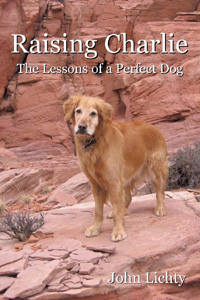 Raising Charlie: The Lessons of a Perfect Dog by John Lichty
Subscribe To

 Posts
All Comments
Posts
All Comments

Showing posts with label fiction. Show all posts
Showing posts with label fiction. Show all posts
Thursday, March 20, 2008

Wednesday, January 2, 2008
Peabody
In keeping with the season, here are the first two paragraphs of a fictional story I started writing a few years ago:
Peabody awoke to the sharp slap of the bartender's hand on the bar top. "Time to go!" the bartender shouted as Peabody lifted his muzzy head to regain his senses. It was closing time, and he had no idea how long he had been passed out. He slid off his stool but reached for the rail as his wobbly legs failed to support him. Images whirling in his vision coalesced into an exit sign above the bar’s door. He stumbled toward it and reached for the door to regain his balance, but the door swung open and he fell face-first into the slush covering the sidewalk outside. Peabody rolled onto his back and stared up into the flurry of snowflakes falling from the yellow sky. Winter, he thought, and exhaled a cloud of beer-soaked steam into the chill night air. More accurately, New Year's Eve, he remembered. Where are all the merrymakers, he wondered, turning his head from side to side to confirm that he was very much alone. He waved his wrist in front of his face to check his watch. It was two o'clock. Rolling back over and struggling to his feet, he brushed the snow off his clothes and staggered off into the night.
Peabody hadn't always been like this, a drunk alone for the holidays. In better times, he had been something of a success. He had always been bright, which is how he had earned the nickname "Peabody," after the smarter half of Peabody and Sherman, the cartoon duo from the old Rocky and Bullwinkle cartoons. The original Peabody was the talking dog who wore glasses and was always a step ahead of his boy sidekick Sherman in solving that episode’s mystery. The intelligence came with a price though, and Peabody didn't realize it until he had already graduated from college in the early 1980s.
Peabody awoke to the sharp slap of the bartender's hand on the bar top. "Time to go!" the bartender shouted as Peabody lifted his muzzy head to regain his senses. It was closing time, and he had no idea how long he had been passed out. He slid off his stool but reached for the rail as his wobbly legs failed to support him. Images whirling in his vision coalesced into an exit sign above the bar’s door. He stumbled toward it and reached for the door to regain his balance, but the door swung open and he fell face-first into the slush covering the sidewalk outside. Peabody rolled onto his back and stared up into the flurry of snowflakes falling from the yellow sky. Winter, he thought, and exhaled a cloud of beer-soaked steam into the chill night air. More accurately, New Year's Eve, he remembered. Where are all the merrymakers, he wondered, turning his head from side to side to confirm that he was very much alone. He waved his wrist in front of his face to check his watch. It was two o'clock. Rolling back over and struggling to his feet, he brushed the snow off his clothes and staggered off into the night.
Peabody hadn't always been like this, a drunk alone for the holidays. In better times, he had been something of a success. He had always been bright, which is how he had earned the nickname "Peabody," after the smarter half of Peabody and Sherman, the cartoon duo from the old Rocky and Bullwinkle cartoons. The original Peabody was the talking dog who wore glasses and was always a step ahead of his boy sidekick Sherman in solving that episode’s mystery. The intelligence came with a price though, and Peabody didn't realize it until he had already graduated from college in the early 1980s.
Subscribe to:
Posts (Atom)
