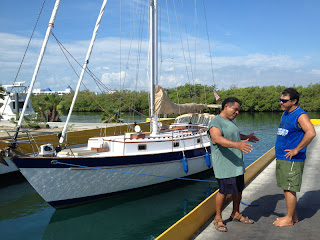
Last Thursday afternoon when we stopped at the boatyard, there were all kinds of work going on. Roberto was finishing up the skeg repair, his assistant was buffing out the touch-up paint on the cosmetic gelcoat repairs, and the boatyard men were applying the first coat of bottom paint to the hull. All assured us that the boat would be ready to go the next morning.
To be certain they hadn't missed anything, Nan and I walked slowly around the boat, looking closely at every surface. The first thing we noticed was that the white and blue paint that had looked like a near-perfect match when it was wet at the paint store was not so perfect when it dried. The white was a little too yellow, and the blue was a little too bright. From a distance you couldn't tell, but up close the margins were easy to distinguish. For what we paid, I can't complain. I would much rather look at slightly mismatched paint than at the scars where our Aries windvane was.
Early Friday morning, Nan and I walked to the boatyard instead of riding our folding bikes. Nazario met us there shortly afterward. The boat was already up in the lift when we arrived. The boatyard men were cleaning up the bottom of the keel before painting it and the patches where the supports were. When they were finished, the boat looked almost brand new, buffed and shiny above the waterline and deep black below.
A ladder was placed against the rail, and Nazario and I climbed aboard for the slow ride over to the haul-out basin. We used the time to rig up fenders and dock lines. Once we were afloat and the lifting straps were released, we tossed the lines and pulled the boat over to pick up Nan. I fired up the engine and backed us out into the channel, put the transmission into forward, and motored toward El Milagro Marina. Whispering Jesse felt good and right again.
This blog is an account of the pursuit of a dream, to sail around the world. It is named after the sailboat that will fulfill that dream one day, Whispering Jesse. If you share the dream, please join me and we'll take the journey together.
For Charlie and Scout
About Me
- John Lichty
- Savannah,
Georgia, USA
"Go confidently in the direction of your dreams. Live the life you have imagined." --Henry David Thoreau
Raising Charlie: The Lessons of a Perfect Dog by John Lichty
Blog Archive
Followers
Recommended Links
- ATN Sailing Equipment
- ActiveCaptain
- BoatU.S.
- Coconut Grove Sailing Club
- Doyle Sails - Fort Lauderdale
- El Milagro Marina
- John Kretschmer Sailing
- John Vigor's Blog
- Leap Notes
- Noonsite.com
- Notes From Paradise
- Pam Wall, Cruising Consultant
- Practical Sailor
- Project Bluesphere
- Sail Makai
- So Many Beaches
- Windfinder
Showing posts with label Puerto Isla Mujeres. Show all posts
Saturday, July 27, 2013
Sunday, July 21, 2013
Fiberglass repair and more
Roberto got right to work the next morning, Friday, arriving at the boatyard with a milk crate full of tools. Nan and I were waiting there to give him the second 1,000 pesos he had requested as a deposit. He thanked us and pulled out his rotary sander. We told him we would return later to see how it was going and pedaled away on our folding bikes.
When we returned, Roberto was at the entrance gate signing out with the security guard. He walked with us back to the boat and showed us how he had cleaned up all the ragged edges on the skeg shells and on the skeg itself. He told us he would be back on Saturday to begin the fiberglassing.
The photos show the progression of Roberto's fiberglass work on the skeg over the next few days. While we were at it, we also contracted with him to repair and paint the scars left by the removal of our old Aries windvane, as well as numerous hull scratches from past docking mishaps, for an additional 3,000 pesos.
This extra work required a trip over to Cancun the following Monday to visit a few different marine paint stores, but first we met Nazario at Nauticos Cancun, a marine supply store, to buy new zincs for the hull and propeller shaft. While we were
there, I noticed that a gallon of Pettit bottom paint was priced at 4,350 pesos. I did the conversion, and it worked out to $362.00! Nazario said it was so expensive because it was so heavy to ship from the United States. (A gallon of water weighs a little over eight pounds, but a gallon of bottom paint weighs at least twice that because of all the growth-inhibiting metals it contains.) We had worked out the details with the boatyard to have them paint the bottom after Roberto finished, but I didn't expect the necessary three gallons to cost over a thousand dollars. Nazario suggested that we use Mexican bottom paint instead and drove us over to Nervion Pinturas, which seemed an appropriate name as the fumes inside the store were enough to cause nerve damage.
We took three gallons of black Nervion bottom paint to the counter, along with three liters of solvent. Then Nazario went back and forth with the paint-mixing man in rapid Spanish to see about getting quarter-liters of touch-up paint, matched as closely as possible to the Awl Grip paint sample sheet I had brought along. Whispering Jesse's "Snow White" and "Royal Blue" were not easy matches, and it took several minutes for the man to mix close colors. Nan and I were getting headaches from the paint fumes by then and wondering why the large ventilation hood above the counter was not running at full blast.
With a trunk full of very heavy paint, Nazario drove us to the ferry dock for the ride back to Isla Mujeres. We thanked him profusely for his help and offered him money to at least pay for his gas, but he would not take it. He is a very good man and we appreciate him tremendously.
Labels:
Puerto Isla Mujeres,
Valiant 40,
Whispering Jesse
Saturday, July 13, 2013
Haul-out
We were finally able to coordinate getting the boat hauled out and the fiberglass repair on our damaged skeg started. It took scheduling the lift at the boatyard, finding a reliable fiberglass repair person, and locating lodging for the duration of the work. It all came together for us on Thursday morning, thanks in large part to the friends we have made here in Isla Mujeres.Nazario, the captain of Ditty Wah, the beautiful sport fishing boat in the slip next to Whispering Jesse, speaks excellent English. He also knows Louis Fernando, the boatyard manager at Puerto Isla Mujeres, and he contacted him on our behalf to get an estimate on the haul-out.
Teresa and Louis, who own the Color de Verano apartments where we have stayed many times, have used Roberto, a fiberglass expert from Cancun, for work on their own sailboat. Roberto speaks no English, but Teresa contacted him for us and set up an appointment for him to meet us at the boatyard on Thursday afternoon.Eric, the owner of El Milagro Marina, let us apply a trade that we had worked out for a magazine article I am writing about the marina to lodging in one of his studio units. We needed a place to stay because the boatyard does not permit people to live aboard their boats while they are there being worked on.
Early yesterday morning, Nan and I packed up the clothing, computers and other items we would need and put them in the marina's office for safekeeping until we could check in to the studio in the afternoon. We removed the awning, hatch-mounted air conditioner, and other equipment from the deck and prepared for departure. Nazario and Felix, the marina's resident handyman, showed up on the pier just before nine o'clock to assist with the dock lines. I fired up the engine and we shoved off, motoring very slowly toward Puerto Isla Mujeres, located on the channel that connects Isla Mujeres's bay to Laguna Makax.
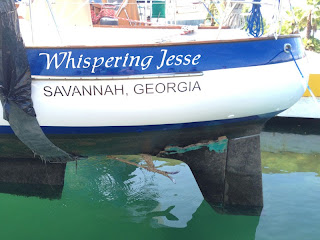
We were met by two boatyard workers at the haul-out basin, and a third drove the lift over. Nazario jumped in the water to ensure that the slings were placed correctly under the hull, and then Whispering Jesse was slowly on her way up and out of the water. There was a round of exclamations as the damaged skeg came into view. The broken skeg shells remained in place, even after the hull was power washed, but they were hanging on only where they joined the bottom of the rudder.Roberto had agreed to see us at one o'clock, and Nazario was kind enough to return to the boatyard to speak with him for us. While the two spoke in rapid Spanish, Roberto evaluated the damage, pulled a hammer and chisel out of his tool bag, and pounded a horizontal crease into the bottom of each skeg shell. He then levered them both off, exposing the raw structural fiberglass beneath. We had not even discussed a price yet, but there was no turning back now.
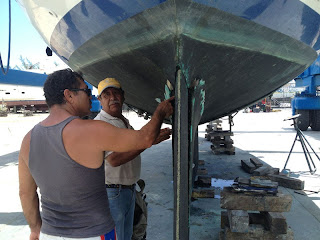
Roberto made some mental calculations and then spoke rapidly with Nazario again. Nazario pointed at the skeg and asked several questions, then turned to Nan and me and said that Roberto would fix the skeg for 9,000 pesos. I pulled out my iPhone to do the monetary conversion using the calculator app. It worked out to about $750, which seemed like a very good deal. We shook hands on it. Roberto then requested 2,000 pesos in advance, but we had only 1,000 with us. We promised to return with the difference the next morning, when he would begin the work.
Nan and I pedaled back to El Milagro on our folding bikes confident that we were in good hands with Roberto. We thanked Nazario and Felix profusely and gave them gifts of beer and cash to let them know how much we appreciated their help.
Subscribe to:
Posts (Atom)