Wednesday, February 27, 2013

Weather Fax

Sample NOAA radiofax / weather fax image
One of the capabilities I have wanted for the boat is the ability to receive weather faxes while out at sea. When I first started looking into it, I was under the impression that it required an expensive single side band (SSB) radio, like what licensed amateur radio operators use. But while searching the Internet one day, I found a British website that advertised a weather fax package consisting of a Grundig shortwave/SSB radio and a software application called Mscan Meteo. The idea was to run a simple audio cable between the radio's headphone jack and a computer's microphone jack, tune the radio to a weather fax frequency, and then watch as the software draws a weather map right on your computer screen. What could be easier and less expensive than that?

I didn't want to place an overseas order or deal with the Euro exchange rate, so I started looking to see what was available closer to home. I went to the Mscan website (mscan.com) and downloaded a trial version of the Meteo Pro software to my laptop. There's not much to look at without a radio signal, though, so I shopped for the shortwave/SSB radio mentioned in the British website, the Grundig G3 Globe Traveler. I found it for sale on the Landfall Navigation website (landfallnavigation.com), where I had recently purchased a courtesy flag, but a nice person there informed me that the radio had been discontinued. Thinking there must be a few still unsold somewhere, I found one at Amazon.com for $99.99, well below the $150.00 retail price. When it arrived, I put the whole package together, using an audio cable I already had, and started experimenting.

Unregistered Mscan Meteo weather fax image
I tuned to the American frequencies I found in Meteo's help screen and discovered that the weather maps they offer focus on different coastal areas depending on the signal's origin: Boston for the North Atlantic; New Orleans for the Caribbean; and Point Reyes for the Pacific. I focused on the New Orleans signals because the Caribbean is my area of sailing interest. With a little fine tuning of both the radio and the software, I was able to get a weather fax to draw on the screen, but then a banner appeared informing me that I was using an unregistered version of the software. It made the weather fax almost unreadable. I checked to see what it would cost to register the software: $239.00! Back to the Internet, where I found a shareware program called SeaTTY that serves the same basic function for a $35.00 registration fee and does not block its weather faxes with banners to encourage registration.

Tuning in the New Orleans frequencies from western Colorado has not been easy. The signals are not very clean, so the weather faxes are also not very clean. I imagine that if I was closer to the point of origin, I would get a much better result, something closer in quality to the weather fax at the top of this post, which was taken from NOAA's radiofax page (weather.noaa.gov/fax/gulf.shtml). When I head out to Savannah for another round of boat projects at the end of this week, I will take the whole weather fax kit with me to see how it does in a place where it could be really useful. More on that later...

Monday, February 4, 2013

The Man in the Moon

The full moon rising over a distant Mt. Garfield
One of my oldest memories is one I revisit frequently, whenever I look up at the night sky and see a full moon. I was reminded of it again this past Monday, as I watched the full moon rise from the window of a jet flying to Cincinnati for a business training.

It must be the summer of 1961. I have just turned three. My little brother Stuart, my baby sister Jane and I are finishing bowls of ice cream at Grandpa and Grandma Lichty's house in Bloomfield, Iowa. My other sister, Susan, is not yet born. We kids are alone at the kitchen table with Grandpa, Jane in a high chair. Grandpa gets up from the table, collects our bowls and spoons, and walks them over to the sink. As he washes them, he looks out the kitchen window and sees the full moon. He calls me over and points. "Do you know what that is, John?" I follow his finger, raise one of my own, smile that I do know, and say, "The moon!" He smiles back. "Can you see the man in the moon?" I look hard at the bright, blue-gray shapes and try in my imagination to make them look like a face. I don't see it. I see a marble, like the ones Grandpa is teaching me to shoot, but I don't say so. He senses my frustration, puts his hand on my shoulder and pats it. "Keep trying. You'll see it."

All these years later, I still look hard at the full moon, willing the shapes to resemble a face, but they never do.

Sunday, January 27, 2013

Fair-Weather Skier

Skiing 'Ozone' in the Bowl at Aspen Highlands
During a normal ski season, we would be enjoying the best snow of the year right now. The cold, dry conditions of late January and early February typically produce the light, fluffy snow that is perfect for skiing. Not this year. Western Colorado is just coming out of a solid month of single-digit temperatures, crystal-clear skies, and no wind. A temperature inversion had settled in and then refused to leave, preventing any new snow from falling and making skiers miserable.

I have skied only twice this season, and not once since December 30. I can't remember an entire January passing by without going skiing at least once since I started skiing forty-five years ago, at the age of ten. It occurs to me that I have become what is known as a "fair-weather skier." This is not necessarily a bad thing. One of the reasons I moved to Colorado from Wisconsin back in 1986 was so I could pick and choose my ski days, not be stuck with whatever conditions existed during annual week-long ski trips out west. My buddies and I would ski some of the most terrible conditions you could imagine, because that is what there was. Also, growing up skiing on Wisconsin's icy runs, we really didn't know any better.

Living in Colorado spoils a skier quickly. Now I won't go skiing unless the weather is good and the snow conditions are decent, even though I live less than an hour away from Powderhorn ski area. It's no fun to freeze your butt off on slow chairlifts to ski rock-hard, month-old snow. Why bother? But our frigid drought ended this weekend. While it was raining non-stop down in town yesterday, it was snowing hard up in the mountains. I just checked Powderhorn's snow report, and it showed seven new inches. Today would have been a great ski day, but there were things that needed doing. I'll just have to wait until next weekend to get up there. I may get to pick and choose my ski days now, but work still limits those choices to weekends only.

A note about the photo above: It's a picture of me skiing "Ozone" in the Bowl at Aspen Highlands, taken by my friend Dave Johns on March 8, 2003, almost ten years ago. The reason you can't see anything but blue sky behind me is that the run is so steep that the camera is pointed up at an angle of almost 45 degrees.

Tuesday, January 22, 2013

"Becoming van Gogh"

"Self-Portrait with Straw Hat" by Vincent van Gogh, 1887
Last weekend, Nan and I were in Denver to celebrate her birthday by attending the "Becoming van Gogh" exhibit at the Denver Art Museum. Curator Timothy Standring had brought together seventy different works by Vincent van Gogh, along with twenty works by his inspirational contemporaries, to chronicle van Gogh's rapid artistic development over his brief ten-year career, before his untimely death at age thirty-seven. The works were displayed in roughly chronological order, with van Gogh's hanging next to those of his post-impressionist associates. The differences were startling.

Early in his career, following a failed stint as a missionary in Belgium, van Gogh's efforts to depict the people and places of that region look crude and dark compared to the beautifully detailed and brightly colored work created by other artists of that time. Apparently, van Gogh recognized his shortcomings and undertook a nineteenth-century do-it-yourself drawing course, copying the illustrations in his course book over and over again until he was satisfied. What he lacked in early talent, he made up in devotion to his craft and clear-eyed self-evaluation, aided through his frequent correspondence with his older brother Theo, a Paris art dealer.

As Nan and I shuffled slowly through the over-crowded exhibit hall, dutifully listening to our audio players in front of painting after painting, we witnessed a remarkable transformation. Van Gogh was experimenting with every style he encountered, from Seurat's pointillistic brushwork to Japanese solid-color backgrounds, trying them on for size and then incorporating the best of what he discovered into his own artistic sensibility. He began to use "vibrating" complementary colors with varied brush strokes and achieved stunning results from subjects as simple as a bowl of oranges against a blue background.

At this point in the exhibit, the works hanging next to van Gogh's began to lose their luster compared to what he was able to achieve. I stood looking at his 1887 painting, "Grapes, Lemons, Pears and Apples", for several minutes, wondering at the shadow effects which give the impression of the fruit lifting off its abstract white background. I couldn't help but think, this is not how a normal person would paint this still-life. The effect of the concentric brushstrokes and the liberal use of white highlighting were almost psychedelic. Vincent was losing it, I thought.

But just two years later, he would paint "The Starry Night", which many, myself included, consider one of the greatest paintings of all time. Whatever mental or emotional troubles he may have had, van Gogh was able to command his faculties to channel his vision of the world into works we will love and admire forever.

Sunday, January 6, 2013

Gangplank

Nan is back in Wisconsin visiting family, so I spent the weekend in our freezing garage working on a gangplank for our sailboat, Whispering Jesse. It's based on an idea I've had about how to get our dog Scout up and down the steep companionway steps, and in and out of the water when we're at anchor. The gangplank, when not being used in the traditional manner to bridge the gap between the boat and a marina dock, would serve extra duty as a ramp into the cabin and, with floats attached to the end, as a ramp into the water. It's sized at 6'7" so that it can be secured in front of the port-side settee when not in use.

Several weeks ago, I found a good-quality pressure-treated 2x12 at Home Depot. A contractor friend cut it to the required length and then I let it season in the garage. Yesterday I used a vibration sander to remove any rough edges and smooth all the corners. I cut four lengths of cedar 1x2 using a mitre board to give the ends 45-degree angles and then fastened them 3 inches from each end on both sides using 2-inch stainless steel screws. They will act as friction reducers to save wear and tear on the heavy-duty non-skid tape and floating lines that will be attached after the wood is sealed with several coats of Cetol. But the sealing will need to wait until the temperature in the garage gets above 50 degrees, at least 20 degrees above where it is now.

Next, I drilled 5/8" holes 1-1/2'' from each corner for the floating lines, which are 4-foot lengths of Samson 3/8" Floatine multi-filament polypropylene. As a final touch, I wood-burned our boat's initials, "WJ", on one side at each end so there's no question about whose boat the gangplank goes with.

Tuesday, December 25, 2012

Christmas Letter 2012

Christmas Card 2012 from John, Nan and Scout

Christmas 2012

Dear Family and Friends,

Last year at this time, we were facing the prospect of a non-white Christmas, and winter continued mostly snowless, for one of the worst ski seasons in memory. This year looks to be more promising: we have had two pretty good snowfalls already. As a neighbor said to Nan and me as we walked Scout past his house this morning following last night’s accumulation, “It’s good to see the wet.”
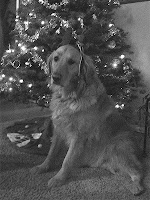
Scout with antlers in front of our Christmas treeAfter the season’s first snowfall last weekend, Nan and I ventured up icy roads to the Colorado National Monument for this year’s card photo. Scout couldn’t join us because dogs are not allowed, so we dressed him up in antlers for the letter photo instead. Yes, that is a cane in Nan’s right hand. She underwent bilateral hip replacement surgery on October 26 and has been making a remarkable recovery. Osteoarthritis and thirty-five years of running had used up all her cartilage, leaving her in constant pain. She should not run anymore, but she may now look forward to a future of other activities, like swimming and cycling, free of hip pain. We owe a huge debt of gratitude to Nan’s sister Monica for her tireless, hands-on assistance in the weeks following Nan’s surgery.

The year started for us in Isla Mujeres, Mexico, where we celebrated New Year’s Eve with local friends at the island’s all-night fiesta. We have vacationed there almost a dozen times now, but this was our first winter trip. It was chilly and windy, definitely not beach weather, and we were happy to have brought our fleece jackets. We went back again in September for a week of perfect weather, lazing on the beach, finding new things to see and do, and checking out the island’s many marinas for a future sailing trip from Savannah. Our friends Mike and Erika from Aspen joined us for a day from their vacation in Playa del Carmen, and we saw all the sights from a rented golf cart.

In April, my family held a reunion of sorts in Savannah. Mom and Dad hosted sister Jane, her husband Josh, their twins Max and Ben, sister Susan, Nan and me for golf, downtown tours, Tybee Island beach time and long, memorable dinners. Missing were Susan’s husband John, their kids Kirsten and Peter, and brother Stuart and his girlfriend Mayumi. Stuart has not visited the mainland from Hawaii for at least five years, but we’re all hoping to visit him there sometime, maybe for Dad’s eightieth birthday in June.

Nan enjoyed a few quick trips home to Manitowoc this year for family time with her mother, her sister Amy, and other members of the Mullins clan. In May, she helped celebrate her mother’s eighty-ninth birthday and sister Monica’s fiftieth.

Summer in Grand Junction was the hottest on record, with many days above a hundred degrees. Even with his cool “puppy cut,” Scout refused his afternoon walks after scorching his paws on the hot asphalt. Nan and I braved the heat most weekends for bad golf at our local public courses, and I finally hit a hole in one after fifty years of trying, witnessed officially by Nan and our friends Kevin and Lesley.

After many years of writing these Christmas letters, I regret to tell you that this is the last one we will be printing and mailing. Like Newsweek magazine, we are going completely digital in the New Year. If we have your email address, we will send you an electronic version at this time next year. If not, please look for the letter on my blog at whisperingjesse.blogspot.com. In case you don’t already have them, our email addresses are johnallenlichty@gmail.com and nanlichty@hotmail.com.

Wishing you and yours a wonderful, wet holiday season and a peaceful, prosperous New Year!

Love,


Monday, December 24, 2012

The Shins at Belly Up in Aspen

Poster outside Belly Up in Aspen for the Shins show on December 14, 2012
Nan and I were up in Aspen last weekend to see the Shins play at the Belly Up nightclub. I have been a fan of their distinctive music since I first heard "New Slang" on the soundtrack of the 2004 movie, "Garden State", starring Zach Braff and Natalie Portman. Over the next several months, I listened to the band's first two albums, "Oh, Inverted World" and "Chutes Too Narrow" almost non-stop.

Two years later, in 2006, my sister Jane and I traveled to Chicago from an August family reunion in Milwaukee to see the Shins play at Lollapalooza in Grant Park. It was heartwarming to see tens of thousands of other fans as crazy about the band as I was, and we were all treated to new songs off their then-upcoming album, "Wincing the Night Away".

The Shins didn't put out another album for several years after that. Band leader James Mercer, partnering with Danger Mouse as Broken Bells, released an excellent self-titled album in 2010, and I assumed that the Shins were no more. But then earlier this year, I saw that the Shins would be the musical guests on the March 11 broadcast of Saturday Night Live. I tuned in and was surprised to see James Mercer surrounded by an all-new band. The distinctive sound was still there, though, and I was impressed enough by the songs they performed to get their new album, "Port of Morrow".

The Shins in concert at Belly Up in Aspen on December 14, 2012
The band line-up in the poster outside Belly Up looked the same as the one from SNL, but when the band took the stage, guitarist/vocalist Jessica Dobson was not with the band. There was very little patter between songs, and no explanations were offered. My impression was that James Mercer is the Shins regardless of who is playing with him, and this was made evident by the line-up that night playing a wide variety of Shins songs from the entire repertoire rather than simply focusing on songs off the new album. It was a show to promote the Shins, not just "Port of Morrow".

The music that night is a blur for me now, just a continuous stream of songs I know by heart, punctuated by favorites "New Slang", "Sleeping Lessons", and the final encore song, "One by One All Day", which I found myself singing for days afterward.

Go see the Shins if you ever get a chance. As Zach Braff's character Andrew says to Natalie Portman's Sam as he slips the headphones over her head, "You gotta hear this one song. It'll change your life, I swear."

Wednesday, December 12, 2012

Failure is not an option


"Failure is not an option" Apollo 13 postcard
Where I work, we have a postcard on the wall of the conference room that was sent to us from the Kennedy Space Center by an employee's husband a few years ago. It shows the Apollo 13 mission patch next to the mission motto, "Failure is not an option." The postcard hangs as a reminder that our work is important, that we must not fail. But more often, when I look at it, as I do frequently during long meetings, I think of the Apollo 13 astronauts, James Lovell, Jack Swigert and Fred Haise, and how close we came to losing them back in April 1970 after an explosion aboard their spacecraft.

When the motto was decided on, the people at NASA must have been thinking specifically of the importance of the mission's success as only the third manned trip to the moon. They could not have foreseen that the motto would take on an entirely different meaning: Failure to bring the astronauts home alive is not an option.

The tremendous effort and ingenuity that went into saving the astronauts' lives are an inspiration to me every day that virtually anything is possible if we set our minds to it.

Now it's back to work...

Thursday, December 6, 2012

John's Chili Recipe

Back in the early 1980s, I found a chili recipe in the "Good Morning!" section of the Milwaukee Sentinel newspaper that was so easy to follow that even I, a cooking-challenged bachelor at the time, could not screw it up. Over the years, I have modified it, adding some ingredients, like jalapeno peppers, and leaving out others, like the twelve-ounce can of American beer called for in the original recipe, until I think my chili is pretty darn good and plenty hot:

Ingredients:

1 standard size package of lean ground beef (or a finely cubed sirloin steak if you like Texas style)
1 large white or yellow onion
1 large green pepper
12 fresh jalapeno peppers (or fewer if you don't like your chili too hot)
4 plum tomatoes
1 15-oz. can of Hunt’s Tomato Sauce
2 8-oz. cans of Mexican pre-cooked pinto beans (or equivalent reconstituted dry pinto beans)
2 tablespoons olive oil
1 teaspoon garlic flakes (or chopped fresh garlic)
1 tablespoon cumin
1 tablespoon paprika
½ 4.5-oz. container of chili powder (McCormick or other)

Directions:

1.  Finely dice the onion, green pepper and jalapeno peppers. Be sure to remove the seeds and insides of the peppers. Use a spoon with the jalapeno peppers to avoid acid burns!
2.   In a large stew pot on medium heat, pour in the olive oil and sprinkle in the garlic. Sautee for a few minutes.
3.   Turn heat up to medium high. Add in the ground beef and then use a wooden spoon to chop it up finely and mix it in with the olive oil and garlic. Add salt and pepper if desired.
4.   When the ground beef begins to brown, add in the onions. Sautee until the onions start to become clear and the ground beef is completely browned.
5.   Turn the heat back down to medium. Add in the green pepper and jalapeno peppers. Mix thoroughly. Cover pot and let simmer while next contents are prepared.
6.   Dice the tomatoes. Drain and rinse the canned pinto beans.
7.   Stir the pot thoroughly and add in the tomatoes.
8.   Stir thoroughly and add in the tomato sauce.
9.   Stir thoroughly and add in the pinto beans.
10. Stir thoroughly and then cover for 10-15 minutes.
11. Slowly blend in cumin, paprika and chili powder.
12. Turn heat to simmer and let chili simmer for at least one hour, stirring occasionally.
13. Turn off heat and serve, or let chili cool to room temperature and then refrigerate for later.

The beans absorb the flavors and the peppers mellow a little over time, so the chili is best served a day or so after preparation. It microwaves well and is really good served with flour tortillas, shredded cheese and sour cream. Enjoy!

Thursday, November 29, 2012

Savannah: long list, little accomplished

Aries windvane on the stern of Whispering JesseSaturday, November 24: It's the fourth day of my trip out to Savannah and I'm not overly happy with what I've been able to get accomplished on my long list of boat projects. Of course, the list is overly ambitious and would realistically take a few weeks to complete, not the five days I have had available. And I don't want to leave any projects half-done. So when I stare at the Aries windvane bolted to the stern of the boat and try to figure out what it will take to remove it, the clock inside my head goes tick-tick-tick and I realize it will take more time than I have on this trip, especially if I try to remove the lag bolts secured through the hull. That would involve emptying out both lazarettes and squeezing down in there with a headlamp and some beefy wrenches. Instead, I work backward toward the windvane, removing the steering drum that was attached to the wheel and the numerous blocks that guided the lines between the windvane and the wheel. It's not much, but it's something.

Gluing the mitered teak molding pieces together
Before I undertook anything related to the windvane removal, I tried to repair a disconnected cockpit scupper using the part I had ordered from Defender Marine Outfitters. I lucked out with guessing the correctly sized plastic elbow fitting for the 1.5-inch scupper drain, but I still couldn't get it to fit. Either the thread spacing is wrong or the drain threads are stripped, which would explain why the previous fitting was only glued in place. I expect that I will end up gluing the new one in place, but I'll wait on that until I'm ready to use up an entire tube of 3M 5200 marine adhesive on this and other applications, since the whole tube will start to set up as soon as it is exposed to air.

My greatest success has been with constructing teak frames for the cockpit cut-outs. I spent a good part of yesterday afternoon using a mitre saw to cut L-shaped molding pieces to fit, and then some time this morning gluing the pieces together. I will need to fasten some small screws as well, but the glue should hold for that process.

Cockpit cut-outs where the new teak frames will goThe molding was part of an order I placed through the West Marine website a couple of weeks ago. West Marine offers free shipping to their stores for in-person pickup, which worked even better for me than drop shipping to my folks' house. While I was at the store on Abercorn Street, I noticed that the Garmin GPSMAP 740s Chartplotter/Sounder was on sale for $400 below list price. I had to think about it for two days, but I couldn't pass up a deal like that on a necessary piece of equipment and went back to buy the last one in stock, along with an external antenna. The installation looks tricky, so I'll wait and have Thunderbolt Marine do it when I return in the spring.

Tomorrow, I'll see if the teak frames fit, take some measurements for some other projects, see if the engine will start and stay cool, and then prepare the boat to be left alone for another winter.