Thursday, August 24, 2006

Life without Television

Click this thumbnail for a full-size version of "Flowers for Trinitron"
For the past two months, Nan and I have been without TV. The neighbors next door to the house we are renting in Basalt had some excavation work done around their foundation back in June. In the process, our cable was cut, or more likely it was just disconnected since I finally traced the cable back to its end and there was still a muddy connector attached. It turns out it was not a legitimate hook-up, which meant there was no calling the cable company to get it reconnected. We stewed about this for quite a while, partly not wanting to pay for something we had been getting for free and partly out of fear that there would be repercussions if we called the cable company to order new service.

For the first couple of days, we would turn on the TV periodically to see if by some miracle the service was back on, but all we ever got was a blue screen. We didn't miss it in the mornings when we normally listen to NPR on the radio, but there was a definite void in the evenings. Fortunately, it was the summer rerun season, so we weren't missing much. Still it would have been nice to watch the news or a sports event or an HBO movie once in a while. Instead we would read both Aspen daily newspapers, follow sports on the Internet, and watch DVDs on my laptop. Nan spent more time emailing family and friends, and I spent more time practicing guitar. We went to bed earlier and felt better rested and more productive at work.

It occurred to me after a couple of weeks that we were living Ruben Bolling's "Flowers for Trinitron" existence, based on one of his old Tom the Dancing Bug cartoons. Hopefully, we won't see it through to its logical conclusion and return to our previous viewing habits, even though we recently gritted our teeth and ordered new cable service--without threat of arrest!--in time for football season. Go Packers!

Thursday, July 13, 2006

Gore 2008: Save the Planet!

Last night Nan and I saw An Inconvenient Truth, Al Gore's documentary film about global warming. It was an eye-opener. I had been lukewarm to the idea of global warming for some time, especially since reading Michael Crichton's book, State of Fear, in which he presents scientific evidence in a fictional context to show that global warming is part of a natural cycle perhaps somewhat enhanced by human activity.

Al Gore blows the top off that idea in the first few minutes with his graphs showing the cycles of carbon dioxide in the atmosphere over the last fifty years. The growth is exponential. Then he goes on to show the potential future consequences of having this much carbon dioxide in the atmosphere. It is not a world we would want to live in: flooded coastlines, summer temperatures consistently over one hundred degrees, even more devastating hurricanes and cyclones, accelerated desertification, political unrest, and natural disasters claiming millions of lives.

The critics are saying that everyone should see this movie, and I agree. If you have an open mind, it will change the way you think about the earth and our future on it. The problem of global warming makes the war on terror seem inconsequential by comparison. Personally, I think Al Gore should run for president in 2008 on the platform of instituting the steps necessary to minimize the impacts of global warming. Anyone who has seen An Inconvenient Truth would have his vote.

Here is the text of a hand-out I picked up in the movie theater lobby:

Ten Things To Do

Want to do something to help stop global warming? Here are 10 simple things you can do and how much carbon dioxide you'll save doing them.

Change a light
Replacing one regular light bulb with a compact fluorescent light bulb will save 150 pounds of carbon dioxide a year.

Drive less
Walk, bike, carpool or take mass transit more often. You'll save one pound of carbon dioxide for every mile you don't drive!

Recycle more
You can save 2,400 pounds of carbon dioxide per year by recycling just half of your household waste.

Check your tires
Keeping your tires inflated properly can improve gas mileage by more than 3%. Every gallon of gasoline saved keeps 20 pounds of carbon dioxide out of the atmosphere!

Use less hot water
It takes a lot of energy to heat water. Use less hot water by installing a low flow showerhead (350 pounds of CO2 saved per year) and washing your clothes in cold or warm water (500 pounds saved per year).

Avoid products with a lot of packaging
You can save 1,200 pounds of carbon dioxide if you cut down your garbage by 10%.

Adjust your thermostat
Moving your thermostat down just 2 degrees in winter and up 2 degrees in summer could save about 2,000 pounds of carbon dioxide a year.

Plant a tree
A single tree will absorb one ton of carbon dioxide over its lifetime.

Be a part of the solution
Learn more and get active at ClimateCrisis.net.

Spread the word! Encourage your friends to see An Inconvenient Truth

Wednesday, July 5, 2006

How much is enough?

I work at Aspen Valley Hospital, where Ken Lay was pronounced dead earlier today. The media, which were already in town to cover the Aspen Ideas Festival, descended on the hospital in force. Wolf Blitzer from CNN was seen in the lobby. TV-station vans and cameras surrounded the building.

At one point early in the day, my duties took me past the morgue. I stopped and stared at the door, wondering if he was still in there, but I didn't dare check to see if it was locked. Instead I thought of the man behind the door and what his life must have been like.

At the peak of his career, Ken Lay was a very wealthy man. It was common knowledge that he owned four multi-million dollar houses in Aspen. This boggles my mind. Any one of the houses was big enough to put up the extended Lay family and several guests. So what were the other three for? To house staff? If so, the man was living large, extremely large. And I think that is what got him into the financial mess he ended up in, the one which ultimately contributed to his early death. When you're living the way he did, the money has got to flow at a tremendous rate just to maintain equilibrium. If that balance is upset and the money suddenly stops, what do you do? If you're Ken Lay, you don't scale back; you figure out ways, many of them fraudulent and illegal, to keep it all going until the inevitable crash.

What may have started out as simple greed grew over the years into something that was well beyond Ken Lay's control. I believe this is a common occurrence in modern society, where the gulf between the wealthy and the poor is every-widening. If you reach a point in your life where you have so much stuff and such a complicated life that you need to hire full-time staff to maintain it and organize it for you, then you are living too large. It is time to step back, realize how lucky you are, and start simplifying your life before it consumes you. It's too late for Ken Lay. May his life and death be a lesson to others.

Sunday, May 21, 2006

Latitudes & Attitudes

I have read various sailing magazines, like Cruising World and Sail, over the years, but I never subscribed to one until I discovered Latitudes & Attitudes. The other mags were a little hoity-toity, with their emphasis on super-expensive racing yachts and the promotion of an ultra-rich lifestyle I knew I would never be a part of. But Lats & Atts is the sailing magazine for the rest of us, the people who dream of cashing in our workaday lives for a used, fixer-upper sailboat and adventure on the high seas.

It has been a few years, but I think I was surfing the Internet when I found the Latitudes & Attitudes website (latsandatts.net), which offers a free trial issue right on the front page. The rest of the website contained just the kind of sailing information I was looking for, so I requested my free trial issue. I read it from cover to cover, gleaning useful sailing tips and smiling at the mishap stories. I became an immediate fan of the regular columnists, Bob Bitchin, who is also the publisher, Tania Aebi, who is the first American woman to sail around the world alone (at age seventeen!), and Captain Woody, who I relate to most closely, a guy who just wants to be out there sailing as much as possible.

Most of the other articles in Latitudes & Attitudes are submitted by readers just like me. So after Nan's and my ill-fated sailing adventure in the British Virgin Islands two years ago, I thought I would write an article and submit it with some pictures to see if I could get it published. The result was "Where's the Dinghy?", which I serialized here in the Whispering Jesse weblog (2005-04-01 whisperingjesse archive, scroll to the bottom of the page). I sent it off to Lats & Atts on a CD-ROM last August and waited for their reply.

A month went by with no response, so I sent an email inquiry. Editor Sue emailed back that she hadn't had time to read it yet because she was under deadline for their biggest issue of the year. A few days later, Editor Sue emailed me again that she had read my article and enjoyed it but that it was too long and the pictures were too small and too low-resolution. She invited me to trim it down to 1500-2000 words, redo the pictures and resubmit it for possible publication. She finished her message with, "We do appreciate the time you've taken and hope to hear from you again."

I was encouraged, so I started editing the article with the idea of making it more concise, but it's difficult to condense more than 7000 words down to just 2000 without some drastic cuts. I tried to tighten up some of the narrative and managed to get it down to about 6000 words, way short of the goal. My sister Jane is a freelance editor, so I emailed her a copy and let her work her magic with it. It came back heavily marked up, which was a bit of a blow to my writing ego, but when I talked with her about it, she said her goal was not to criticize my writing but rather to make the article shorter. She had marked whole paragraphs as probably not necessary, so I used that idea to eliminate complete sections, like the crazy night at the Bomba Shack and the explanation of how we freed ourselves from a tangled anchor line. It's now just under 4000 words and I'm afraid it would become almost a Cliff Notes version of the original if I kept hacking away at it, so I think I'm going to let it go for now.

Nan and I are planning another sailing trip for next May, to the BVI again with maybe a side trip to Anegada. If we have a "less complicated" adventure than last time, maybe I could write an article that captures everything in 1500-2000 words right from the outset and see if Latitudes & Attitudes would publish it. I'll keep you posted.

Saturday, May 13, 2006

The Nature of What's Funny

Two weeks ago, Stephen Colbert roasted George W. Bush at the White House Correspondents' Dinner. (Click here to see the video on Google Video.) In the guise of his Comedy Central "Colbert Report" character, he took sharply critical potshots at Bush, the press and just about everything else. The thing that made it so outrageous was that Bush was sitting just a few feet away with his wife Laura watching the whole thing, at first with an expression of mild amusement and later in a condition of frozen-faced discomfort.

Since it first aired live on C-SPAN, the video has been watched by thousands on the Internet, myself included. I have read many of the articles and blog entries that followed, and I have some observations:

The first is that I can't believe this hasn't been more widely publicized. It's as though the embarrassment felt by the press at some of Colbert's remarks caused them to ignore this obviously newsworthy event, remarks such as: "Write that novel you got kicking around in your head, you know, the one about the intrepid Washington reporter with the courage to stand up to the administration. You know, fiction!"

The second is that many of the more conservative blogs have criticized Colbert's roasting of Bush as "not funny." Huh? I thought it was hysterical, mostly because it was so surprising and harsh. The nature of what's funny is always relative. If Colbert's remarks cut a little too close to the bone for some, then I understand why they would think it wasn't funny. But that doesn't lessen the impact or automatically dismiss those who applaud Colbert for having the guts to make light of what many consider a seriously flawed administration and the fawning press that covers it.

One of my favorite jokes goes, "How many feminists does it take to screw in a light bulb?" The stock punchline is "That's not funny." Once when I told it in mixed company, a woman didn't wait for the punchline before saying, "I'm offended by that." I burst out laughing because that's an even better punchline than the original. The point is that people need to get over themselves, to stop taking everything so seriously that they can't find the humor in everyday life. It's like Dennis Miller once said on his Friday night HBO show several years back, before he went over to the conservative side: "You can't tell me that when the tall magi smacked his forehead on the cross-beam while entering the manger that Joseph didn't take his mind off wondering who had impregnated his wife for just a second and laugh his little carpenter's ass off."

Monday, March 27, 2006

Old Dog, New Tricks

Best powder day of the season,
Sunday, March 12
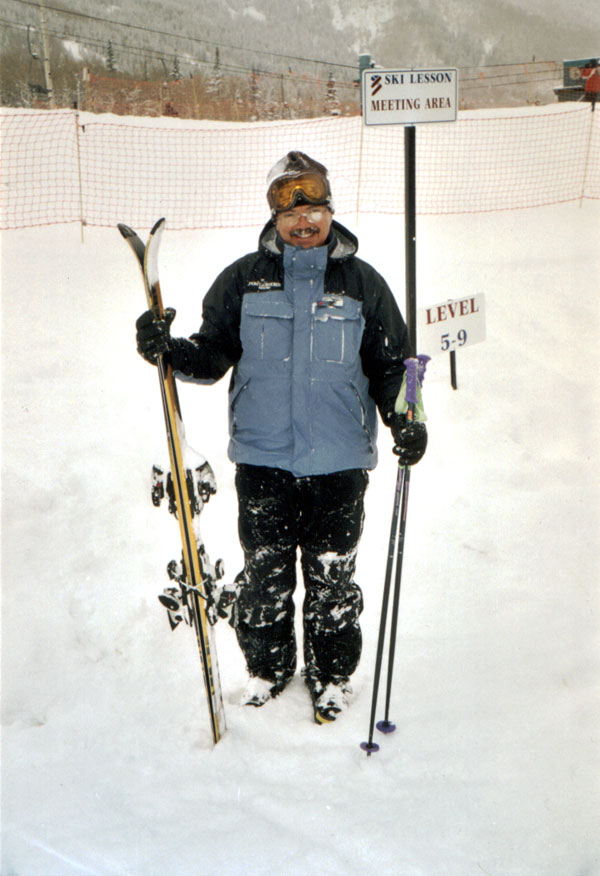
When Nan and I first moved to Aspen almost twenty years ago, her first job was working at a hotel at the base of Buttermilk Mountain. After finishing work at my computer job in town, I would wait at the hotel's bar for Nan to get off work. Most of the bar crowd at that time of day was the après-ski crowd, winding down from a day on the slopes. One afternoon, as I was nursing a beer, a young lady on the other side of the U-shaped bar yelled across to me, "Hey, this guy says ski instructors are the best skiers. Is that true?" I immediately determined that the guy in question was wearing a ski instructor's uniform and that he was using the line in an attempt to pick up the young lady. Without thinking, I shot back, "Yeah, they're the strongest intermediates out there!"

As a long-time skier, my attitude has always been that ski instructors make pretty turns on groomed runs but can't ski the tough stuff. All that changed for me this ski season when I became a ski instructor myself. The business I had moved to Grand Junction to open last January never really took off, so by October I was looking for something else to do. I was also thinking ahead to the ski season and wondering if nearby Powderhorn Resort would fill the bill for me after twenty years of skiing in Aspen. I checked powderhorn.com for a trail map and ski pass rates, and noticed that the ski school was hiring. I thought, why not give it a try? It couldn't possibly be as competitive as Aspen, so I was pretty sure they would take me. And Nan said it was fine with her, so I applied.

I had no idea how the training would be structured. I thought I could just go in and say something like, "I've been skiing for thirty-seven years and I'd like to teach skiers who are looking for a breakthrough in skiing moguls, steeps or powder." I quickly found out that this is not how it works. Everyone starts at the bottom, teaching "never evers," people who have never ever skied before. If I stuck it out, I might be teaching breakthroughs in about three years!

We new applicants spent an evening session finding out what it's all about and then an all-day session learning about the movements involved in skiing, people's learning styles, and the progression that turns them into safe, competent skiers. All this took place before we ever hit the snow. On Saturday, December 10, when Powderhorn opened for the season, all the prospective ski and snowboard instructors were out there trying to impress the trainers with their ability. Most survived to ski or ride again on Sunday. Everyone who survived to the end of that second day on snow was accepted into the school--only about fifteen of us. Actual teaching began the very next day. As someone who had agreed to teach full-time, I was scheduled to teach the next seven days in a row.

Needless to say, this rookie instructor quickly gained experience in getting people, mostly kids, to progress from having trouble keeping their balance to riding a chairlift and skiing safely and in control down an easy ski slope, sometimes in as little as two hours. When it went poorly, it was frustrating, but when it went well, it was deeply rewarding. For example, I was waiting with a class of ten-year-olds in the lift line one day when I spontaneously yelled out, "Are you guys having fun?" They responded in unison with an enthusiastic "Yeah!!" It made me smile for the rest of the day.

While all this teaching was happening, I was noticing that some of the veteran instructors were extremely good skiers, much better than I would have expected given my past close-minded perspective. They were not only great skiers, they were also great instructors and they taught seminars to other instructors most mornings. A frequent topic was what I would call "new school" skiing, a concept I had been resistant to since the introduction of shaped skis almost ten years ago. My five-year-old, "lightly shaped" 191-centimeter skis were not going to cut it, so I bought some new 169-centimeter "R16s." What a difference! Instead of letting my edges skid slightly through short-radius turns, I could now stand on my edges and feel them carve all the way through a turn. Instead of my inside ski just being along for the ride, it was now an active component of the turn, tracking its own edge. With fine-tuning during the early-morning seminars, I felt my skiing move to a whole new level, way beyond where it had been stuck for the last ten or so years. And boy was it fun!

By the time the ski season ended on March 26, I had skied close to seventy days and taught at least as many lessons. I had also taken and passed my PSIA (Professional Ski Instructors of America) Level 1 certification exam, which entitled me to proudly wear the badge of a professional ski instructor on my uniform jacket. Was it worth it? Yes! Will I be back again next year? You bet! Did I learn anything? More than I ever would have believed.

Tuesday, November 29, 2005

Victory against the terrorists?

In his speech today in El Paso, President Bush said:

"The whole objective is to achieve a victory against the terrorists. The terrorists have made it very clear that Iraq is the central front on the war on terror. See, they want us to leave before we have achieved our mission. You know why? Because they want a safe haven. They want to be able to plot and plan attacks. This country must never forget the lessons of September 11, 2001. And a victory in Iraq will, uh, deny the terrorists their stated goal."
Despite all intelligence to the contrary, Bush continues his efforts to tie the 9/11 terrorist attacks to Iraq. It's as though he believes that if he has the courage to proclaim it, then it must be true through the authority of his position as president. That might work for the true believers, but a growing majority clearly sees that "the emperor is naked."

Will establishing democracy in Iraq be a victory against the terrorists? I doubt the terrorists think so.

Is Iraq the central front in the war on terror? If it is, it is only because we have made it so by our prolonged occupation.

Would leaving Iraq create a safe haven from which terrorists will be able to plot and plan attacks? The terrorists seem to be capable of plotting and planning attacks, such as the ones since 9/11, in Bali, Spain and England, from whatever location is convenient to them.

The lessons of September 11, 2001 should include paying attention to intelligence in Presidential Daily Briefings indicating that a terrorist attack involving airliners colliding with skyscrapers on US soil is imminent.

Diverting attention away from the possibility of another terrorist attack in the United States, under the guise of fighting terrorism in Iraq, at a cost of over two thousand American lives so far, accomplishes nothing. The problem is not in Iraq, it is here at home.

Thursday, November 24, 2005

Giving thanks

On this Thanksgiving day, few of us stop to think about what exactly it is we are giving thanks for, or in some cases, giving thanks to. I am thankful for my wife Nan and my dog Charlie, my family and friends, my health, and for a life full of opportunity and experience. To whom am I thankful? I am thankful to all the people in my life for sharing their lives with me. I am not thankful to God because, like Penn Jillette of the comedy and magic act Penn and Teller, I don't believe in God.

Here is what Penn had to say about God on Monday's National Public Radio segment, "This I Believe" (http://www.npr.org/templates/story/story.php?storyId=5015557):
There Is No God
by Penn Gillette

I believe that there is no God. I'm beyond Atheism. Atheism is not believing in God. Not believing in God is easy -- you can't prove a negative, so there's no work to do. You can't prove that there isn't an elephant inside the trunk of my car. You sure? How about now? Maybe he was just hiding before. Check again. Did I mention that my personal heartfelt definition of the word "elephant" includes mystery, order, goodness, love and a spare tire?

So, anyone with a love for truth outside of herself has to start with no belief in God and then look for evidence of God. She needs to search for some objective evidence of a supernatural power. All the people I write e-mails to often are still stuck at this searching stage. The Atheism part is easy.

But, this "This I Believe" thing seems to demand something more personal, some leap of faith that helps one see life's big picture, some rules to live by. So, I'm saying, "This I believe: I believe there is no God."

Having taken that step, it informs every moment of my life. I'm not greedy. I have love, blue skies, rainbows and Hallmark cards, and that has to be enough. It has to be enough, but it's everything in the world and everything in the world is plenty for me. It seems just rude to beg the invisible for more. Just the love of my family that raised me and the family I'm raising now is enough that I don't need heaven. I won the huge genetic lottery and I get joy every day.

Believing there's no God means I can't really be forgiven except by kindness and faulty memories. That's good; it makes me want to be more thoughtful. I have to try to treat people right the first time around.

Believing there's no God stops me from being solipsistic. I can read ideas from all different people from all different cultures. Without God, we can agree on reality, and I can keep learning where I'm wrong. We can all keep adjusting, so we can really communicate. I don't travel in circles where people say, "I have faith, I believe this in my heart and nothing you can say or do can shake my faith." That's just a long-winded religious way to say, "shut up," or another two words that the FCC likes less. But all obscenity is less insulting than, "How I was brought up and my imaginary friend means more to me than anything you can ever say or do." So, believing there is no God lets me be proven wrong and that's always fun. It means I'm learning something.

Believing there is no God means the suffering I've seen in my family, and indeed all the suffering in the world, isn't caused by an omniscient, omnipresent, omnipotent force that isn't bothered to help or is just testing us, but rather something we all may be able to help others with in the future. No God means the possibility of less suffering in the future.
Believing there is no God gives me more room for belief in family, people, love, truth, beauty, sex, Jell-o and all the other things I can prove and that make this life the best life I will ever have.

Happy Thanksgiving to you and yours!

Friday, November 11, 2005

Not so intelligent

From an article on IndyStar.com today:

Robertson warns town that he says rejected God

Virginia Beach, Va. -- Religious broadcaster Pat Robertson warned residents of a rural Pennsylvania town Thursday that disaster may strike there because they "voted God out of your city" by ousting school board members who favored teaching intelligent design.

All eight Dover, Pa., school board members up for re-election were defeated Tuesday after trying to introduce "intelligent design" -- the belief that the universe is so complex that it must have been created by a higher power -- as an alternative to the theory of evolution.

"I'd like to say to the good citizens of Dover: If there is a disaster in your area, don't turn to God. You just rejected him from your city," Robertson said on the Christian Broadcasting Network's "700 Club."

I was as amazed as anyone back in August when Pat Robertson publicly advocated the assassination of Venezuela's president Hugo Chavez, but this new outburst is beyond ridiculous. This is a man who claims to be God's mouthpiece? What a horse's ass!

Wednesday, November 9, 2005

The Great Scheme of Things

From an article on MSNBC.com today:
TOPEKA, Kan. - Risking the kind of nationwide ridicule it faced six years ago, the Kansas Board of Education approved new public-school science standards Tuesday that cast doubt on the theory of evolution.
The 6-4 vote was a victory for “intelligent design” advocates who helped draft the standards. Intelligent design holds that the universe is so complex that it must have been created by a higher power.
Well, here's a very different take on "intelligent design," an essay I wrote at the end of 1998:

The Great Scheme of Things
12/31/98

Life is not as it seems. Our role as humans is completely different from what we imagine it to be in our daily lives. Read and see. The evidence is compelling.

There is a very real possibility that life on Earth was seeded by an outside intelligence about 4.5 billion years ago. When Watson and Crick discovered the nature of DNA in 1953, they were surprised that every living thing on Earth shared the same genetic code. In a world that contained such a variety of life, why was there no variation? If life itself was a random occurrence, then why was the code that determined it so inflexible?

When a manned mission reaches Mars early in the next millennium, it may discover evidence of primitive lifeforms. What if the genetic code of those lifeforms matches the DNA of life on Earth? The possibility of there being two identical genetic codes on two separate and distinct planets is tiny. Wouldn't that confirm that life on Earth and elsewhere in our solar system was not the result of random events but rather was a deliberate act by an outside intelligence billions of years ago?

Flash forward to the present, and life on Earth has evolved to the point where humans have developed the intelligence and tools to control almost every aspect of their environments. The evolution of intelligent beings on Earth has reached its peak. Many would agree that life as we know it is actually in decline. Our increasing population and consumptive lifestyles are taxing Earth's resources to the breaking point.

Is the UFO and alien abduction phenomenon a psychological outgrowth of modern life and the media? Or does it have a basis in reality? According to David Jacobs, author of The Threat, UFOs and alien abductions are very real. He has interviewed hundreds of people who believe they have had encounters with extraterrestrial intelligence. They report having eggs and sperm taken from their bodies, being shown alien-human hybrid children, and being told that they will have important roles to play in the future.

People who believe what these abductees are saying postulate that the aliens are trying to rejuvenate their dying species with our genetic material or that they are here to help us through this difficult period in human history. Jacobs postulates that the aliens' intentions are not at all benevolent. He says that as they are, the aliens can only live on Earth for short periods of time before they need to return to a controlled environment. Their purpose in hybridizing is to combine their characteristics with ours to create an alien being that can exist comfortably on Earth and also appear to be human. When they succeed, they will be ready to colonize.

The aliens are not interested in us. They want our planet. We are merely the catalyst that will allow them to claim the Earth for themselves. Wouldn't it be the ultimate irony if these aliens represented the same civilization that seeded life on Earth in the first place?

When the abductees asked the aliens what the future held for humankind, they were told that there is no future for humankind but that those who assisted them would be allowed to live. When the abductees asked the aliens when this would happen, they were told soon, within the next few years. If this is true, then it paints a pretty bleak picture of the future. Perhaps the aliens are planning their own millennium celebration.

What, if anything, can be done? Not much. First of all, most people will not believe that the Earth is being taken over by aliens until they see it on the evening news. By then, anything that could have been done would be too late. Secondly, we are obviously dealing with an intelligence far beyond our own. What could we possibly do that would stop the process and not be countered by the aliens?

It is humbling to think that our place in the great scheme of things might ultimately prove to be merely as the intermediary for another civilization's development.