Sunday, May 22, 2005

Isla Mujeres

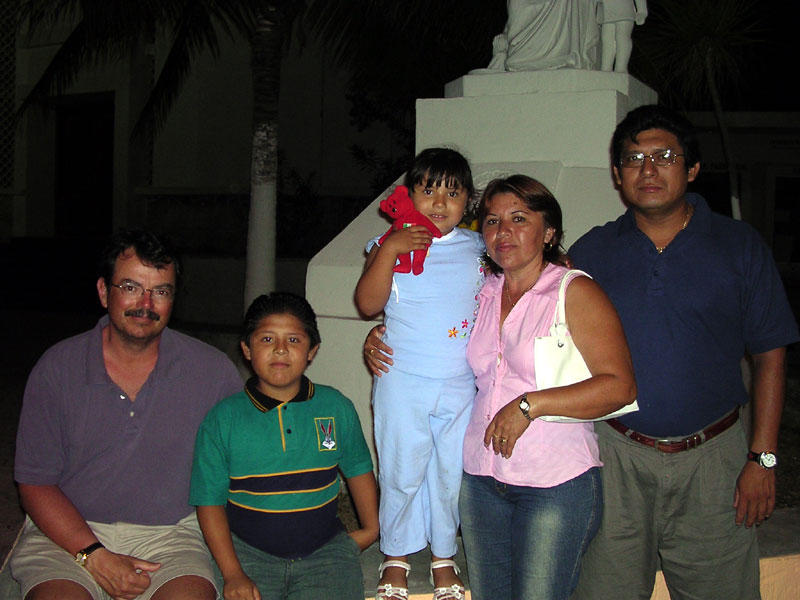
Isla Mujeres: Juan Gomez Chan and his Family
Juan, su esposa Paola, sus niƱos Manolo y Paolina, y el autor delante de la iglesia donde Juan y Paola se casaron en 1987
Juan, his wife Paola, his children Manolo and Paolina, and the author in front of the church where Juan and Paola were married in 1987
Nan and I just returned from a ten-day vacation to Isla Mujeres, a tiny island five miles off the coast of Cancún in the Yucatan peninsula of Mexico. It was our fourth trip to the island in the last seven years, so it goes without saying that it is one of our favorite vacation spots. In the past we have stayed twice at the Na Balam hotel and once at the Hotel Playa La Media Luna. This time we tried something different, a wonderful, fully equipped one-bedroom apartment above the Color de Verano café and boutique (www.colordeverano.com). We stayed in the third-floor apartment and had great views looking out over the beach at the northwest corner of the island.

Our daily routine quickly evolved into an early morning walk on the beach followed by perfect cappuccinos and muffins at the café while we checked our email messages using the café's free Internet access. Then it was off to the beach to read and relax, or bombing around the island on scooters to see the sights too far away to walk to. The island is only five miles long and a half-mile wide, so exploring it is easy. There are several places of interest along the west coast. This time out, we stopped at Playa Indios, a beach club that caters to visitors catching a ferry over from Cancún, but it was crowded so we just sat in the shade and drank Cokes to avoid the mid-90s heat of mid-day. Then is was off to Punta Sur.

Isla Mujeres: Paolina and Manolo at Amigos Restaurant
Paolina travieso en Amigos despuƩs que metiendo accidentalmente a su hermano en el ojo
Mischievous Paolina at Amigos after accidentally poking her brother in the eye
The recent influx of tourism dollars to CancĆŗn has osmosized to Isla Mujeres, and the improvements are dramatic. The first time we visited Punta Sur, all there was to see were the ruins of the Mayan temple to the goddess of love, Ixchel, an old man selling shells and starfish from under a tarp, and a small lighthouse. Now, in addition to the over-developed Garrafon Reef Park, there is a sculpture garden, a restaurant, a museum, a gift shop, nicely manicured grounds and paths, and the nicely rehabilitated temple and lighthouse. The old man is still there, and he looks to be prospering.

The best part of our visits to Isla Mujeres is the people we have befriended there. Many of them are Mayan and most are from the mainland. The story we've heard is that when the island was being developed for tourism, the developers recruited masons from the Yucatan peninsula to build the hotels. Many of them liked the island so much that they stayed on after the work was completed, taking jobs in the hotels and restaurants they had built. Our friend Juan was not one of these early arrivals, but he came to Isla Mujeres from a town south of Tulum on the east coast of the peninsula and has made a good life for himself and his family working as a waiter at the Na Balam's restaurants. Juan was the first person we met on our first visit to the island, and although his English was not great and our Spanish was considerably worse, we were able to communicate well enough to make each other laugh and form a friendship. During our third visit, Juan invited us to his home to meet his wife Paola, his sons Juan Jr. and Manolo, and his baby daughter Paolina. They live in what is locally known as a "colonial," one of several tiny villages scattered around the island to the south of the main town, which is not normally referred to as anything but "downtown." Juan's family lives with his wife's family in a shared house. Their accommodations are simple--they sleep in hammocks they put up at night--but they have every modern appliance plus a good computer with Internet access. Juan typically rides a scooter to work, but he also owns a car that his family uses for trips to their hometowns on the mainland, taking the car ferries that make the passage several times a day.

Isla Mujeres: Nan with Juan at the Na Balam Restaurant
Nan con Juan en el restaurante de Na Balam balcón romÔntico de primer piso
Nan with Juan on the Na Balam restaurant's romantic second-floor balcony
The highlight of our visit this year was our dinner out with Juan's family. We belatedly celebrated Manolo's twelfth birthday by going out for pizza to Amigos, a restaurant partly owned by Paola's brother-in-law and located on Av. Hidalgo, the island's main street for restaurants and shopping. Paolina brought the little red Beany Baby with the Mexican flag on its chest that Nan had given her when she was a baby four years before. Now she was a rambunctious five-year-old with a shy but mischievous smile. After pizza we had ice cream and sang feliz cumpleaƱos (happy birthday), then walked up and down Hidalgo until the kids were tired and ready to go home.

We promised Juan that we would put some pictures of our visit on the Internet for his family to see, so here they are with the captions in both Spanish and English. Juan, we hope you enjoy them as much as we enjoyed spending time with you and your family. Readers, if you ever get a chance to vacation in the CancĆŗn area, be sure to take the ferry across to Isla Mujeres, Mexico's best-kept secret.

Wednesday, May 4, 2005

Lin and Larry Pardey

The Pardeys are one of the most recognized couples in the sailing world. They have written several books on cruising, including the indispensable "Self-Sufficient Sailor". Nan and I attended a two-day seminar they gave in Denver in January, 2004 at the Marriott Inn in West Denver. We were surprised to see more than two hundred people in attendance when we entered the lecture room that Saturday evening. I guess this sailing bug is contagious.

The Pardeys started things out with a slideshow of their adventures on their sailboats, Seraffyn and Taleisin, which Larry the master boat builder had built himself. Their images were so enticing that everyone in attendance was soon longing for the open sea and faraway tropical islands. During intermission both Lin and Larry were available for questions as well as signings of their books, which were on sale in the lobby.

The following day was spent in lectures and question-and-answer sessions on topics important to anyone considering the cruising lifestyle. Larry and Lin said they had been sailing pretty much continuously since 1968 and that during that time they had been around the world four times, twice in each direction. Much of their experience is condensed in their many excellent books, in which the overriding principle is to keep it simple. To that end, they sail without a motor and have just the bare minimum of electronics on board, figuring that these are things upon which it would be too easy to become dependent, only to have them fail when most needed.

For me the most important topics were how to survive a storm and how to handle the paperwork of international boat travel. Larry handled the first topic and Lin the second. Larry said that with the proper equipment and techniques, any storm at sea is survivable. He showed us slides demonstrating heave-to procedures and the use of storm sails and sea anchors. Some of the slides were truly frightening: fifty- to sixty-foot waves towering over their little thirty-foot boat. Lin’s talk was a little more calming. She assured us that with the proper documents it was possible to travel the world, stopping at every place of interest, and never run into trouble with foreign authorities. She also touched on important topics like outfitting a serious first aid kit, getting the necessary immunizations and how to keep life back home manageable in terms of mail, banking and bill paying.

By the end of the day, you could see the dreamy look in many people’s eyes starting to turn alert and calculating as they began to think in concrete terms about giving up their workaday lives for ones of high adventure cruising the world’s oceans. I know I was one of them.

Saturday, April 23, 2005

U2 Concert in Denver

Nan and I were lucky enough to get tickets to see U2 perform on Thursday night in Denver. It was one of the best concerts we've ever experienced. The stage set-up and light show were absolutely incredible, and the full house of fans stood and sang through the entire 2.5 hour set of songs. Bono commented on how well-received they always feel when they come to Colorado. Afterall, this is where U2 recorded their live album "Under a Blood Red Sky" back in 1983 at the Red Rocks Amphitheatre just outside of Denver, in Morrison.

Bono used portions of the concert as a platform for his message of world-wide love and compassion, especially for the people of Africa. He asked people to use their cell phones to "text" their names in support of The ONE Campaign. There were also booths out in the lobby where people could sign The ONE Campaign's petition, so Nan and I signed it again even though we had both already signed it online at the ONE website (see my Monday, April 18, 2005 post). To learn more about the concert, including the set list and photos, please click here: U2 Concert in Denver.

Monday, April 18, 2005

The ONE Campaign

This weblog is devoted to sailing, but once in a while, it will address other issues. Last week, I saw a TV commercial for a new non-profit organization called The ONE Campaign, whose message is simply this:

"WE BELIEVE that in the best American tradition of helping others help themselves, now is the time to join with other countries in a historic pact for compassion and justice to help the poorest people of the world overcome AIDS and extreme poverty. WE RECOGNIZE that a pact including such measures as fair trade, debt relief, fighting corruption and directing additional resources for basic needs – education, health, clean water, food, and care for orphans – would transform the futures and hopes of an entire generation in the poorest countries, at a cost equal to just one percent more of the US budget. WE COMMIT ourselves - one person, one voice, one vote at a time - to make a better, safer world for all."

If you believe as I do that the time is right for Americans to voice their concern for the welfare of all the world's people, then please click the ONE image in this post to go to the ONE website and sign the ONE declaration. Together we will make a difference!

Saturday, April 16, 2005

Where's the Dinghy? Day 8

or, How We Learned Most of Cruising's Lessons in Just One Week

Day 8 (Saturday, May 8, 2004)

The next morning, we both awoke feeling hungover from the previous night’s wine. The only thing on our immediate agenda was to get the boat back to Conch Charters before noon. All we had to do was negotiate the six miles back across Sir Francis Drake Channel to Road Town, and our trip would be over. Partly because I wasn’t feeling well and partly because it was such a short distance, I didn’t bother to put up the sails. We just motored across the channel and circled around near the Conch Charters dock until someone responded to our call and came out in a dinghy to guide us into our boat’s slip. We worked on packing up our stuff and moving it to the dock until Miles came along to check us out. Miraculously, the only damage was to the boat hook, which was a little crumpled from being bent and straightened, but Miles didn’t notice and we didn’t mention it. He was more concerned with explaining to me the intricacies of our previous day’s impellor problem, which I already understood thoroughly from having experienced it firsthand. He gave us an exit survey to fill out while he poked around the boat. One of the questions was, “Did you circumnavigate Tortola?” I hadn’t really thought about it much before I read the question, but that was exactly what we had done. We didn’t do it very directly, and we certainly didn’t do it very gracefully, but we had managed to make our way around the island and return to our point of origin, safely and on time. We had faced many trials, and we had learned from each of them. I don’t know if Nan would agree, but I felt confident that we could handle almost anything at this point. I was already thinking ahead to our next trip, and ultimately to my dream of sailing around the world.

Epilogue

When people ask about our sailing trip, I tell them that we had quite a bit of trouble, everything from bad weather to mechanical problems. But I also tell them that I never said to Nan, “We’re screwed.” Everything, even the completely unexpected, was manageable in the end. In fact, at one point during the trip, what I said to Nan instead was, “Despite all the problems we’ve been having, I’m having the greatest time of my life.”

Thursday, April 14, 2005

Where's the Dinghy? Day 7

or, How We Learned Most of Cruising's Lessons in Just One Week

Day 7 (Friday, May 7, 2004)

Friday morning we awoke rested despite the previous night’s interruption. We took a quick dip off the stern, then fired up the engine and started motoring out the way we should have come in the day before, through the gap between Prickly Pear Island and Mosquito Island. There was absolutely no wind and the water in Gorda Sound was like glass, a huge difference from previous days. As we approached the west end of Prickly Pear, the engine alarm suddenly sounded. I quickly turned off the engine and then went below to check on it. I had been doing all the morning engine checks that the Conch Charters people had instructed me to do, and everything had been fine. Now as I removed the cover, something was obviously wrong. Heat poured out of the engine compartment. I set the cover aside to let the engine cool and then climbed back out to the helm. I told Nan that the engine was overheating and that we should put up the sails even though there was no wind. In the short time I was below, the boat had drifted closer to Prickly Pear so we were facing an imminent lee shore problem. Just then, the Salty Kat crew, who had spent the night at Saba Rock, passed us at a good clip under engine power. We thought they might notice us floating aimlessly and ask if we needed help, but nobody even glanced our way. I put the mainsail all the way up and unfurled the jib. Both sails started luffing like lazy flags. We weren’t making any noticeable headway and shore was getting closer. I said to hell with it and started the engine. We motored away from shore for about two minutes before the alarm went off again. I turned off the engine again but started to figure that we could go along like this, using the engine for a few minutes at a time until we reached open water and hopefully some sort of breeze. Several starts and stops later, we were floating aimlessly again, in open water with no wind.

It was time to call Conch Charters. I got Miles on the phone and explained our situation. He asked me to start the engine and check to see if water was coming out with the exhaust. Since the exhaust pipe was underwater, I had to go under the boat, for the third time in six days, to check it. Sure enough, there was only stinky diesel exhaust coming out, no water from the cooling system. I called Miles back and he said it was probably a problem with the impellor, the little spinning device that circulated cool sea water through the engine to keep it from overheating. He said he would have to have his mechanic Tom come out and fix it for us. About an hour later, Tom showed up in a big speed boat.

Tom was a laid-back mechanic from Canada, and very different from the intense all-English crew at Conch Charters headquarters. He tossed me a line so I could tie his boat to our stern, then came aboard with his toolbox. He went below, carefully spread a protective cloth, and went to work on the engine. Sure enough, the impellor was the problem. The rubber part with the little fins on it had spun loose from its brass core. Tom replaced it with a new one, put everything back together, and came back up to the cockpit to test the engine. He started it and looked over the stern. It was now pretty obvious that water was coming out with the exhaust. Big smiles all around. Tom was sweating hard from working on the hot engine, so we all sipped Cokes in the cockpit while he chatted about his split existence between the British Virgin Islands and Canada, and also about hockey, of course.

After Tom took off, we decided to keep the engine running for a while to charge up the batteries and keep the refrigerator cool, plus there still wasn’t much wind. The combination of the engine and the sails kept us moving along at about four knots, which was good because we had lost a lot of time already and were hoping to make it the remaining ten miles to Manchioneel Bay, on the west side of Cooper Island, before dark. It would be our last night on the boat, so we were hoping for something special. We were not disappointed. The little bay and its tiny facilities—a beach bar and restaurant, and a few modest rooms—are a magical place. We arrived late in the afternoon, tied up to a mooring, and took Squishy over to the dinghy dock. We toured the area, which took all of five minutes, then headed to the bar for what felt like a well-deserved margarita. On our way out, we made dinner reservations for later, then headed back to the boat for a swim and a shower.

When we returned, it was dusk. The sun was setting over Salt Island to the west and the wait staff were lighting the candles on the small tables overlooking the bay. We ordered a good bottle of red wine and sipped it while we reflected back on the week. Nan asked if I was ready for the trip to be over. I smiled and said I could keep going forever. I could tell by the look on her face that she was ready to be back on dry ground for a while. She started talking about the great week we would have at Round Hill Villa on Tortola’s Cane Garden Bay starting the next day. Dinner arrived and we ate fresh seafood prepared in an Italian style that was so good we bought drinks for the kitchen staff. We ordered a second bottle of wine, then dessert and coffee. By the time we stumbled back to the dinghy dock, it was apparent that we had had enough to drink. The dock was pretty high, so when I turned around and started to climb down to the dinghy, the step was further than I thought it would be. Combined with the night-time squishy condition of Squishy, I lost my balance and tumbled backward into the water. Whatever wine buzz I had was lost immediately as I thrashed my way back into the dinghy. Nan was still on the dock, looking concerned. I’m fine, I said, just very wet. I hadn’t lost anything, but my watch, wallet and shoes were soaked. We motored slowly back to the boat, where I toweled off and spread my stuff out to dry.

Tuesday, April 12, 2005

Where's the Dinghy? Day 6

or, How We Learned Most of Cruising's Lessons in Just One Week

Day 6 (Thursday, May 6, 2004)

Sailing to The Baths
We wanted to get an early start for the Baths that Thursday morning because we had heard that the day moorings filled up quickly and that anchoring was not allowed. We motored over to the Salty Kat catamaran at about 8:00 to pick up Shannon, who told us that with four gung-ho guys on board her boat, she wasn’t getting any real sailing time. We changed that quickly, having Shannon jump around on top of the cabin and down in the cockpit to rig the mainsail with a single reef while I steered us into the wind. We were well protected from the high wind and swells by the mass of Virgin Gorda to our east, so it was finally time to sail! We bore off to port and watched with delight as the mainsail filled with wind for the first time this trip. We put out the jib as well and soon were flying along at a respectable six knots. With easy teamwork, we smoothly came about and were now on a starboard tack. Shannon snapped a picture of Nan and me sitting together at the helm, and Nan was actually smiling. This was the most fun we had had all week. The Salty Kat soon motored past us mid-tack, on a straight run to the Baths. Those guys don’t know what they’re missing, we commented. Several tacks later we arrived at the Baths ourselves to find that all the day moorings were already filled. We dropped the sails and motored in lazy loops, enjoying the rock formations and waiting for something to open up, but nothing ever did. Shannon decided she should rejoin her group instead of staying with us all the way to the Bitter End Yacht Club, where we planned to spend the night. So as we passed the bow of the moored Salty Kat, Shannon heaved her backpack onto the trampoline and then jumped into the water. We waved good-bye and promised to meet up with her later.

In the shelter of shore, we put the sails back up and headed north in an effortless beam reach past Spanish Town and Collision Point to starboard and then the Dogs islands to port. In almost no time, we passed an inlet where other boats were pulling in. It’s too soon, I thought. The inlet we want is the next one. As we rounded to the east, following the contour of shore, we saw nothing ahead of us but a massive reef, open ocean and big swells. This can’t be right, I thought. I checked the chart and saw that we were north and east of where I had thought we were, in Virgin Sound between Necker Island and Prickly Pear Island. Add “lost” to our list of problems for the week. We dropped the sails and steered for what appeared to be a break between the reef and shore, then watched as the water went from dark blue to the brilliant aquamarine of shallow water. The depth finder indicated that we were in about only six feet of water. Nan thought for sure that we would run aground at any moment. But I suggested that as long as we were in the sheltered water behind the reef and could clearly see the bottom and any obstacles, we might as well go exploring. The water was so beautiful she couldn’t help but agree. We followed a line of small buoys to a tiny bay at the easternmost end of Virgin Gorda. This could have been a private island paradise for the night but there were already a couple of boats anchored there and we really had our hearts set on spending the night at the Bitter End. We turned around and headed toward Saba Rock, which marks the northeastern entrance to Gorda Sound.

We rounded east after entering the sound and there was the Bitter End Yacht Club, perhaps the most famous sailing destination in the Caribbean. It looked like a country club set at water’s edge. We moored about a hundred yards from the dinghy dock and then piloted Squishy over to it. We explored the little theme park-like village and then ducked into the bar to escape the heat and drink a cold beer. Everything was pretty expensive, like the $50 per person prix fixe dinner (wine extra) advertised outside the restaurant, so we decided to buy some steaks at the grocery store and try out the little stern rail barbecue grill that came with the boat. I installed the grill and got the coals going while Nan worked her magic on some salads, vegetables and garlic bread down in the galley. As dusk turned to twilight, we ate like royalty in the cockpit while gazing across the water at the series of pyramid-roofed huts that are the primary land-based accommodation at the Bitter End. I was able to pick out the original three that Robin Graham, of Dove fame, had helped to build when he sailed through the area in the late 1960s, near the end of his epic solo, around-the-world sailing adventure. A couple of glasses of wine later, it was time for bed. Nan roused me just a few hours later. A boatload of drunks from the bar was having difficulty locating their boat. They were in the process of boarding ours when Nan yelled out, “Wrong boat!” Slurred apologies and the sound of an outboard motor disappearing into the distance lulled us back to sleep.

Monday, April 11, 2005

Where's the Dinghy? Day 5

or, How We Learned Most of Cruising's Lessons in Just One Week

Day 5 (Wednesday, May 5, 2004)

The next morning, around 8:00, one of our neighboring boats motored past us while blaring a Sousa march at top volume. They made two loops around the slumbering party catamarans then headed out of the bay. We couldn't resist big smiles and thumbs-ups on their return pass. Payback’s a bitch.

Leaving sheltered Cane Garden Bay for Marina Cay, we discovered that conditions were pretty much the same as the day before: brisk wind and swells directly out of the east, our direction of travel. If we ever get a chance to sail around Tortola again, I think we'll go counter-clockwise just to avoid this situation. Like the day before, I opted not to beat into the wind and motored serenely along instead. Unfortunately, most of the beaches along the north shore of Tortola are fairly exposed and do not feature safe anchorages, otherwise they would be little bits of paradise. Across from Lambert Bay, a secluded paradise all its own, we passed Monkey Point, which looks to be a great day anchorage, with its interesting rock formations and giant cacti. But we wanted to get a mooring at Marina Cay and we had heard that they filled up quickly. As we rounded out of the passage between Little Camanoe and Great Camanoe, we were struck by the beauty of the perfect little island sitting in the sapphire blue water. Small wonder that a young married couple, Robb and Rodie White, had made it their own private utopia back in the 1930s.

We moored successfully about fifty yards from the fuel dock, then dinghied over to the island to explore. We walked from one end to the other in about fifteen minutes, stopping to admire the gardens, the view across to Virgin Gorda, and the little house the couple had built at the highest point on the island, which has since been converted to a visitors' library and bar. We had soft drinks at the separate Pusser's bar and restaurant down by the beach, then went to talk to the fuel dock guys to see what the procedure was. Just bring it on over, “mon,” was about all they had to say. We went back to the boat and tied the dinghy up to the mooring ball to reserve our place, then put out the fenders and dock lines so we'd be ready. A big trawler took almost a half-hour to fuel up, but then it was our turn. We motored over to the fuel dock and swung in sweet as can be. While the boat was being fueled, I took the hose to fill the water tank. Thirty-odd gallons later, it was topped off. I guess we did manage to go through all that water somehow. Surprisingly, with all the motoring we had been doing, we had only used up about eight gallons of fuel, when I had worried we might not reach Marina Cay with what we had. I guess putting along at low knots really does help conserve.

Feeling pretty confident after the easy docking, I motored back to our mooring ball. Maybe because the dinghy's painter was black and hard to see or maybe because I was going a little too fast, Nan missed the mooring pick-up and we went right over the painter. The engine stalled almost immediately. Not good. I didn't want to believe that we had just tangled up our propeller, so I tried to restart the engine. No go. I felt sick to my stomach as I looked over the side at our dinghy nosed tightly against the side of the boat while we slowly turned to face downwind, tethered to the mooring ball by our propeller. "Now what?" Nan asked. I have to go into the water to fix a big problem for the second time in three days, I thought. I was about to change into my swim trunks and grab my snorkel gear when a local gentleman in a dinghy came by and asked if we needed some help. Jimmy, as he later introduced himself, was a captain on a chartered boat nearby and had witnessed our predicament. I nodded and pointed at the bent boat hook floating near his dinghy. Smiling, he fished it out of the water, straightened it out and handed it back to Nan, then asked me for a dock line. We tightly secured the stern of the boat to the mooring ball to take the stress off the painter, then I changed and went under the boat with my snorkel gear and a steak knife. It was worse than I imagined. In addition to the painter, the mooring line and its milk jug float and line were all wrapped tightly around the propeller's driveshaft. I cut the float's line and untangled it from the rest. Doing this involved diving under the boat and holding my breath while bouncing off the sharp barnacles attached to the boat's underside. When I handed the jug, line and knife to Nan, she said, "You're bleeding!" I grimaced and went back under. It took several more trips under the boat to loosen and untangle the painter and mooring line during which I managed to cut a finger pretty badly on a barnacle. When they were free, I let the mooring line dangle since we were still attached to the mooring ball by the dock line, and swam around to the stern to hand Nan the dinghy's painter. I told her to tie it to the boat, then climbed aboard and headed to the bow. Jimmy and I worked a new dock line from the bow to the mooring ball so we could release the stern line. The boat swung back around to face the wind, and things were back to normal. I thanked Jimmy profusely and promised to buy him a drink at the bar later. He smiled, waved and headed back to his own boat. I returned to the stern and was stowing the extra dock line when Nan uttered the most memorable line of the trip, "Where's the dinghy?" Sure enough, it wasn't attached to the boat. In fact, it was already about a hundred yards away, floating free. I uttered something unprintable and shook my head in disbelief. I was already exhausted, and there was no way I was going to be able to dive in and swim fast enough to catch up to the dinghy as it drifted away on the wind. Another nearby neighbor noticed what was happening, got in their dinghy and chased ours down. When they returned it, to our immense gratitude, they mentioned that one of their crew was having trouble with seasickness. As a thank-you, Nan gave them some Anavert, an anti-vertigo drug that she apparently had been taking since we stepped onto the boat. "It really works!" she said. I gave her a quizzical look.

When we finally returned to the island, it was starting to get dark. We wandered up the path to the library/bar, following the sound of amplified guitar music and singing. There was a huge crowd enjoying the onstage musical antics of Captain Mike Bean, including a conch shell horn-blowing contest. We found Captain Jimmy, thanked him profusely again, and bought him his drink of choice, a cranberry and soda. As a hired boat captain, he was still working, after all. Then we spotted some friends from back home whom we had also run into at the Bomba Shack. With Nan's nodding agreement, I mentioned how difficult it had been sailing the boat essentially singlehandedly on the days we had actually had the sails up. Shannon piped up that since we were all sailing to the Baths at Virgin Gorda the next morning, she would be happy to join us and help with the sailing. Good deal!

Sunday, April 10, 2005

Where's the Dinghy? Day 4

or, How We Learned Most of Cruising's Lessons in Just One Week

Day 4 (Tuesday, May 4, 2004)

Sunset over Cane Garden Bay
The next morning, the faucets started to gurgle a little. We can't be out of water already, I thought. Maybe the Conch people hadn't filled our little thirty-gallon water tank all the way. We were on our way to Cane Garden Bay that day and wanted to get there early to get a good mooring, so we thought we'd wait and get more water, if indeed we needed it, when we got there. The weather was somewhat better this Tuesday, but I still held my breath as we motored around Steele Point. The swells were not as bad as the day before but they were still sizable, and they were coming from the direction we needed to go, directly east and straight into the wind. The idea of tacking back and forth for hours trying to make headway was not appealing, especially given yesterday's adventure, so we left the sails down and motored into the wind and swells at a very modest two knots.

When we arrived at Cane Garden Bay, we had our pick of moorings and found a nice sheltered one not too close to shore. We ran the dinghy over to the dinghy dock and tied up, then I diligently tossed out the stern anchor, as Emma at Conch Charters had advised, to keep the dinghy's bow from getting beaten up or punctured by the high wooden dock. We had some shopping to do, but first we were eager for an early lunch at Rhymer's, the two-story beach bar, grocery store, hotel and beauty salon. Our waitress Mary remembered us from our previous visits and it was all smiles until we asked her about water and fuel. "Oh, no. There's no fuel and water dock here. You have to either go to Sopers Hole or Marina Cay." Great, we thought. Guess we should have noticed that small detail earlier and planned accordingly. Well, at least we could buy gallon jugs of drinking water at the grocery store. But it remained to be seen if we had enough fuel to get to Marina Cay the next day. Rather than worry about it, we ate our grilled ham and cheese sandwiches, drank our piƱa coladas and enjoyed the view out over the bay.

We bought only what we needed at Rhymer's grocery store because everything was so expensive. The man behind the counter wanted to charge us $18 for a six-pack of Red Stripe! We lugged our ice and water back to the dinghy and motored back to the boat. Of course I forgot about the stern anchor and dragged it all the way there. I wondered why Squishy, as we had christened our dinghy due to its tendency to lose turgidity in the evenings, was straining even more than usual.

Later that afternoon, we were lounging on the boat when two catamarans full of twenty-somethings pulled in and moored about thirty yards away. We thought they might be trouble because they were flying an anatomically correct blow-up doll from one of their masts like some kind of party flag. The party started as soon as they tied up. I don't mind loud music if it's good, but I can't stomach white-boy rap, especially when drunken people in skimpy swimming suits are trying to dance to it. We took the disruption as a sign that we should get ready for our big evening: the full moon party at the Bomba Shack.

We dinghied back to Rhymer's to purchase fresh-water showers since our stern shower was dry, then ditched our stuff back at the boat, locked the dinghy to the dock and went to look for a taxi to take us over to Apple Bay. The first two taxis we saw wanted to charge us $30 for the fifteen-minute ride, so we started walking. A taxi with two people already in it stopped and picked us up to split the fare. They were headed to Bomba's, too, but like us, they planned on dinner first. Wilbert the taxi driver dropped us off at Sebastian's on the Beach, where we reacquainted ourselves with Cynthia, who had been our waitress during our previous two visits. One thing we have learned is that restaurants in the BVI appreciate reservations, so we always call ahead. It guarantees you a table and, we usually find, better service. Cynthia seated us at the window where we could watch the sun set and served us some fabulous shrimp dishes. On our way out, Nan asked her if she was going to the full moon party after work. "Oh, no! That would be trouble," said Cynthia with a big smile.

We walked down the road a couple of hundred yards to the plywood monstrosity that is the Bomba Shack. It sits on pilings above the beach and has collected an eclectic assortment of junk from its thousands of visitors. Dead boomboxes, hubcaps and driftwood are tastefully arranged around dozens of pairs of cast-off panties and bras, like a perverse reverse souvenir shop. Everyone leaves something behind to show the world they were there. Needless to say, the place was rocking. Bomba, the big man himself, was sitting in his throne room holding court with the ladies. One of the big attractions of the full moon party is the "tea" that is served free to anyone who wants it. It's made from mushrooms and is hallucinogenic. Since we had to make the complicated journey back to our boat later that night, we passed on the tea. We still managed to have a very good time.

Saturday, April 9, 2005

Where's the Dinghy? Day 3

or, How We Learned Most of Cruising's Lessons in Just One Week

Day 3 (Monday, May 3, 2004)

Early the next morning we received a call over the boat's cell phone, which was our direct lifeline to Conch Charters. Emma said my bag had finally shown up, where were we? When I told her we were at Sopers Hole, she said she would have someone run it right down to us. Three hours and several phone calls later, David arrived at the marina with my bag, sweating and out of breath, almost as if he had literally run the bag down to us. We were familiar with the concept of "island time" but this was bordering on the ridiculous, even for a Monday. We did appreciate the great customer service, but we were now getting a pretty late start for Jost Van Dyke, our final destination for the day.

We rounded Steele Point at the western-most point of Tortola and headed almost due north for Sandy Cay, where we hoped to snorkel and eat a late lunch. As on the two previous days, we were again flying just our jib. Good thing, too, because the wind and seas on the north side of the island were even stronger than on the south. At one point, I clocked us at 5.3 knots, which is pretty honking fast for a thirty-foot sailboat under jib alone. Nan was nervous. The boat was rolling severely each time a swell passed under us, and there was an ominous-looking black cloud out to the east. A little while later, as we approached Sandy Cay, the storm associated with that cloud hit us hard. The wind picked up to close to 40 knots and the rain started to come down in sideways sheets under our bimini. There weren't any day moorings and Nan didn't want me to try to anchor, so we decided to head for a safer mooring in the shelter of one of Jost Van Dyke's southern bays. This would require a jibe, and it was entirely too dangerous to attempt at this moment, so I did a 270-degree "chicken jibe" instead, slipping and sliding around the cockpit to get the jib over while Nan held the wheel through the turn. We were now running down, or more accurately, surfing down huge swells with the wind directly at our backs. Rain was pouring into the open cabin, so I asked Nan to get out the storm boards and put them in place. She pulled out the three trapezoid-shaped pieces of fiberglass but couldn't figure out how they went into their slots--sideways, upside down, largest one first? It would have been almost comical to watch her struggle if we and everything we owned weren't getting soaked. I think it was at this point that she said, "I hate this! I am never doing this again!" Not for the first time. And not for the last.

We whizzed past Little Harbour, Great Harbour and White Bay in quick succession, but every available mooring was taken. The prudent sailors were all waiting out the storm. Still not wanting to trust the anchor, we said the hell with it and headed back to Sopers Hole. We arrived in the late afternoon to find that every mooring was taken there as well. No way around it, we would have to anchor. I had Nan steer as I untied the anchor's securing line and made sure the bitter end was cleated. I had her aim at where we hoped to end up, then put the engine in neutral. I ran forward and, lacking a windlass, dropped the anchor quickly hand over hand. When I felt it hit bottom, I let out what I thought would be sufficient rode and then tied off the line. There wasn't much room and the wind was still blowing, so I thought our backward motion would set the anchor for us. It seemed to work. At least, it didn't appear that we were moving backwards relative to the boats around us.

As luck would have it, about a half-hour after we anchored, a boat near us left its mooring. Nan still didn't trust the anchor because of the weather and wanted us to move, so it was up anchor. I fired up the engine and put it in gear, then ran forward to pull up the anchor while Nan steered. If you've ever tried to pull up a thirty-pound anchor by hand, you know it's not easy. I couldn't pull it up fast enough and the boat was veering to starboard toward an old private mooring. Sure enough, the anchor line wrapped around the mooring and we were left dangling. I went back to the helm and motored counter-clockwise to free us. No go. OK, then twice around clockwise should do the trick. All it did was shorten the line. "Now what?" Nan asked. "I guess I have to go in the water and figure it out," I said. Good thing my snorkel gear had finally arrived that morning. When I swam out to the mooring ball, I couldn't believe the collection of junk that was just below the surface--old fenders, milk jugs and a random collection of algae-covered rope holding it all together. Wrapped tightly in a figure-eight pattern in and out of the mess was our anchor line. With the weight of the boat in the wind, there was no way to untangle the line without taking the tension off it first. I went back to the boat for one of our fenders and a dock line. I tied an end of the dock line to the ring on top of the mooring ball, then went back to the boat to secure the other end to one of the bow cleats after pulling the boat up as close as possible to the mooring ball. I untied the bitter end of the anchor line and threw it overboard. With the tangle, there was no danger of losing the anchor. After going back in the water to untangle the line, I tied the bitter end to the fender so it wouldn't get away, then went back on board to retrieve the anchor. Of course, while all this fun activity was going on, someone else came in and took the available mooring. By this time, it was starting to get dark, so we said the hell with it, private mooring or not, we're staying here for the night. I adjusted the dock line and opened a beer.

It had been a day when only stupid people, or people who thought they could stick to an agenda regardless of the weather, were out. I think we were guilty of both. We found out later that small craft advisories had been in effect on this day--and we definitely qualified as a small craft--but we didn't know it at the time. There isn't a full-time weather channel on the VHF in the BVI, just a couple of local radio stations that announce forecasts between reggae songs. Maybe we should have been listening. That evening at the Jolly Roger, where we treated ourselves to the special, we ran into an old friend who runs a day charter that we had done during both of our previous visits. I asked him if he had been out with paying customers that day. He shrugged and said that it hadn't been so bad. Later I overheard him at the bar animatedly telling someone that he had gotten his catamaran going over ten knots under jib alone. I had to close my eyes and shake my head.